Issue No. 83 • Friday September 18, 2026 The Trading Addict Newsletter by Maria Helmick
In This Issue | | Micron's Earnings Countdown: Will Workers Walk Out? — Taiwan strike vote looms 9 days before Sep 30 earnings. Union wants 83-mo bonus + quarterly profit share. Maria stays long. Jump to this story → | | He's Back in the Trenches — Aschenbrenner (Situational Awareness, -67% July) buying "hundreds of millions" in FLEX call premiums. $315M reported across AMD, BE, CRWV, SanDisk, SK Hynix. Jump to this story → | | Lennar Hits a Wall: Buyers Want Homes, Not the Payments — LEN cuts full-year deliveries to 80-81K, revenue $8.05B, EPS $1.23, net income halves. Gross margin 15.8% (from 17.5%). Jump to this story → | | Guess the Stock · Three Clues. One Ticker. — Founders cooked up the business plan at a Denny's. Started making chips to give gamers better graphics. Co-founder famous for a leather jacket. Answer at the end. Jump to this story → | | Earnings Watch · Sep 18 — Oct 1 — AZO Tue. COST Thu. MU end-of-month. Jump to this story → | | Tech & Semi Heatmap · Sep 17 Close — The full board after Thursday's session. Jump to this story → | | Day 230 · Thu Sep 17 Trading Update — $1M +$2,938 (48 tr). $30K sat out. Combined +$2,938. Cum $750,830 (+75.08%). Jump to this story → | | Today's Live Show — Watch Rob and Nick on YouTube — 9:15 AM & 3:15 PM ET. Jump to this story → | | Guess the Stock · The Answer — Reveal at the bottom of the issue. Jump to this story → |

Tap the image to view full size
Micron (MU) · Earnings Sep 30 Micron's Earnings Countdown: Will Workers Walk Out? | |
Micron's September 30 earnings report is approaching, but a threatened strike at its Taiwan factories could complicate the announcement. Workers want a permanent share of the company's profits, and unions are warning they could move toward a strike vote if upcoming negotiations fail.
Talks are scheduled for September 18 and 21. With earnings on September 30, Micron has just nine days after the second meeting to reach a solution before reporting results. A walkout has not been formally approved, but the timing gives investors a reason to pay attention. Micron needs its factories running smoothly as it prepares to discuss results and expectations for the coming quarter.
The dispute centers on how employees benefit from the company's success. According to Barchart's Ebube Jones, unions are seeking a one-time bonus equivalent to approximately 83 months of pay, followed by quarterly payments tied to operating profit. Micron has announced substantial rewards, including a package equivalent to 35-68 months of pay for Taiwan direct-labor employees. Workers want a permanent profit-sharing arrangement, and the offer has not resolved that disagreement.
The Timing Matters
Taiwan is a major manufacturing center for Micron. If workers walk out and production slows, deliveries could be delayed, potentially affecting future sales and earnings. Strong demand for AI memory would not eliminate the consequences of an interruption.
A September strike would not change the financial results of the quarter Micron has already completed. But it could affect the outlook presented on September 30, shifting attention from the company's performance to questions about production, shipments, and costs.
That is the concern heading into earnings: even strong numbers could be overshadowed by uncertainty about what comes next. An agreement before the report would give management one less problem to address. Failed talks could leave investors weighing an unresolved strike threat alongside the earnings announcement.
Maria's Bottom Line I'm definitely a Micron investor, and I'm staying with Micron. I see it as a major player alongside Nvidia and AMD. I'll watch these negotiations closely, and the outcome will help determine whether I do an earnings play. Great company. Let's make sure it's a good trade, too. I already have some open options on MU. So, Taiwan, don't make me come there. |
Sources: Reuters · Micron Investor Relations · Barchart
|

Tap the image to view full size
Maria's Market Perspective · September 17, 2026 He's Back in the TrenchesHundreds of millions riding on another AI bet | |
Apparently, one very expensive lesson hasn't changed Leopold Aschenbrenner's mind about artificial intelligence. After his hedge fund, Situational Awareness, suffered a reported 67% decline in July and sold most of its public stock holdings to Citadel, he is back buying options. JPMorgan has since ended its lending relationship with the fund. That would give most traders something to think about.
The comeback was already underway when CNBC's David Faber reported it on September 11. According to his sources, Aschenbrenner had purchased hundreds of millions of dollars in option premiums late the previous week and early that week. That is the money paid just to establish the positions.
Here's Where the Money Is Showing Up
CNBC identified AMD, Bloom Energy, CoreWeave, SanDisk, SK Hynix and the Roundhill Memory ETF (DRAM). Nvidia was not named in that reported batch. Whether fresh investor money financed the purchases remained unclear.
More detailed coverage, citing observations from Nomura strategist Charlie McElligott, described approximately $315 million in FLEX call-option premiums across AI-related trades around September 4 and September 8.
| Underlying | Activity | Premium |
| AMD | 5,000 calls | $18.7M |
| AMD | 3,700 calls | $17.5M |
| Bloom Energy | Two sessions | $48.2M |
| CoreWeave | Two sessions | $43M+ |
These trades total more than $127M in premiums. They are reported market transactions associated with speculation about his comeback, not a verified statement of Situational Awareness's holdings.
Different Financing, Familiar Stocks
The Financial Times reports that Aschenbrenner is rebuilding with fully paid-for options, including customized FLEX contracts, and has begun working with brokerage Clear Street. The change addresses the financing pressure that comes with borrowing to hold large positions. It doesn't make the stock selection any less concentrated.
FLEX options allow customized terms while retaining exchange trading and clearing. For an outright purchased call, the premium is the amount at risk before exercise, but the entire premium can be lost. Paying upfront gives the buyer a defined commitment; it does not guarantee enough time or enough upside to make the trade profitable.
Maria's Bottom Line He's back in the trenches. Let's see what he does this time. He has one expensive lesson under his belt, but one lesson doesn't make you a seasoned trader. All the schooling in the world won't replace time in the market. Unfortunately, he's learning with other people's money. Hopefully, he's learned enough to make this round a successful one. I'd like to see him do well. Oh, by the way, I'd like to get some of those FLEX options for myself. |
Sources: Reuters · CNBC · Financial Times · OCC (FLEX structure) · Nomura observations via Anue. Reports reviewed Sep 17, 2026.
|
Homebuilders · NYSE: LEN Lennar Hits a Wall: Buyers Want Homes, Not the Payments | |
The model home can sell the dream. The mortgage payment can end the conversation. Lennar's latest results show just how expensive that gap has become for homebuilders.
Lennar (LEN) cut its full-year delivery target to 80,000-81,000 homes, down from 82,000-83,000. Quarterly revenue fell to $8.05 billion, adjusted earnings were $1.23 a share, and net profit dropped to $283.9 million from $591 million a year earlier. Management pointed to affordability and interest-rate pressure on buyers, despite continued underlying housing demand.
The strain is showing up in each sale. Lennar's gross margin on home sales fell to 15.8% from 17.5% a year earlier. Management is accepting lower margins to keep homes selling, construction moving, and cash coming back into the business.
Builders can reduce prices, contribute toward closing costs, or fund mortgage-rate buydowns. A permanent buydown lowers the loan's interest rate through an upfront payment. A temporary buydown subsidizes early payments, but that relief expires. Neither makes taxes, insurance, or maintenance disappear.
Existing homeowners add another complication. Someone with a 3% mortgage may want a different home without wanting a different loan. Even a hypothetical 4% or 5% replacement mortgage means a higher rate, potentially on a larger balance. This mortgage "lock-in" effect discourages moves and limits resale supply.
Fewer resale listings can send buyers toward new construction, giving builders an opening. But a shortage of choices does not increase a buyer's budget. That leaves companies such as Lennar trying to offer enough help to win the sale without sacrificing too much profit.
Maria's Bottom Line I'm not interested in the housing stocks right now. Buyers can't afford the payments, and homeowners with 3% mortgages don't want to give them up. Builders can offer incentives, but that only goes so far. Housing has a big problem, and I think it's going to take a long time to get back on track. |
|
» GUESS THE STOCK · THREE CLUES. ONE TICKER.

» Answer at the end of the newsletter
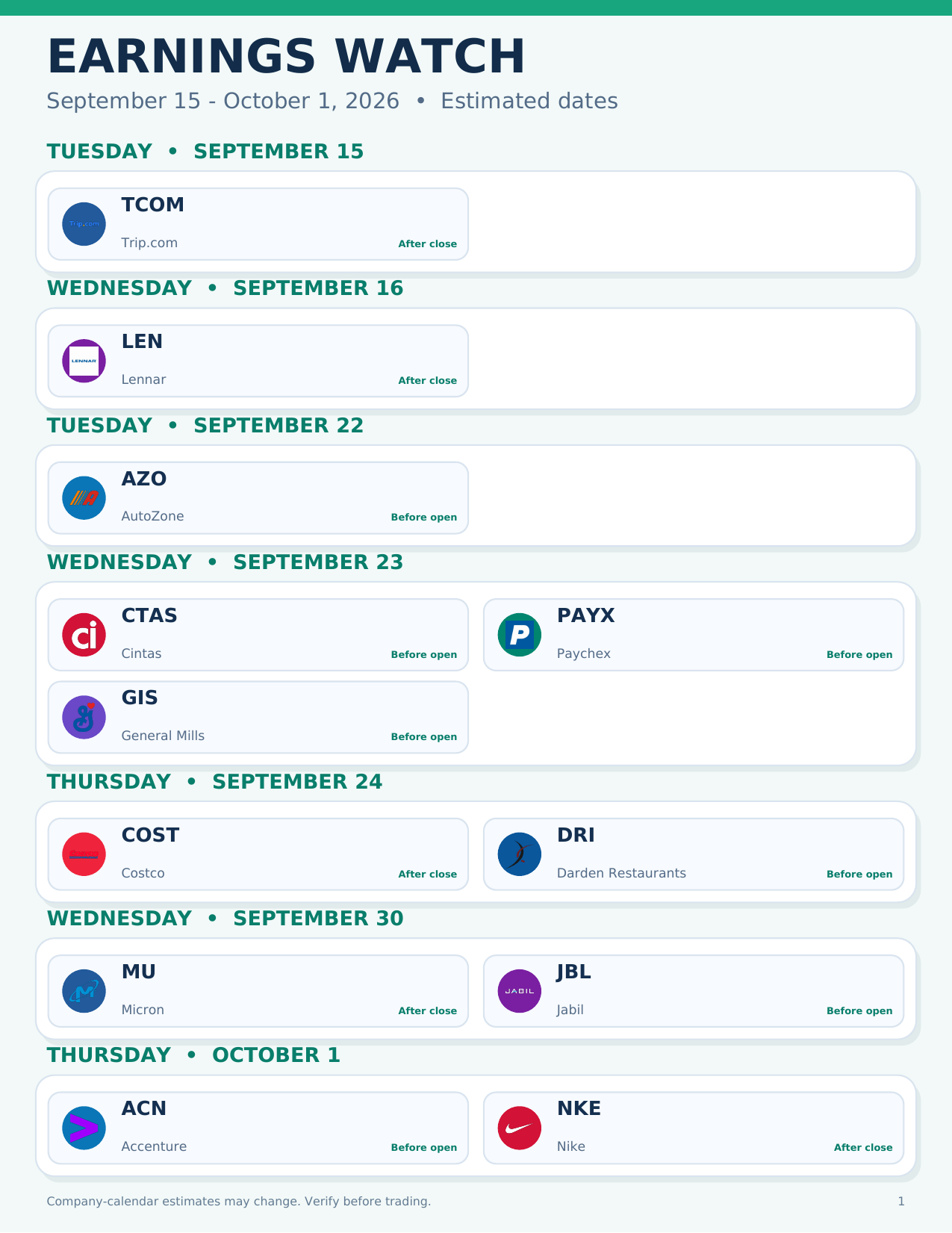
» EARNINGS WATCH · SEP 18 — OCT 1
Tap to view full size
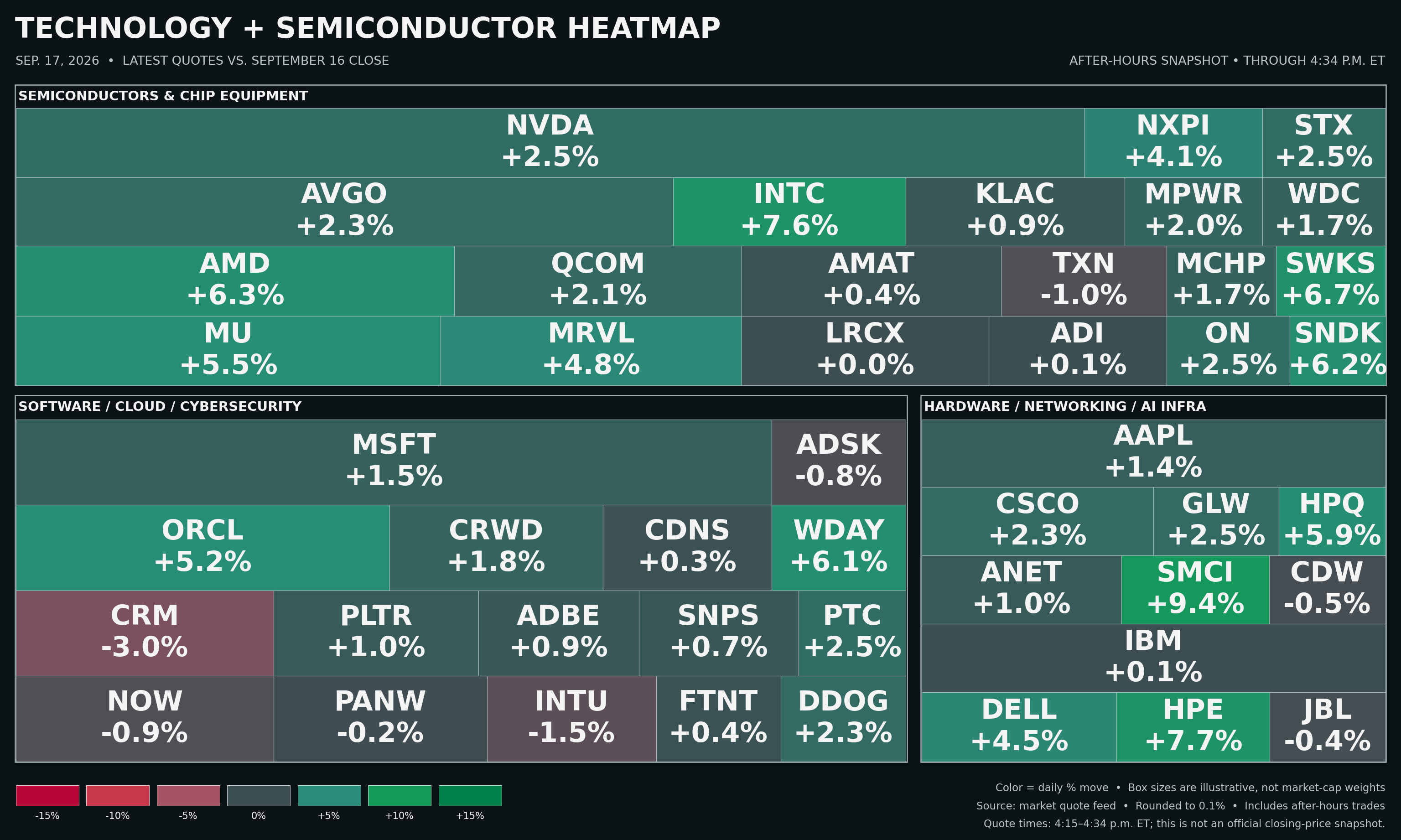
» TECH & SEMI HEATMAP · SEP 17 CLOSE
Tap to view full size
» DAY 230 · THU SEP 17 · DAILY TRADING UPDATE
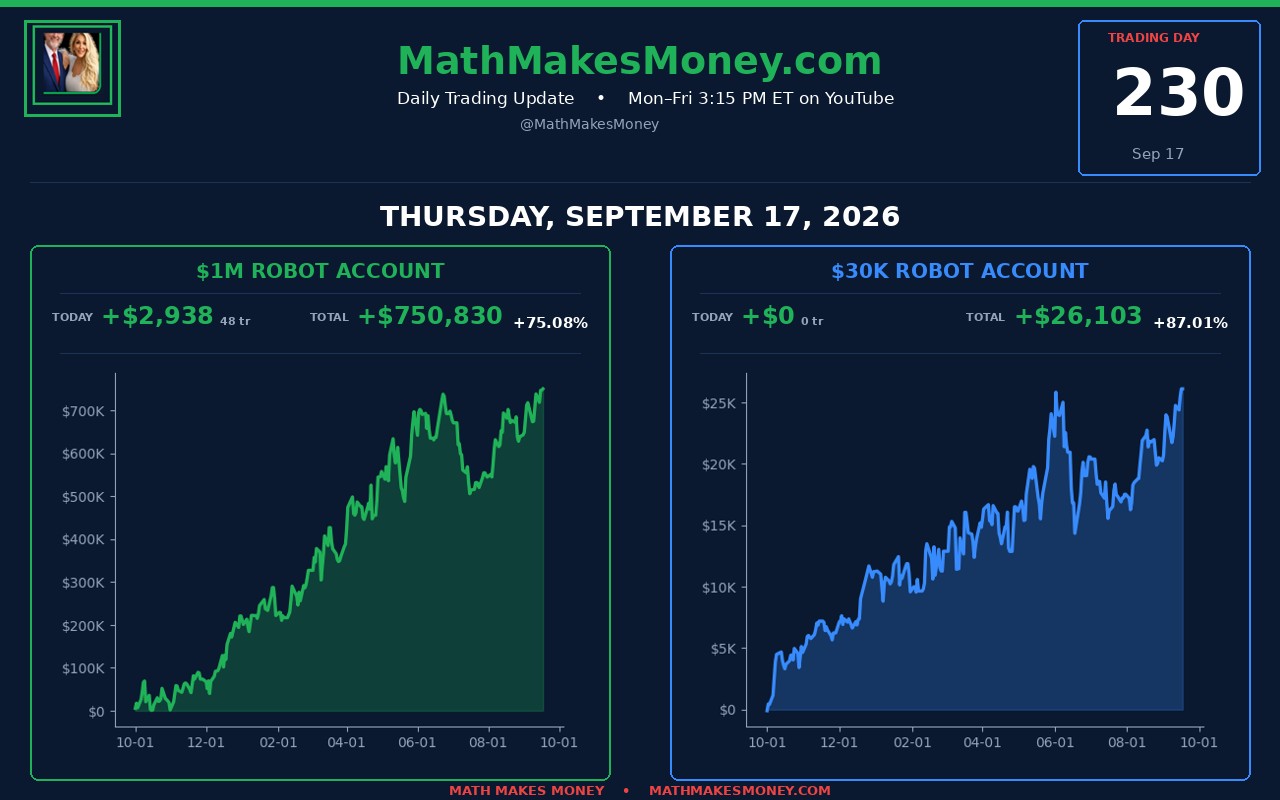
Tap the dashboard to see the full summary online
» TODAY'S LIVE SHOW

» Tap to watch today's live show — 9:15 AM & 3:15 PM ET Monday through Friday, plus Sunday 5:55 PM ET
Free Community Join our Discord with over 1,000 like-minded traders who believe that math makes money when it comes to trading Trade ideas, screenshots, daily banter. Zero cost. Join the Discord → |
» GUESS THE STOCK · THE ANSWER

MATH MAKES MONEY Rob and Maria Helmick and Nick Battista · The Trading Addict Newsletter MathMakesMoney.com Educational only. Not investment advice. Trading options involves substantial risk. Past performance does not guarantee future results. |
|