Issue No. 77 • Thursday September 10, 2026 The Trading Addict Newsletter by Maria Helmick 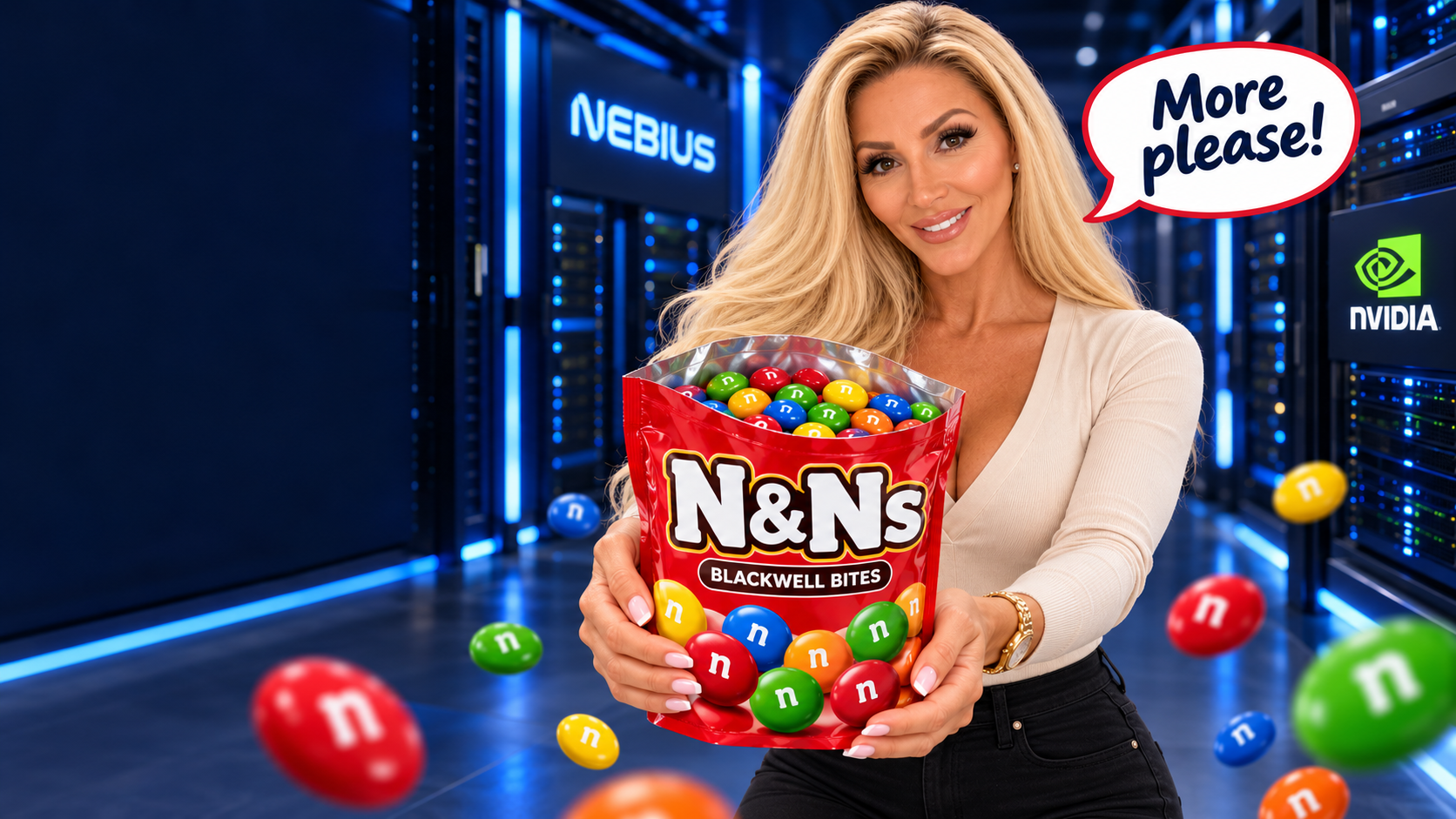 Tap the image to view full size Math Makes Money · Market Newsletter · NASDAQ: NBIS Blackwell Demand Sparks a Bidding WarNebius raised prices. Customers wanted more. | |
Nebius has discovered something every business wants to learn: customers are willing to pay more — and then bid against each other for the privilege.
Demand for Nvidia's newest Blackwell computing power became so intense that simply raising prices was not enough. Nebius began auctioning available capacity, and the winning bids came in 15% to 20% above its standard pricing. That is not just a price increase. It is a clear sign that access to high-end AI computing remains scarce.
Why Customers Are Paying Up
For companies building artificial-intelligence models, time matters. Waiting months for computing capacity can delay a product, slow development and give a competitor an opening. Paying a premium may be the cheaper decision when the alternative is falling behind.
That helps explain why guaranteed access carries so much value. Customers are not merely buying chips; they are buying speed, certainty and a place in the AI race.
Nebius reported $399 million in first-quarter revenue, nearly eight times the amount recorded one year earlier.
The Numbers Behind the Demand |
That kind of growth helps explain the urgency behind its expansion plans. The company expects to spend between $20 billion and $25 billion during 2026 to build data centers, purchase equipment and add more computing capacity.
The opportunity is enormous, but so is the construction bill. Nebius must spend heavily before all of that new capacity can produce revenue. Investors therefore have to weigh two very different facts at the same time: customers are lining up for more computing power, but meeting that demand requires an extraordinary amount of capital.
What It Means for Nebius and Nvidia
For Nebius, auction prices provide real-world evidence that its capacity has pricing power. For Nvidia, the story reinforces the continuing appetite for Blackwell systems. Every customer willing to bid above the posted price strengthens the argument that demand for advanced GPUs remains ahead of available supply.
Maria's Bottom Line In this AI era, any company joined at the hip with Nvidia starts with an advantage — and Nebius is proving the point. Customers are bidding above the posted price just to secure its Blackwell capacity. So yes, I need to get more Nebius. More, please. |
|
Join the Math Makes Money Trading Team One-Button AI Bot Trading Join Today — Trade with Rob's AI Bot (Phil) Today. Live VIP Group Video with Rob and Nick. ↓ Click the big red button below to join ↓ » Join the Team Now » |
 Tap the image to view full size The Options Clock Is Ticking Michael Burry Hits the Brakes — and I Get ItTwo opposite options strategies. One increasingly familiar conclusion: this market needs to make a real move. | |
Michael Burry is pulling back on risk. The investor famous for The Big Short trimmed every position in his portfolio and completely closed his December 2026 put options on Nvidia and Palantir.
That does not mean Burry suddenly turned bullish. He still owns 2027 puts on Palantir and the QQQ. Oracle, Palantir and Nebius remain his three largest shorts, followed by Nvidia and the iShares Semiconductor ETF. He is still betting against parts of the AI trade — he just will not keep paying while he waits for it to crack.
Burry closed the December puts because time decay was accelerating. When you buy puts, being right eventually is not enough; the decline must happen before the clock eats away the option's value. Rather than roll farther out, he reduced his exposure and raised cash.
Opposite Sides, Same Wait
I understand the frustration, although I trade from the other side. Burry buys puts because he expects stocks to fall. I sell puts on stocks I am willing to own or manage. Time decay works against him and generally works for me — but this market is giving neither of us what we want.
He needs a decline to make his bearish positions pay. I need that same decline to create fear, raise volatility and restore real option premium. I have kept trading, but for the past couple of months I have not wanted to go all in. The premiums are not rich enough to justify committing more buying power.
I am not willing to sell a strike closer to the stock price just to collect more premium and manufacture income — it is not worth the added risk. Weak premium can tie up my money for weeks, leaving me without buying power when a better opportunity appears.
I would rather keep cash ready for a genuinely good red day, when quality stocks pull back, volatility jumps and I can sell puts farther away while still being paid properly.
Maria's Bottom Line This market is giving neither side much to work with. Burry needs a meaningful decline to make his bearish positions pay. I need that same decline to restore volatility and premiums worth selling. Until something gives, I am holding back cash and refusing to force trades. Cash is not wasted buying power — it is ammunition for the day real opportunities return. For once, Burry and I are not only in the same book — we're on the same page. |
|
Math Makes Money · Market Brief · September 9, 2026 SpaceX Share Unlock Opens the Door to More Volatility |
319M Shares Unlocked | −4%+ Wednesday's Decline |
SpaceX shares fell more than 4% Wednesday as 319 million previously restricted shares became eligible for sale. At Tuesday's $153.47 close, that block represented nearly $49 billion in potential supply. Unlocked does not mean every share was sold, but early investors and insiders now have the freedom to sell — enough to pressure the stock.
The reaction looked familiar. SpaceX also dropped about 4% after a 319 million-share unlock on August 20, then recovered the next session. More supply is approaching: 59.1 million shares are scheduled to unlock Thursday, followed by roughly 328 million on September 24.
Investors are also watching Starship Flight 14. The long-term bullish case depends heavily on making Starship rapidly reusable, potentially allowing each vehicle to fly dozens of times. For now, shareholders face two moving targets: expanding tradable supply and another major test of the company's most important rocket.
What to Watch » More Unlocks + Starship Flight 14 |
|
Market Sparks | 1 | Oil Crashes the $100 Party Brent crude pushed back above $100 a barrel, putting inflation worries right back on Wall Street's doorstep. Higher oil doesn't just hurt at the pump — it can complicate the interest-rate picture and squeeze consumers and businesses. Oil is suddenly a market-moving story again. |
2 | Treasury Brought $6 Billion. Bonds Wanted More. The Treasury stepped in with a $6 billion long-bond buyback, triple recent levels, hoping to ease pressure in the bond market. Traders essentially shrugged. The 10-year Treasury yield climbed toward 4.85% anyway. Higher yields make borrowing more expensive and give stocks serious competition for investor dollars. |
3 | Google's AI Has a Power Problem Google is planning roughly $15 billion in AI and data-center investment in Finland — and all those servers need enormous amounts of electricity. The company also lined up a 22-year power agreement. AI is becoming much bigger than a semiconductor story: chips need data centers, and data centers need power. Lots of it. |
4 | Qualcomm Wants More Than Your Phone Qualcomm (QCOM) is pushing deeper into the AI infrastructure race through a major collaboration with Amazon's AWS. Qualcomm built its reputation around mobile chips, but the growth battle is increasingly happening inside massive AI data centers. Another chipmaker wants a bigger chair at the AI table. |
5 | Oracle or Adobe... or Neither? Oracle (ORCL) and Adobe (ADBE) report earnings Thursday after the close. Oracle brings cloud infrastructure and AI demand; Adobe brings software, subscriptions and the question of whether AI becomes a growth engine — or a competitive headache. For us, a good company story doesn't automatically make a good options trade. We'll watch expected moves, premiums and strike placement before deciding whether either one deserves our money. |
|
» TRADE WITH US  » TAP THE CARD ABOVE TO JOIN THE MATH MAKES MONEY TRADING TEAM » TECH & SEMI HEATMAP · SEP 9 CLOSE 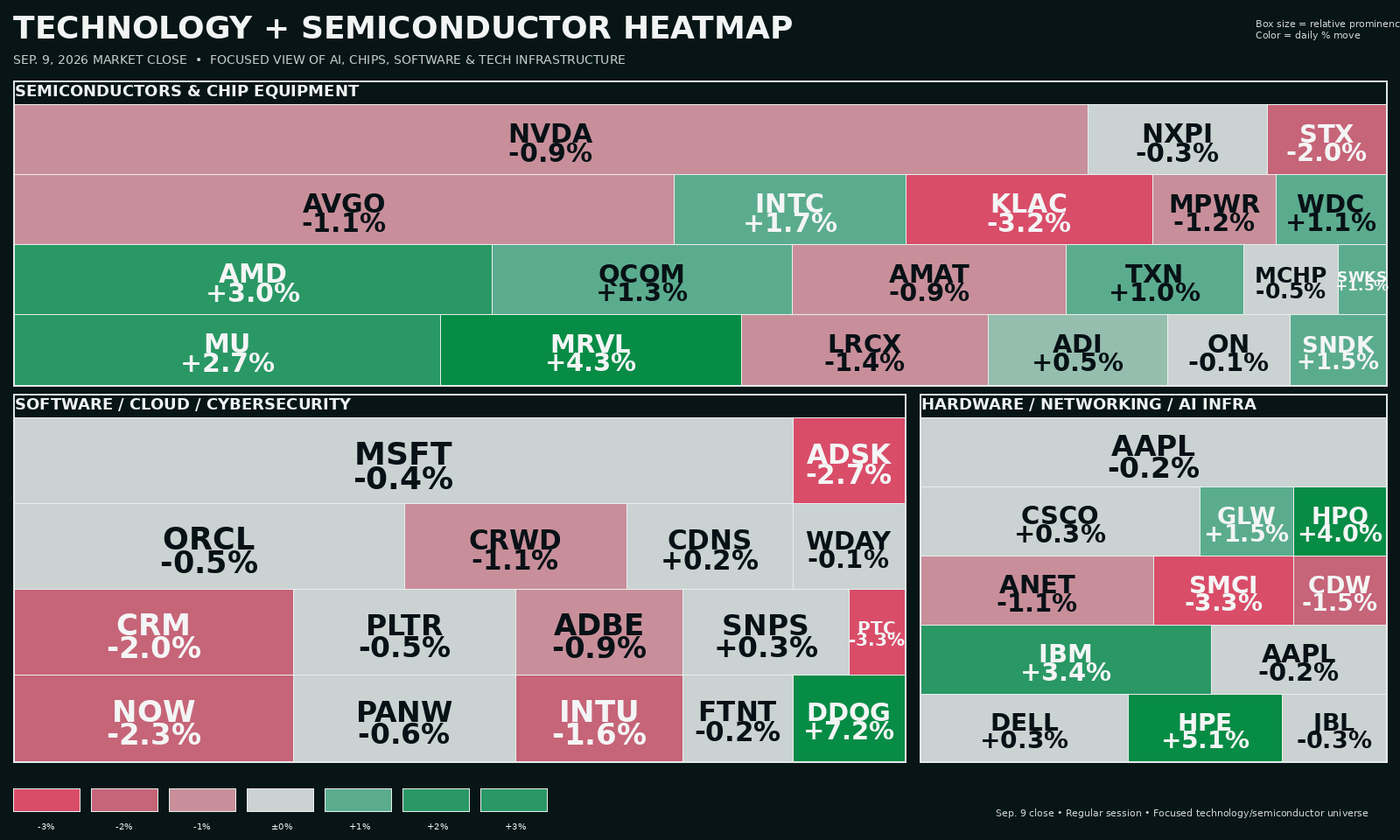 Tap to view full size » TODAY'S LIVE SHOW  » Tap to watch today's live show — 9:15 AM & 3:15 PM ET Monday through Friday, plus Sunday 5:55 PM ET Free Community Join our Discord with over 1,000 like-minded traders who believe that math makes money when it comes to trading Trade ideas, screenshots, daily banter. Zero cost. Join the Discord → |
MATH MAKES MONEY Rob and Maria Helmick and Nick Battista · The Trading Addict Newsletter MathMakesMoney.com Educational only. Not investment advice. Trading options involves substantial risk. Past performance does not guarantee future results. |
|