Issue No. 71 • Tuesday September 1, 2026 The Trading Addict Newsletter by Maria Helmick 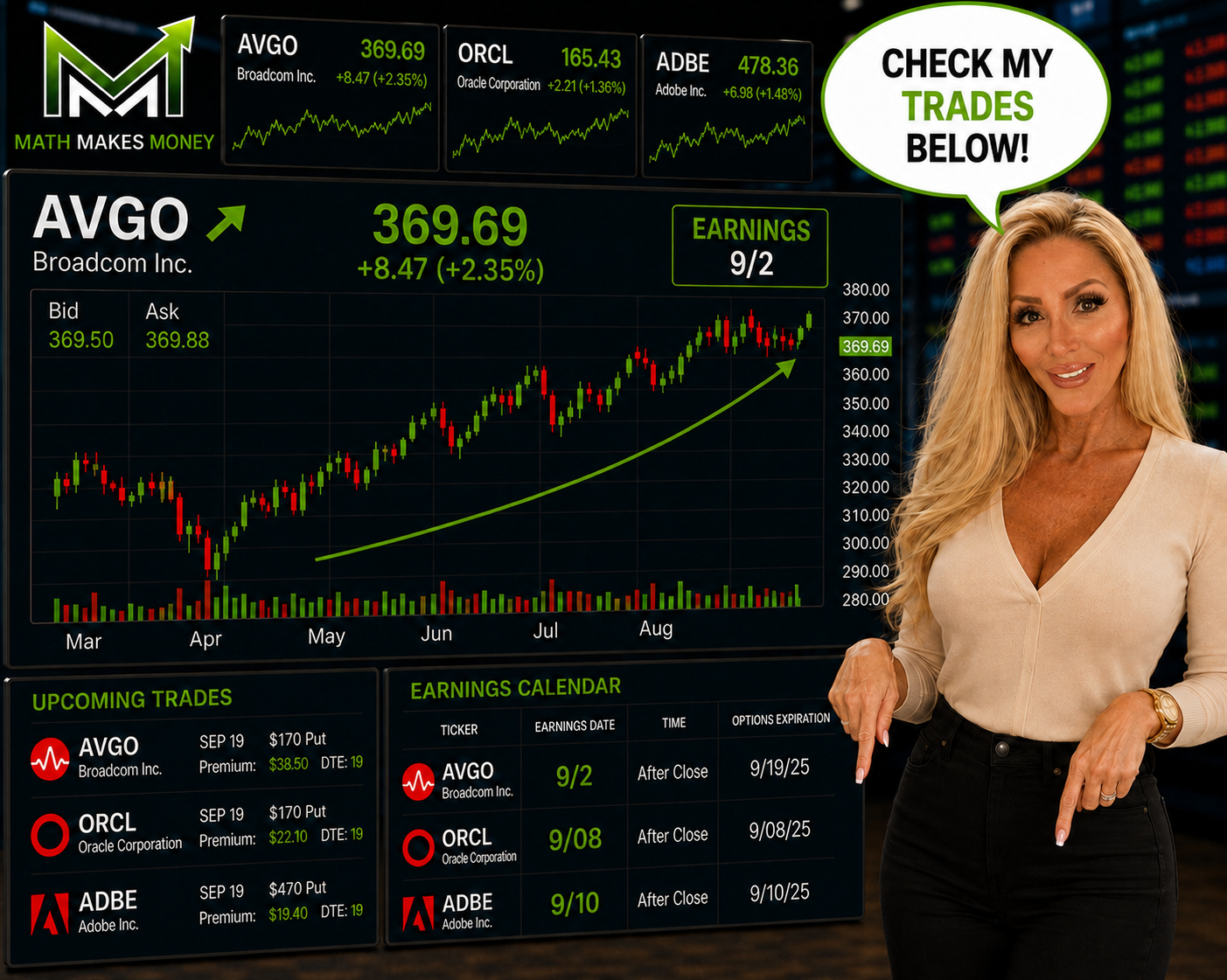 Tap the image to view full size Vera 3.0 · Earnings Watch AVGO Earnings Trade Watch: Broadcom's Big WeekVMware Explore, AI momentum, and a potential AVGO earnings setup. | | Broadcom (AVGO) has an important week ahead. VMware Explore 2026 kicks off Aug 31 in Las Vegas, followed by fiscal Q3 earnings after the market closes on September 2. Broadcom is already one of the major beneficiaries of the AI infrastructure boom, but VMware gives the company another path into enterprise AI. At VMware Explore, Broadcom is highlighting VMware Cloud Foundation, private AI clouds and agentic AI as companies look for ways to bring more AI capabilities inside their own infrastructure. The semiconductor business is already delivering impressive growth. Broadcom reported $10.8 billion in AI semiconductor revenue last quarter, up 143% YoY, while AI semiconductor bookings exceeded $30 billion — strong indication that demand remains robust. Where the Trade Gets InterestingInstead of trying to predict whether AVGO jumps or falls after the report, the opportunity is to see whether the options market offers enough premium at a strike comfortably below the current stock price. For an earnings trade like this, the numbers matter more than the prediction. The $330 Put SetupThe $330 put sits 10.6% below the cited $369.23 stock price, nearly matching AVGO's roughly 10.8% average absolute move over its last eight earnings reports. With the option showing a $7.70 bid / $7.85 ask, there is meaningful premium while still leaving room below the stock. Target strike around 18-20 delta range; adjust if AVGO moves before entry. Vera's AVGO Trade Watch ◆ AI / Semiconductor Demand — STRONG ◆ Put Location — INTERESTING ◆ Quoted Option Spread — REASONABLE ■ Earnings Event Risk — HIGH ▲ VERA'S DECISION: WAIT — RECHECK THE NUMBERS BEFORE ENTRY |
Standard entry rule: We do not take the trade at the mid price. We start at the ask or higher and only take the trade if the market pays enough premium for the risk. If the credit is not there, we pass rather than chase the fill. |
Sources: user-provided AVGO Broadcom newsletter and options-chain screenshot. Educational only. |
Maria's Market Note · Oracle Oracle's $638 Billion AI Bet: Opportunity or Warning?Oracle is becoming one of the biggest players in AI infrastructure — but building that empire is proving expensive. | | Citi believes the recent selloff has gone too far. The firm placed Oracle on an “upside 90-day catalyst watch,” maintained its Buy rating and kept its $330 price target, arguing that investor capitulation and technical selling contributed to the decline. The growth numbers support the bullish case. Oracle reported fiscal Q4 revenue of $19.2 billion, up 21%, while cloud revenue climbed 47% to $9.9 billion. Oracle Cloud Infrastructure was the standout, surging 93% to $5.8 billion. Even more striking is Oracle's $638 billion in remaining performance obligations (RPO) — contracted revenue that has not yet been recognized. RPO jumped 363% year over year, giving Oracle enormous visibility into future demand. Management expects fiscal 2027 revenue to reach approximately $90 billion, with Q1 cloud revenue projected to grow 58% to 64%. The Price of the AI BuildoutOracle spent approximately $55.7 billion on capital expenditures in fiscal 2026, while free cash flow fell to negative $23.7 billion. The company also plans to raise approximately $40 billion through debt and equity financing. Oracle clearly has extraordinary AI demand, but the market wants proof that its massive backlog can translate into profitable growth without putting too much pressure on the balance sheet. Maria's Bottom Line Oracle's selloff was much bigger than I expected. I'm usually cautious about companies taking on this much debt, but Oracle is borrowing to fund significant AI growth — not to support a struggling business. If that investment pays off, it should translate into stronger profits over time. I already own the stock and would consider adding more at a lower price. With September 8 earnings approaching, I'm watching for a good options setup with better volatility and premium. For now, I'm waiting for the right setup. |
Earnings Watch: September 8 · Watching volatility, premium, entry price & risk/reward. |
Earnings Trade · Short Put DELL Oct 16 $360 Short PutDecision: ENTER · Setup Quality: GOOD · 46 DTE | | Brief AnalysisThe $360 strike is roughly 22% below the displayed DELL price. At an $8.50 proposed credit, the effective basis is $351.50 and the credit equals about 2.36% of strike. The ~0.13 delta and 56.1 IV Rank shown in the screenshot support the premium-selling setup. ManagementConsider taking 50%-75% of maximum premium if the trade moves favorably. Reassess if the stock structure materially deteriorates. Main RiskA sharp DELL decline can create substantial downside exposure and assignment risk. Educational analysis based on the supplied option-chain screenshot. Market conditions and option pricing can change. |
 Tap the image to view full size Market Momentum · Special Report The AI Trade Didn't Break.
The Crowd Did.Wall Street's hottest strategy cracked under the weight of crowded positions, leverage, and a sudden reversal in the stocks hedge funds expected to keep winning. | Wall Street's hottest trade of 2026 did not collapse because Nvidia stopped selling chips or because demand for artificial intelligence disappeared. It cracked because too many investors were making the same bet. The strategy is called momentum trading: Buy the stocks already rising and short the ones falling behind. This year, that meant loading up on Nvidia, AMD, Micron, and other AI winners while betting against companies expected to lose ground as AI expanded. For months, it worked spectacularly. The S&P 500 Momentum Index surged 44% during Q2, its strongest quarter on record. By early June, a basket of AI data-center stocks had gained 47% for the year, compared with only 3.5% for non-AI large-caps. The gap between winners and losers had reached its widest level since 1990. Those returns attracted hedge funds, institutions, computer-driven strategies, and individual investors. Many owned the same stocks, and some used leverage, futures, and options to increase their exposure. The buying pushed AI stocks higher, which attracted even more buying. Then the Trade FlippedSince July 1, the S&P 500 Momentum Index has fallen more than 9%, while the S&P 500 gained approximately 2.8%. Momentum is now heading toward its worst quarterly underperformance in 25 years. Bank of America called July the strategy's second-worst month in roughly four decades. Only April 2009 was worse. The damage came from both sides. Popular AI and semiconductor holdings began falling while heavily shorted stocks suddenly rallied. Moderna was a clear example. Encouraging cancer-vaccine news involving Moderna and Merck sent the shares soaring. Traders who had shorted Moderna had to buy back the stock to limit their losses, pushing it still higher and forcing more short sellers to follow. At the same time, many of those funds were losing money on their AI holdings. On August 19, systematic long-short funds fell approximately 1.4%, their worst day in more than two years. Goldman Sachs estimated that momentum trades caused about half the damage. Morgan Stanley's pure-momentum index dropped more than 4% in one session, even though the S&P 500 finished higher. Leverage Turned Losses Into Forced SellingAs funds reached their risk limits, they sold AI stocks to raise cash and bought back losing short positions. That pushed former winners lower and former losers higher, creating additional losses for other funds holding the same trades. Yet Nvidia quickly showed why the collapse of momentum should not be confused with the collapse of AI. The company reported quarterly revenue of $96.2 billion, more than double the previous year, and forecast $108 billion for the following quarter. Nvidia also projected approximately 70% revenue growth for its next fiscal year. The stock surged after the report and lifted other semiconductor stocks with it. That is the real story. AI's business fundamentals remained strong, but the stocks became vulnerable because the trade was overcrowded. A great company, an expensive stock, and a dangerous position can all exist at the same time. Maria's Bottom Line I don't need Nvidia — or any of my tech stocks — to go straight up every day. As a premium seller, I would rather see some movement. Those swings can make premiums richer and create better opportunities, especially on the red days when fear starts creeping in. I'm still bullish on AI and technology, but even the best stocks will never give us a perfectly smooth ride. If they did, we'd all be driving Lamborghinis — or better yet, a Koenigsegg. |
Sources: J.P. Morgan Private Bank, WSJ, Financial Times, Reuters. |
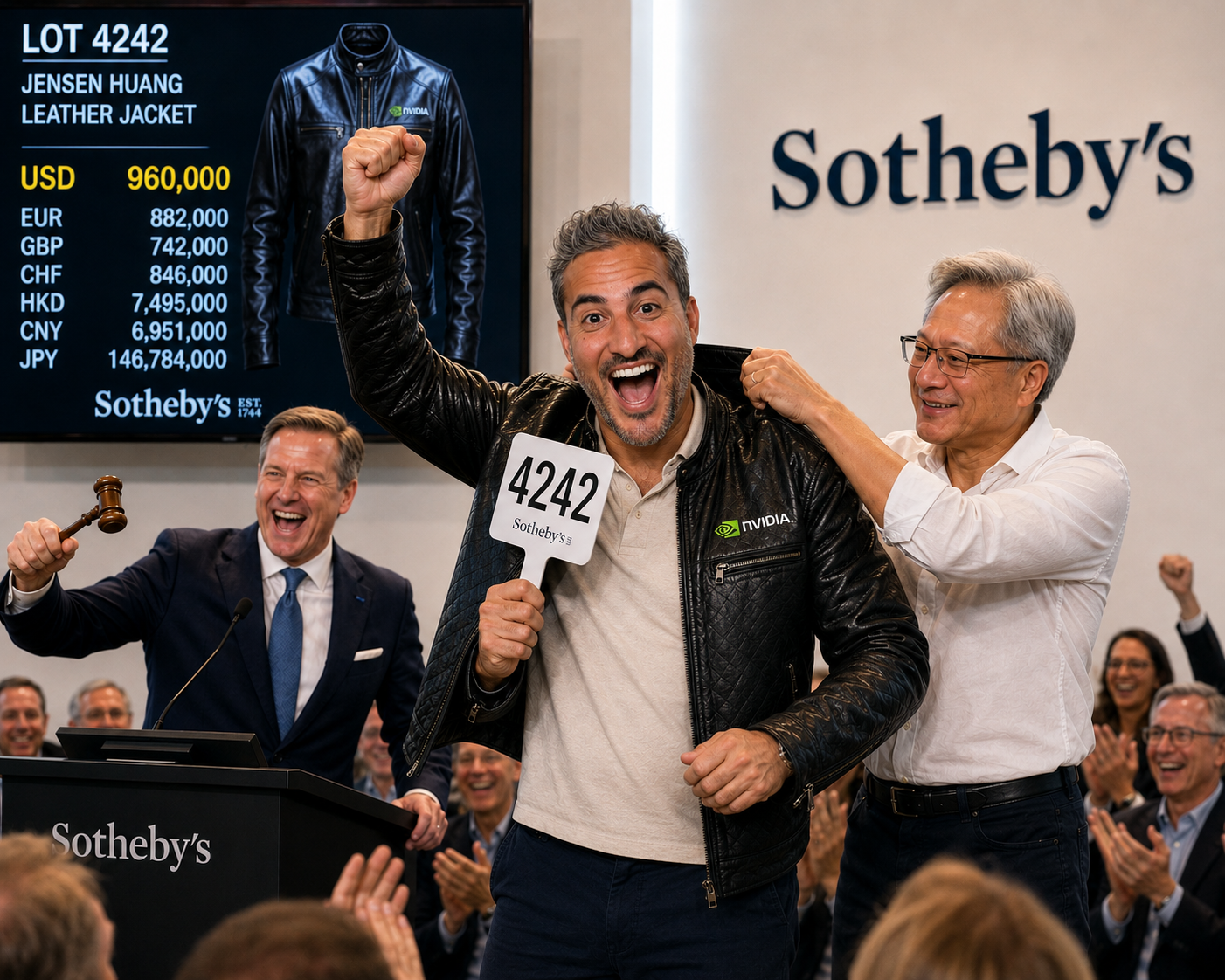 Tap the image to view full size Market Tidbit Jensen Huang's Famous Look Just Became a Collector's ItemIt started as the Nvidia CEO's signature style. Then the bidding began. | There are expensive jackets, and then there are jackets that become pieces of history. One of Nvidia CEO Jensen Huang's signature Tom Ford leather jackets recently hit the auction block. Sotheby's expected it to fetch between $40,000 and $60,000. That estimate didn't survive long. By the time the bidding stopped, an unidentified buyer had paid $960,000 for a jacket that originally cost roughly $7,000. But this wasn't really about leather. It was about Jensen Huang — and the extraordinary moment in technology he has come to represent. As Nvidia became one of the defining companies of the AI boom, Huang transformed from a semiconductor executive known largely in tech circles into something closer to a corporate rock star. Along the way, the black leather jacket became his uniform. Steve Jobs had the black turtleneck. Mark Zuckerberg had the gray T-shirt. Huang has leather. The jacket sold by Sotheby's was worn during a 2023 appearance at Foxconn in Taipei. The auction house described it as the uniform of a “first believer” — an artifact from a transformative period in technology. Collectors apparently agreed. The final price was roughly 137 times the jacket's approximate original retail price. There's even a perfect footnote. In 2024, Huang and Meta CEO Mark Zuckerberg swapped jackets onstage. Zuckerberg joked that Huang's jacket was worth more simply because Huang had worn it. At the time, it was a joke. After a Jensen Huang jacket sold for $960,000, it doesn't sound quite so funny anymore. That's the power of an icon: eventually, people aren't buying the object. They're buying the story attached to it. |
|
» EARNINGS WATCH · AUG 31 – SEP 4 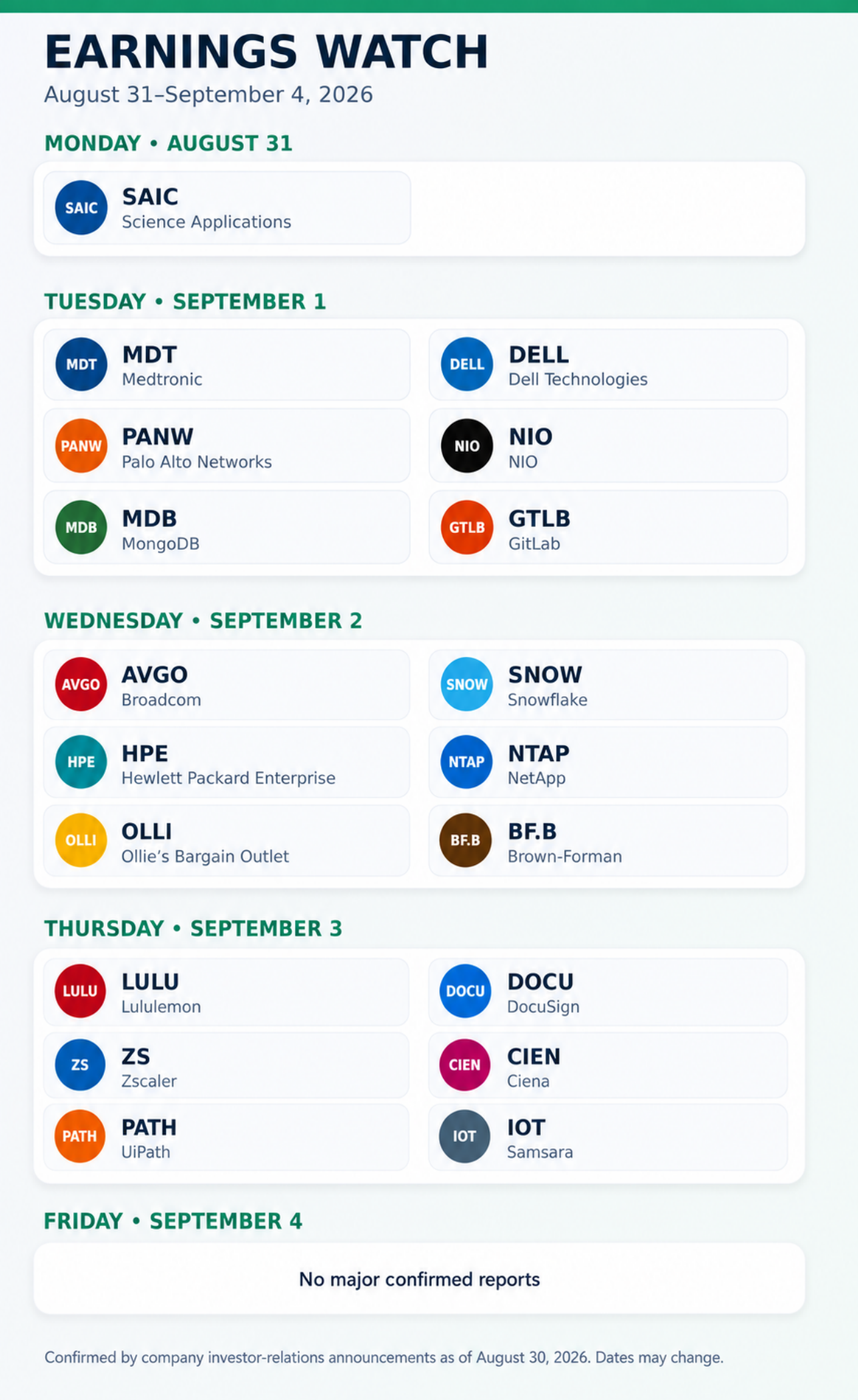 Tap to view full size » TRADE WITH US  » TAP THE CARD ABOVE TO JOIN THE MATH MAKES MONEY TRADING TEAM AT MATHMAKESMONEY.COM » DAY 218 · MON AUG 31 · DAILY TRADING UPDATE 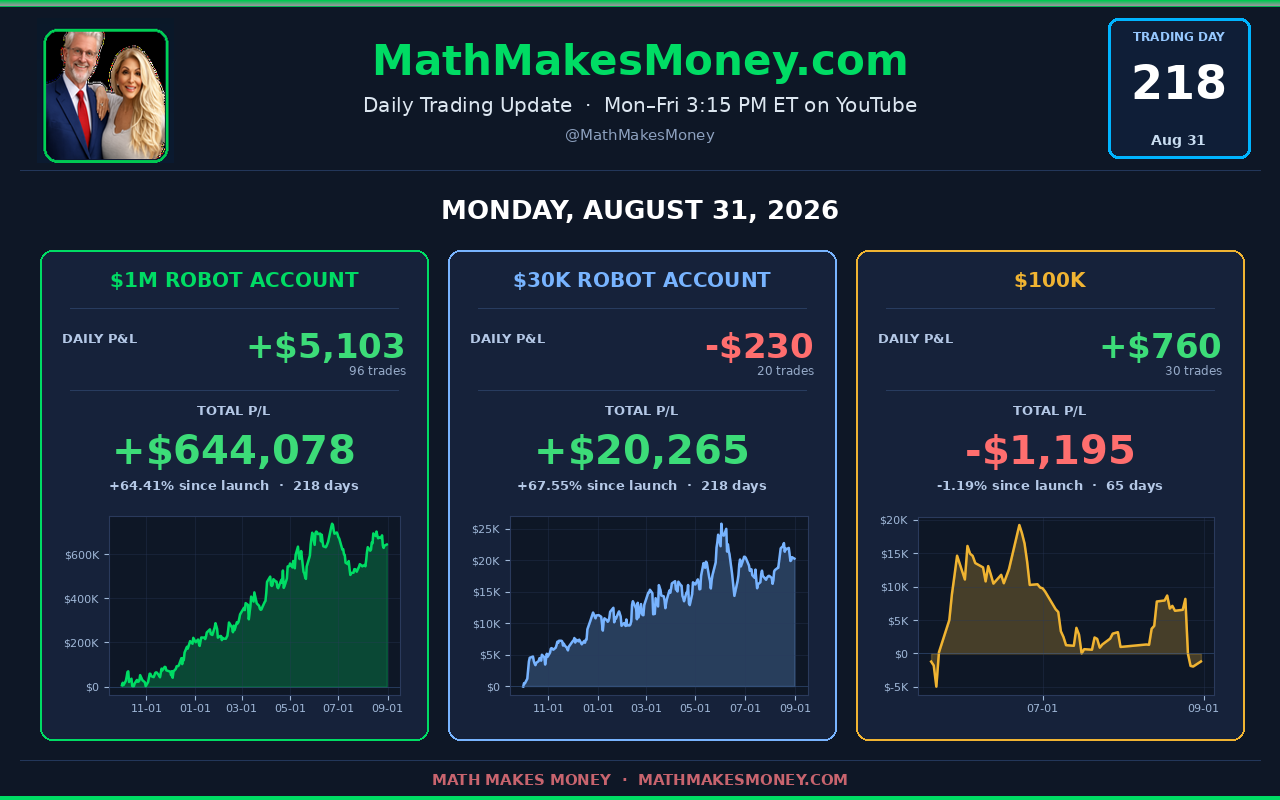 Tap the dashboard to see the full summary online » TODAY'S LIVE SHOW  » Tap to watch today's live show — 9:15 AM & 3:15 PM ET Monday through Friday, plus Sunday 5:55 PM ET Free Community Join our Discord with over 1,000 like-minded traders who believe that math makes money when it comes to trading Trade ideas, screenshots, daily banter. Zero cost. Join the Discord → |
MATH MAKES MONEY Rob and Maria Helmick and Nick Battista · The Trading Addict Newsletter MathMakesMoney.com Educational only. Not investment advice. Trading options involves substantial risk. Past performance does not guarantee future results. |
|