Issue No. 69 • Friday August 28, 2026 The Trading Addict Newsletter by Maria Helmick  Tap the image to view full size Nvidia · Market Insight Nvidia Isn't Just Selling Chips AnymoreJensen Huang is positioning Nvidia to help customers build the entire AI factory. | Nvidia just posted another staggering quarter: $96.2 billion in revenue, up 106% year over year, with Data Center revenue reaching $89 billion. Next-quarter guidance is approximately $108 billion. Those numbers are enormous, but the more important story may be how Nvidia's business itself is changing. From Chips to the Whole AI FactoryCustomers increasingly aren't coming to Nvidia for a GPU alone. They need the whole AI factory: GPUs, CPUs, networking, storage and software, along with the infrastructure planning required to make the system work together. These projects require enormous amounts of power, cooling, memory, advanced semiconductors and data-center capacity. Nvidia's Vera Rubin platform alone is being ramped through hundreds of supply-chain partners across more than 350 factories in 30 countries. That scale also explains why Nvidia now has visibility roughly a year in advance. Customers have to plan these installations long before deployment, while Nvidia and its suppliers have to reserve manufacturing and component capacity. For a company that historically did not guide this far ahead, that forward visibility is significant. Demand Is Greater Than What Nvidia Can SupplyNvidia expects revenue to grow approximately 70% in fiscal 2028, but Jensen says actual demand is higher. The forecast reflects roughly what Nvidia believes its supply chain can confidently deliver. That is an important distinction: at the moment, Nvidia's limitation isn't simply how much customers want to buy — it is how much Nvidia can build and deliver. The customer base is also widening beyond the giant hyperscalers. AI clouds, enterprises, industrial companies and sovereign AI projects are becoming a much larger part of the business, giving Nvidia another growth engine beyond Amazon, Microsoft, Meta and Google. Rubin Changes the EconomicsVera Rubin isn't simply the next GPU. It is an integrated AI-factory platform designed to make the entire data center more productive. Power is becoming one of AI's scarcest resources, and Nvidia estimates the compute opportunity from one gigawatt rises from roughly $18 billion with Hopper, to $25 billion with Grace Blackwell, to $40 billion with Vera Rubin. That helps explain why customers are willing to plan so far ahead. The newest systems aren't valuable merely because they are faster; they can potentially produce substantially more useful compute from the same limited power and physical footprint. Jensen's phrase “compute is revenue” captures the idea: once AI infrastructure performs productive work, computing capacity becomes an economic asset rather than just another technology expense. Amazon Just Put an Exclamation Point on ItOnly months after committing to more than 1 million Nvidia GPUs, AWS plans to deploy another 2 million during 2027 and 2028 after demand exceeded expectations. That is particularly notable because Amazon builds its own AI chips. Yet AWS is expanding with Nvidia across GPUs, Vera CPUs, networking, AI models, robotics and broader AI infrastructure. That may be the clearest example of what Nvidia is becoming. Its competitive advantage is no longer just one chip. The moat is increasingly the entire ecosystem surrounding it. Maria's Bottom Line The more I listen to Jensen Huang, the more impressed I am — not just with Nvidia, but with him. He has taken Nvidia far beyond chips and built an entire AI ecosystem around a vision he seems to see several steps ahead of everyone else. I'll trade Nvidia along the way, but I want to own it for the long run. For me, it's the right technology, the right company and the right leader at the right time. |
Sources: Nvidia earnings materials and public Nvidia/AWS announcements. Not investment advice. |
 Tap the image to view full size Salesforce (CRM) · Market Tidbit · Aug 28, 2026 Wall Street Buried Salesforce a Little Too EarlyThe software company investors had nearly written off delivered the quarter they were told not to expect. | +23% Day's Reversal One-day post-earnings surge |
| $11.35B Q Revenue +11% year over year |
| $33.5B Future Biz Contracted, up 14% |
|
| Salesforce spent much of 2026 being treated like one of AI's first corporate casualties. Investors worried that companies would need fewer Salesforce subscriptions as AI agents began handling sales, customer service and administrative work. Anthropic's new tools intensified those fears, helping erase roughly $830 billion from global software stocks in only six trading days earlier this year. By late February, Salesforce shares had fallen approximately 30% for the year. Then the company reported earnings. Quarterly revenue rose 11% to $11.35 billion, and Salesforce increased its full-year revenue forecast to between $46.1 billion and $46.4 billion. Future contracted business climbed 14% to $33.5 billion. Those numbers did not support the story that customers were abandoning the company. Adjusted earnings of $5.90 per share came with an important qualification: the total included a $2.53-per-share investment gain, plus help from stock buybacks. The cleaner story was the revenue growth, stronger bookings and increasing demand for Salesforce's AI products. The biggest surprise was Claudeforce, Salesforce's expanded partnership with Anthropic. Claude will operate inside Salesforce and Slack, connecting Anthropic's AI to the customer information and business data companies already keep on the platform. Salesforce says Claude-powered Slackbot has produced 8.1 million hours of annualized productivity gains inside the company. Anthropic was supposed to help push Salesforce aside. Instead, Salesforce brought Claude inside and found another way to sell AI to its existing customers. Wall Street had priced Salesforce like a company losing the AI battle. These results showed it may finally have figured out how to fight back. Maria's Bottom Line For months, everything I heard about Salesforce was negative. Even the research I did turned up very little positive data, so staying away made perfect sense. Nowhere did I expect the stock to rise this much — or rise at all. Salesforce pulled this one straight out of its you-know-what. Fool me once, shame on you. Fool me twice, shame on me. |
Sources: Salesforce Investor Relations and Reuters. Not investment advice. |
Streaming & Media · Market Perspective Netflix Has a Growth Problem — Just Not the One Wall Street ThinksThe business is still producing strong growth and enormous cash flow. The stock is struggling because investors no longer know how much to pay for a streaming giant that is growing up. | | Netflix shares are sitting near $80 after falling roughly 37% from their 2025 high. That kind of drop usually suggests something has gone badly wrong. In Netflix's case, the numbers say otherwise. Second-quarter revenue rose 13.4% to $12.56 billion, earnings per share climbed 35.6% to $0.80, and the operating margin reached 33.4%. Management also maintained its forecast for 13% to 14% full-year revenue growth and approximately $12.5 billion in free cash flow. Those are not broken-company numbers. The problem is that Netflix spent years training Wall Street to expect blockbuster subscriber growth. Now it is becoming a mature entertainment company, and very good results no longer create the excitement they once did. The Missing ScoreboardNetflix no longer regularly reports subscriber totals, removing the scoreboard investors used for years. Revenue, margins, advertising and cash flow now matter more, but the transition has left Wall Street searching for the next obvious growth engine. Advertising Is the New BetThe ad-supported tier may be the best answer. Netflix is targeting about $3 billion in advertising revenue for 2026, using a lower-priced plan to attract customers while creating a second way to earn money from every hour watched. Live programming, special events and gaming could deepen engagement, but none has yet proved it can reproduce the explosive growth of the original streaming boom. Competition Still Has a PriceNetflix remains the streaming leader, but viewers now divide their time among Disney+, Amazon Prime Video, YouTube, Apple TV and other services. Staying on top requires billions in annual content spending. A hit series travels around the world; an expensive miss disappears into the menu. That makes consistent execution just as important as audience size. A More Reasonable Price — With a CatchAt roughly 22 times earnings, down from about 30 times earlier in 2026, the valuation finally reflects some disappointment. The stock could recover if advertising scales, margins hold and double-digit revenue growth continues. If engagement weakens or growth slips into single digits, however, the market may decide that even 22 times earnings is too generous. Maria's Bottom Line There is almost nothing worse than holding a stock that just sits there. You cannot sell calls because there is no money in them, so you wait — and get reminded of it every time you turn on the television. Netflix is still a good company, but until the stock starts moving again, good company or not, it is dead money in the portfolio. |
Sources: Netflix investor materials. Not investment advice. |
Market Tidbit The $10 Million MistakeHe wanted one put. Somehow, he bought 1,000. | Shortly before the 1987 stock market crash, a trader stepped into the S&P 500 options market and placed what he believed was a small order for one put. At least, that was what he thought he bought. Several hours later, he discovered that something had gone spectacularly wrong. Instead of one contract, his account showed 1,000 S&P 500 puts — an enormous bearish position that could have wiped him out if the market moved higher. He had accidentally placed the trade of his life. He just did not know which way it was going to end. Then Came Black Monday. On October 19, 1987, selling erupted from the opening bell. Trading systems buckled, phones jammed and panic swallowed Wall Street. By the close, the Dow had fallen 508 points — or 22.6% in a single session. It remains the largest one-day percentage collapse in the index's history. As stocks plunged, the trader's accidental pile of puts exploded in value. A position that should never have existed reportedly produced a profit of more than $10 million. Most traders spend their careers trying to place the perfect trade. This trader placed his by mistake. He went to bed thinking he owned one put. He woke up holding 1,000 tickets to the biggest market crash in Wall Street history. It May Have Been the Most Profitable "Extra Zeroes" Ever Entered. |
A CBOE trading-floor legend. |
» TRADE WITH US  » TAP THE CARD ABOVE TO JOIN THE MATH MAKES MONEY TRADING TEAM AT MATHMAKESMONEY.COM » SEMICONDUCTOR HEATMAP 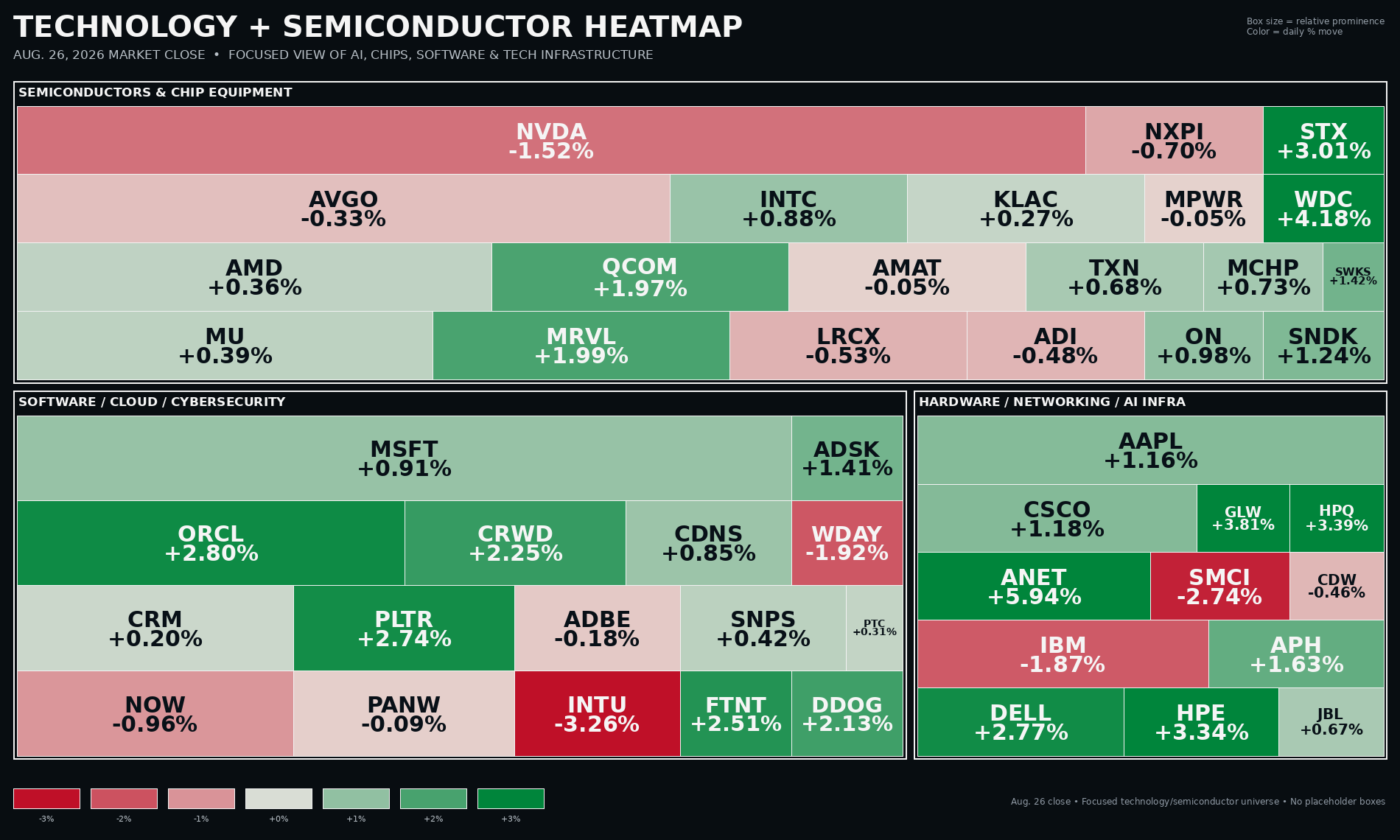 Tap to view full size Next Week's Report Card Earnings Calendar · Sep 1–11 | 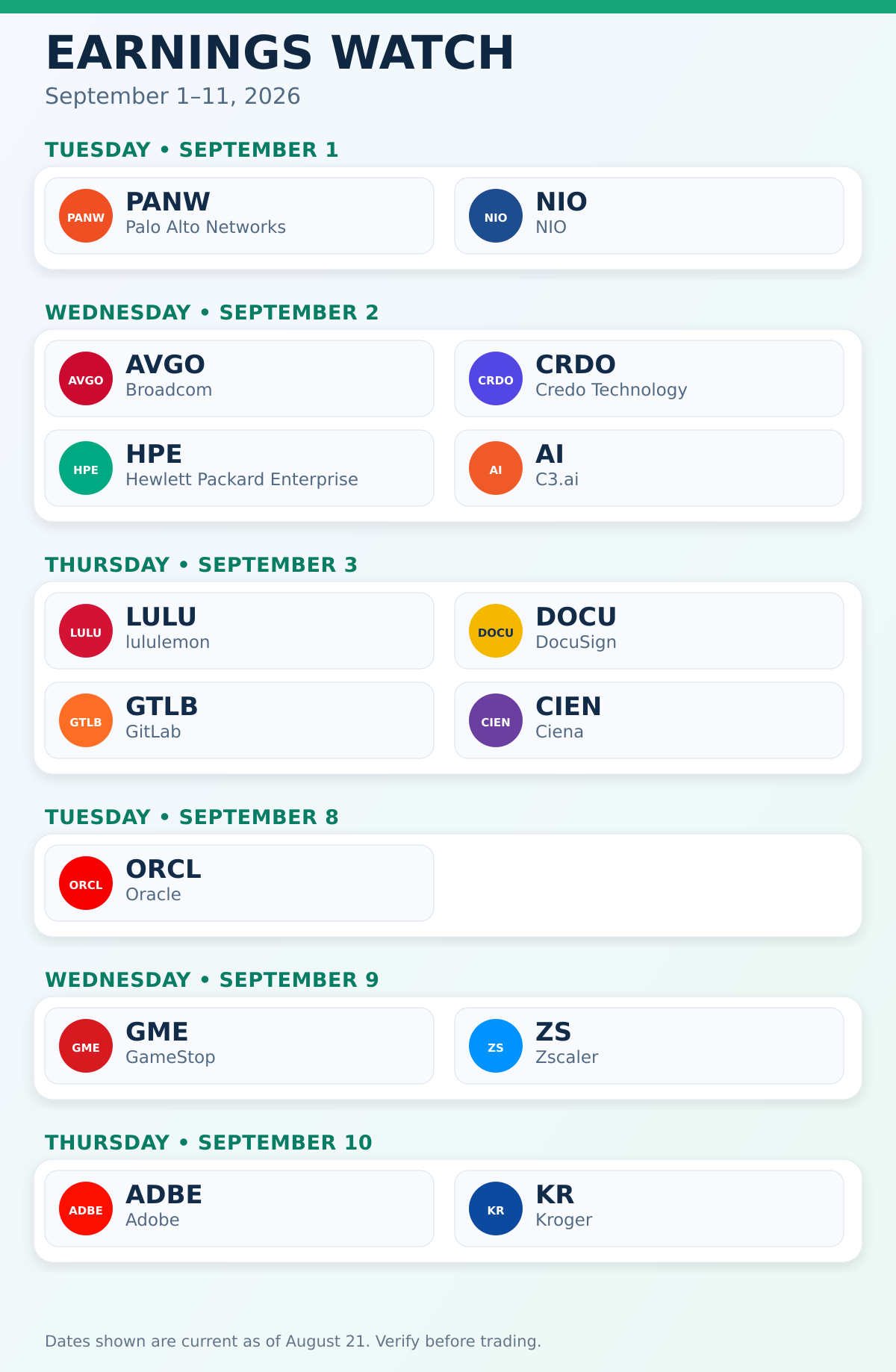 Tap the chart to view full size |
» DAY 216 · THU AUG 27 · DAILY TRADING UPDATE 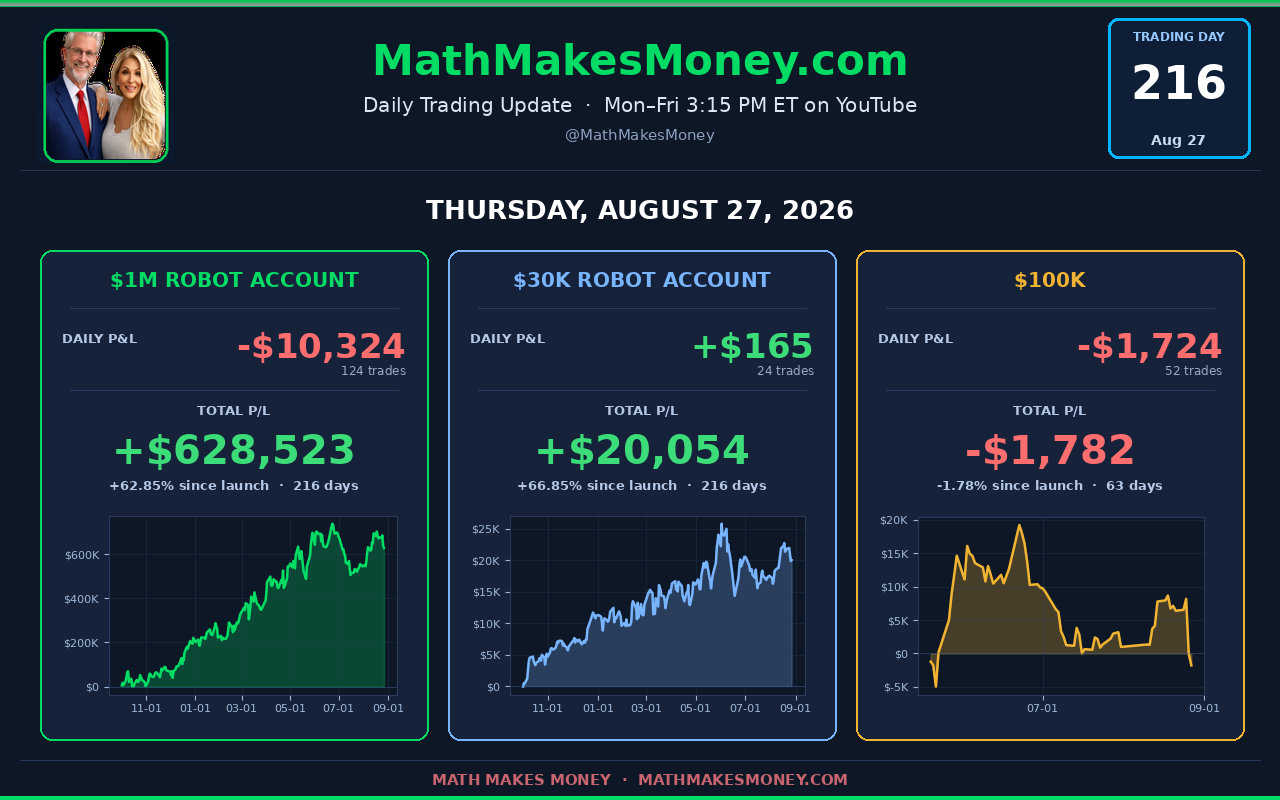 Tap the dashboard to see the full summary online » TODAY'S LIVE SHOW  » Tap to watch today's live show — 9:15 AM & 3:15 PM ET Monday through Friday, plus Sunday 5:55 PM ET Free Community Join our Discord with over 1,000 like-minded traders who believe that math makes money when it comes to trading Trade ideas, screenshots, daily banter. Zero cost. Join the Discord → |
MATH MAKES MONEY Rob and Maria Helmick and Nick Battista · The Trading Addict Newsletter MathMakesMoney.com Educational only. Not investment advice. Trading options involves substantial risk. Past performance does not guarantee future results. |
|