The Trading Addict · Issue No. 62 · Wednesday August 19, 2026

It's Meta's Fault
— Or Is It?

A $200 billion lawsuit puts doomscrolling, parental responsibility and META's advertising machine on trial. Plus oil is carrying a war premium, long-term Treasury yields are above 5%, and one unfinished 1974 trade that changed international banking forever.

The Trading Addict Newsletter · by Maria Helmick
»  APPLY TO JOIN THE MATH MAKES MONEY TEAM  »
AI Robot Trading — Nick, Maria & Rob — Math Makes Money

Issue No. 62  •  Wednesday August 19, 2026

The Trading Addict Newsletter by Maria Helmick

Meta lawsuit - Maria surrounded by kids on phones with chips and soda chaos, dog holding a phone (tap to enlarge)

Tap the image to view full size

The Meta Debate

It's Meta's Fault — Or Is It?

A $200 billion lawsuit puts doomscrolling, parental responsibility and META's advertising machine on trial.

Claim Sought

~$200B

Not an expected judgment

Q2 Revenue

$60.8B

Up 28% year over year

Cash + Securities

$90.3B

June 30, 2026

Meta is facing a landmark trial brought by 29 states over claims that Facebook and Instagram were designed to keep children scrolling and improperly collected data from users under 13. Meta denies the allegations and says it has invested heavily in protecting younger users.

The case raises a larger question: Is this only about protecting children, or is Meta an attractive target because it has the money to pay?

Doomscrolling and Personal Responsibility

The lawsuit focuses on infinite scroll, autoplay, notifications and recommendation algorithms — the features that can turn five minutes online into an hour of doomscrolling.

These tools clearly encourage engagement. But "engaging" and "addictive" are not automatically the same thing. Repeatedly calling users addicted can make the states' allegations sound proven before the trial is finished. The real question is whether Meta knowingly used these features in ways that harmed children or concealed information about the risks.

But where are the parents? Parents decide when a child receives a smartphone. They can control which apps are downloaded, establish screen-time limits and remove access when online behavior becomes unhealthy.

Meta may have built the endless feed, but it did not buy the phone or decide that hours of unsupervised scrolling were acceptable. Technology companies should answer for deception or unlawful harm, but courts cannot replace parental supervision inside the home.

Is Meta Being Used as an ATM?

Meta is one of the wealthiest companies in the world, making it an obvious legal target. The approximately $200 billion being sought equals about 14% of Meta's market value. That does not prove the lawsuit is a money grab, but the size of the demand deserves scrutiny.

A case can raise legitimate concerns while still seeking an excessive penalty. Accountability should be based on proven harm and Meta's conduct — not simply on how much the company can afford to pay.

How the Lawsuit Could Affect META Stock

The stock risk goes beyond a fine. A court could require Meta to reduce notifications, weaken infinite scroll, change recommendation algorithms or introduce stricter age controls. Less engagement could mean fewer advertisements and slower revenue growth.

Meta already recorded $2.4 billion in second-quarter legal charges. Testimony, internal documents, settlement talks and court decisions could create sharp moves in META and increase option premiums. For premium sellers, higher volatility can create opportunity — but it also increases overnight gap risk.

Meta Has a Financial Cushion

Meta reported $60.8 billion in second-quarter revenue, up 28% from the prior year. Advertising revenue increased 27%, while cash and marketable securities totaled approximately $90.3 billion. That gives Meta resources to fight the case and appeal an unfavorable ruling.

The greater threat is not a one-time payment. It is a court order that permanently weakens engagement and advertising growth. A fine can be paid. A damaged business model can affect the stock for years.

Maria's Bottom Line

Parents, do your job.

A phone is not a babysitter, and an app should not be responsible for raising your children. Know what they are watching, set limits and take the device away when necessary.

This goes beyond Meta. Many problems affecting children today come back to the same issue: too little supervision, too few boundaries and too much responsibility handed to schools, companies and the government.

Children need parents — not another lawsuit to do the parenting for them.

Technology may create the temptation, but parents must provide the discipline.

Sources: Fox Business; Meta Q2 2026 results; U.S. Surgeon General social-media advisory. Data as of Aug. 18, 2026. Commentary is opinion. Educational only; not financial advice.

Not Subscribed Yet?

Sign up for the newsletter here

mathmakesmoney.com →

The Math Makes Money Team

APPLY TO JOIN THE TEAM

Sign up to be interviewed by Nick and Rob to see if you qualify.

Join the MMM Team Waitlist →
 

Trader's Market Brief

War, Oil and 5% Treasuries — Oh My!

Oil is carrying a war premium. Long-term Treasury yields are above 5%. Stocks now face pressure from both higher operating costs and a tougher alternative for investor dollars.

30-Yr Treasury

5.31%

Aug. 17, 2026

10-Yr Treasury

4.72%

Aug. 17, 2026

Brent Q3 Forecast

~$85

per barrel, EIA

The New Hurdle Rate

On August 17, the 30-year Treasury yield stood at 5.31% and the 10-year at 4.72%. That gives investors a serious alternative to stocks: a high nominal yield backed by the U.S. government. Treasuries still carry inflation risk, and their prices can fall if they are sold before maturity, but they do not depend on a company's earnings or balance sheet.

That changes the math for equities. When long-term yields are this high, a stock needs stronger earnings, cash flow or dividend growth to justify its risk. Highly valued companies and heavily indebted businesses feel the pressure first. Growth stocks are sensitive because more of their value rests on future profits; smaller companies often feel it through the cost and availability of financing.

Oil Is the Shock. Yields Are the Multiplier.

The Strait of Hormuz is one of the world's most important oil routes. The EIA estimates that crude oil and petroleum-liquid flows through the strait fell from 21.6 million barrels per day in the fourth quarter of 2025 to 4.9 million in the second quarter of 2026 as conflict disrupted shipping and production.

Those disruptions drained inventories and pushed energy risk back into the market. In its August outlook, the EIA forecast Brent crude to average about $85 per barrel in the third quarter, then ease as traffic and production gradually recover. The forecast is not a promise; it depends heavily on how quickly flows normalize.

For stocks, the split is direct. Higher oil can support producers and some pipeline and oil-service companies; refiners still depend on the spread between crude costs and fuel prices. Airlines, trucking, cruise lines and other fuel-intensive businesses face a clearer squeeze. If the route reopens faster than expected, that trade can reverse just as quickly: energy may lose momentum while transportation and consumer names catch a bid.

The Trader's Tension

Oil can lift select energy shares while taxing the rest of the economy. High yields can reward cash-rich companies while punishing expensive or highly leveraged stocks. When both rise, the pressure compounds.

A Trader's Map — Not a Prediction

The useful signal is whether oil and yields confirm each other. If both rise, the market faces higher business costs and a higher valuation hurdle at the same time. Energy, defense and cash-rich companies may hold up better, while technology, small caps, airlines and REITs can face pressure.

If both fall, rate-sensitive stocks may recover — but the reason matters. Easing inflation pressure can support growth stocks. Falling yields caused by recession fear may instead favor healthcare and staples. The point is not to predict every turn. It is to know what your position depends on before the regime changes.

Volatility Pays — Until It Doesn't

For premium sellers, uncertainty is inventory. War headlines, rate surprises and fast sector rotation can raise implied volatility and option premiums. The edge appears when the market prices a larger move than the stock ultimately delivers.

There is historical evidence for that edge. Cboe research found that from 1990 through 2018, the VIX averaged 19.3%, while realized volatility for the S&P 500 averaged 15.1%. That 4.2-point difference is the volatility risk premium option sellers seek to capture. It is not guaranteed. Premium is high precisely because the market knows a headline can push price beyond the expected move.

That is why the highest premium is not automatically the best trade. I want liquidity, a clear thesis and defined risk. I also check for hidden concentration: positions in technology, oil and rate-sensitive stocks may look different while depending on the same macro outcome.

Maria's Bottom Line

I remain bullish, but I am not ignoring the crosscurrents. High yields make stocks earn their place. Oil keeps inflation and headline risk alive. Together, they can create the kind of nervous market that pays premium sellers well — right up until nervousness becomes panic.

I want fear high enough to create opportunity, not so high that every position becomes the same bet. So I stay selective, trade smaller when the backdrop demands it and define the risk before I collect the premium. The goal is not to eliminate fear. The goal is to keep fear from making the decisions.

Welcome the premium. Respect the headline. Protect the account.

Sources: U.S. Treasury Daily Treasury Rates; U.S. Energy Information Administration August 2026 STEO; Cboe volatility-risk-premium research. Data as of Aug. 18, 2026. Historical results are not guaranteed. Educational only; not financial advice.

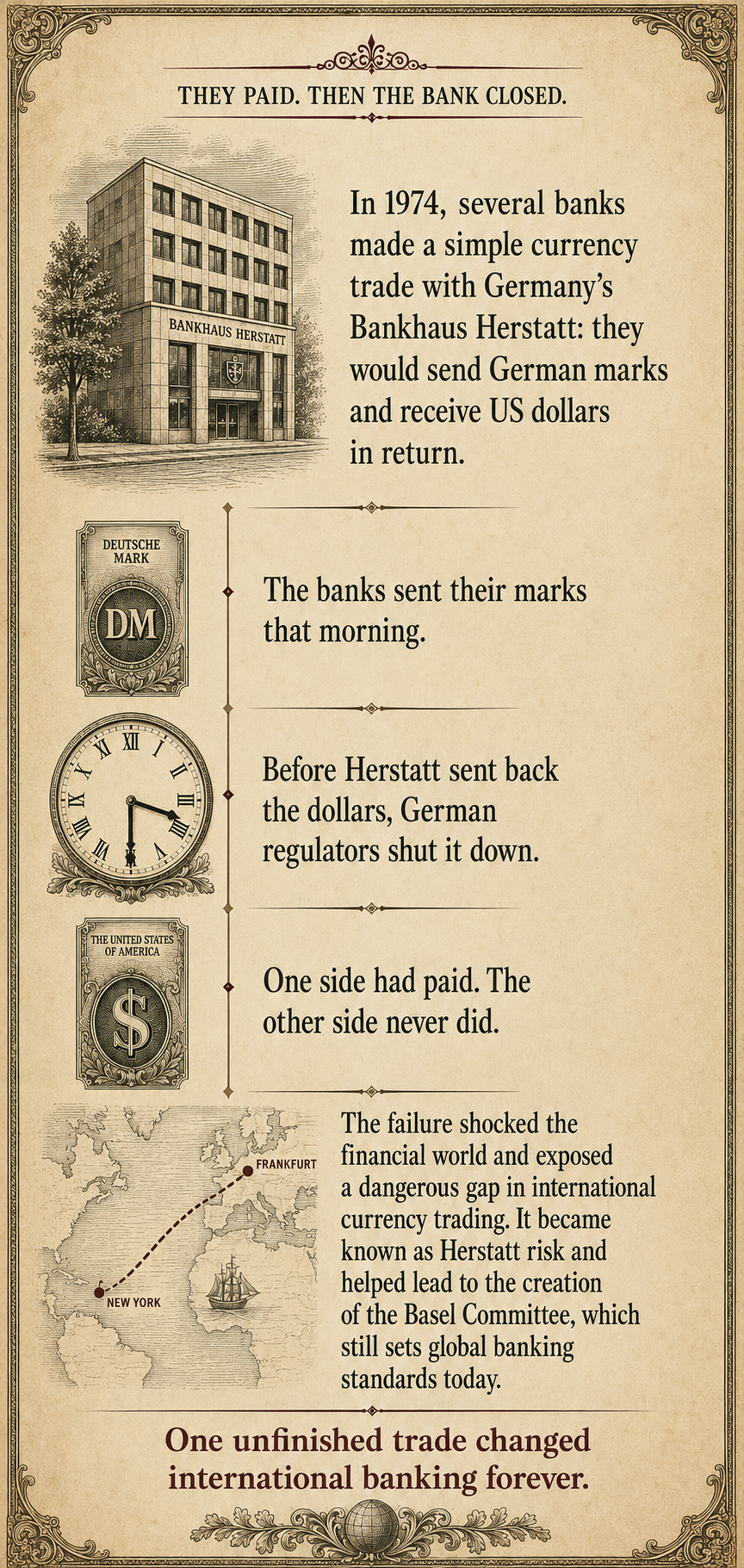
» MARKET TIDBIT

Market Tidbit - They Paid. Then the Bank Closed. - the 1974 Bankhaus Herstatt story that created Herstatt risk and led to the Basel Committee (tap to enlarge)

Tap the tidbit to view full size

The Week Ahead

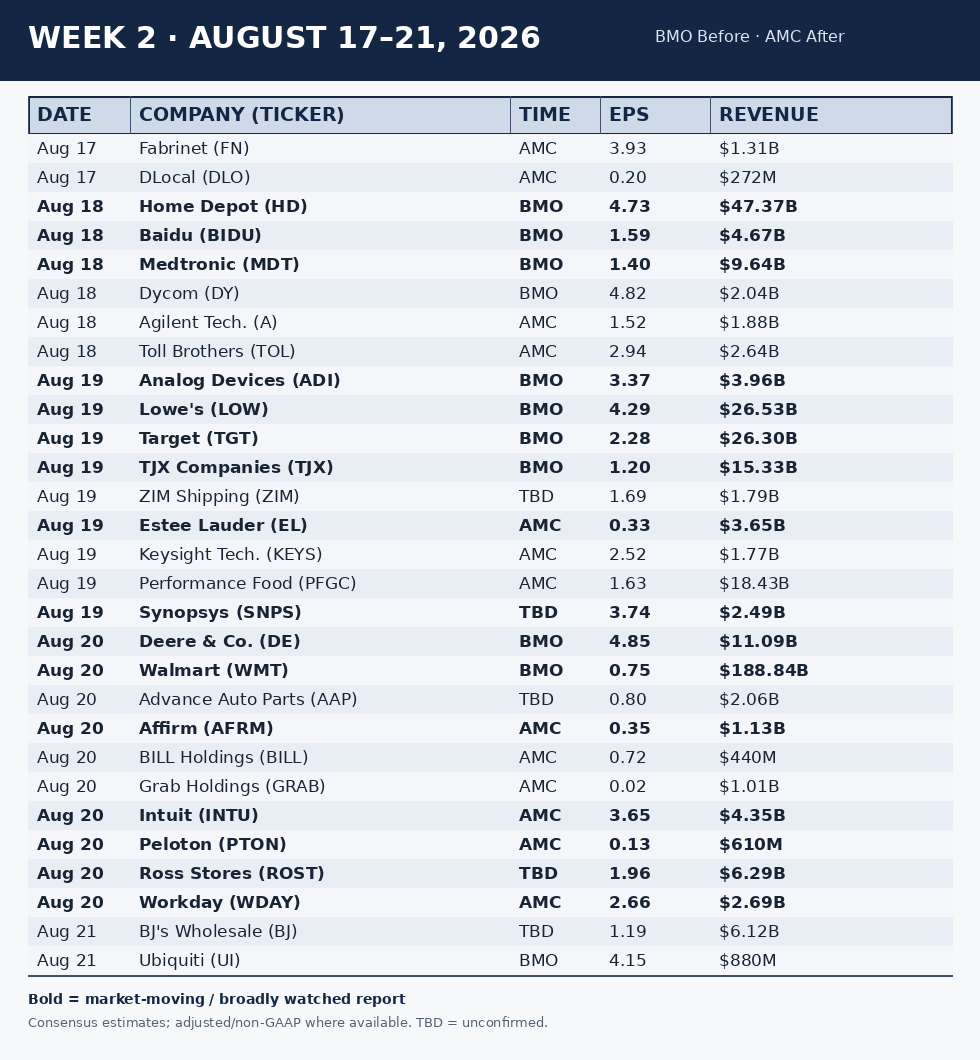
Earnings Calendar · Aug 17–21

Earnings Calendar Aug 17-21 2026 - compact view (tap to enlarge)

Tap the chart to view full size

Today's Report Card

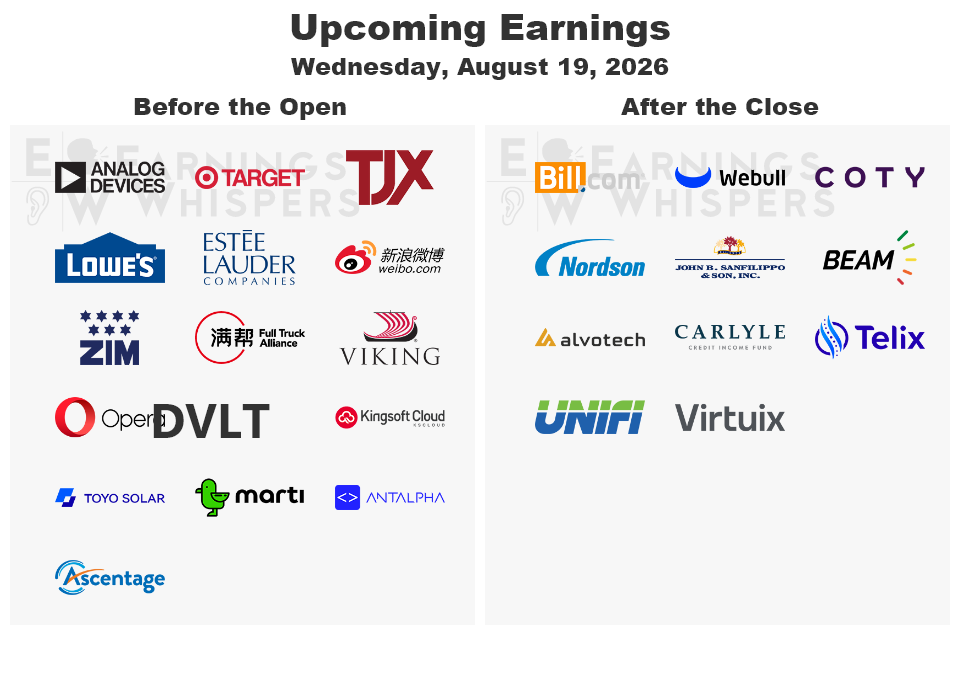
Upcoming Earnings · Wed Aug 19

Upcoming Earnings Wednesday Aug 19 2026 - Before Open (Analog Devices, Target, TJX, Lowe's, Estee Lauder, ZIM, Viking, Opera, DVLT, Kingsoft Cloud, Toyo Solar, Marti, Antalpha, Ascentage) and After Close (Bill.com, Webull, Coty, Nordson, John B Sanfilippo, BEAM, Alvotech, Carlyle, Telix, UNIFI, Virtuix) - tap to enlarge

Tap the chart to view full size

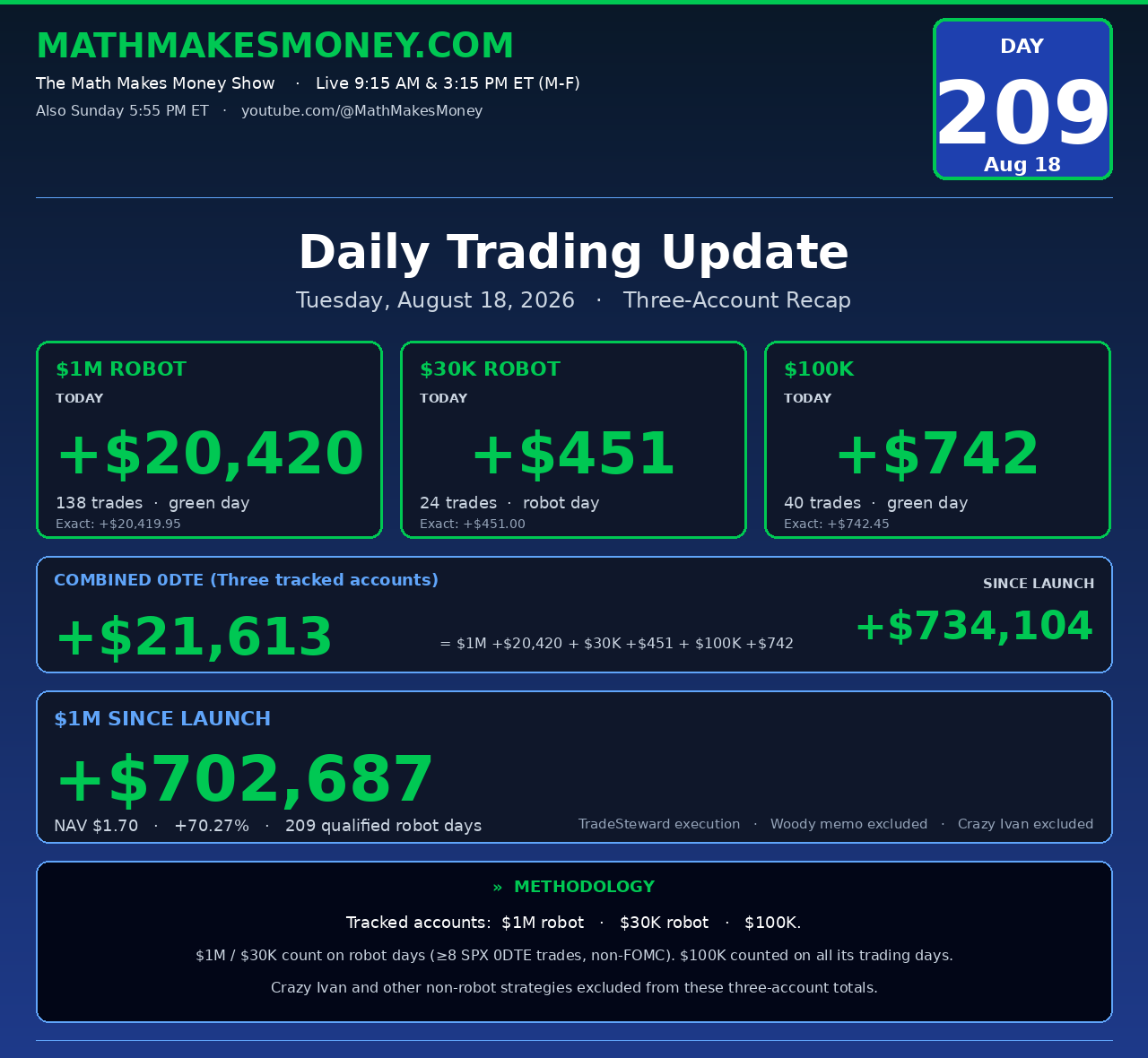
» DAY 209 · TUE AUG 18 · DAILY TRADING UPDATE

Daily Trading Update Day 209 - Tue Aug 18 2026 - $1M +$20,420, $30K +$451, $100K +$742, combined +$21,613

Tap the dashboard to see the full summary online

The Math Makes Money Show (tap to watch on YouTube)

» Tap to watch the live daily show at 9:15 AM and 3:15 PM ET Monday through Friday, and Sunday at 5:55 PM ET

Free Community

Join our Discord with over 1,000 like-minded traders who believe that math makes money when it comes to trading

Trade ideas, screenshots, daily banter. Zero cost.

Join the Discord →

MATH MAKES MONEY

Rob and Maria Helmick and Nick Battista · The Trading Addict Newsletter

MathMakesMoney.com

Educational only. Not investment advice. Trading options involves substantial risk. Past performance does not guarantee future results.