Issue No. 57 • Wednesday August 12, 2026 The Trading Addict Newsletter by Maria Helmick 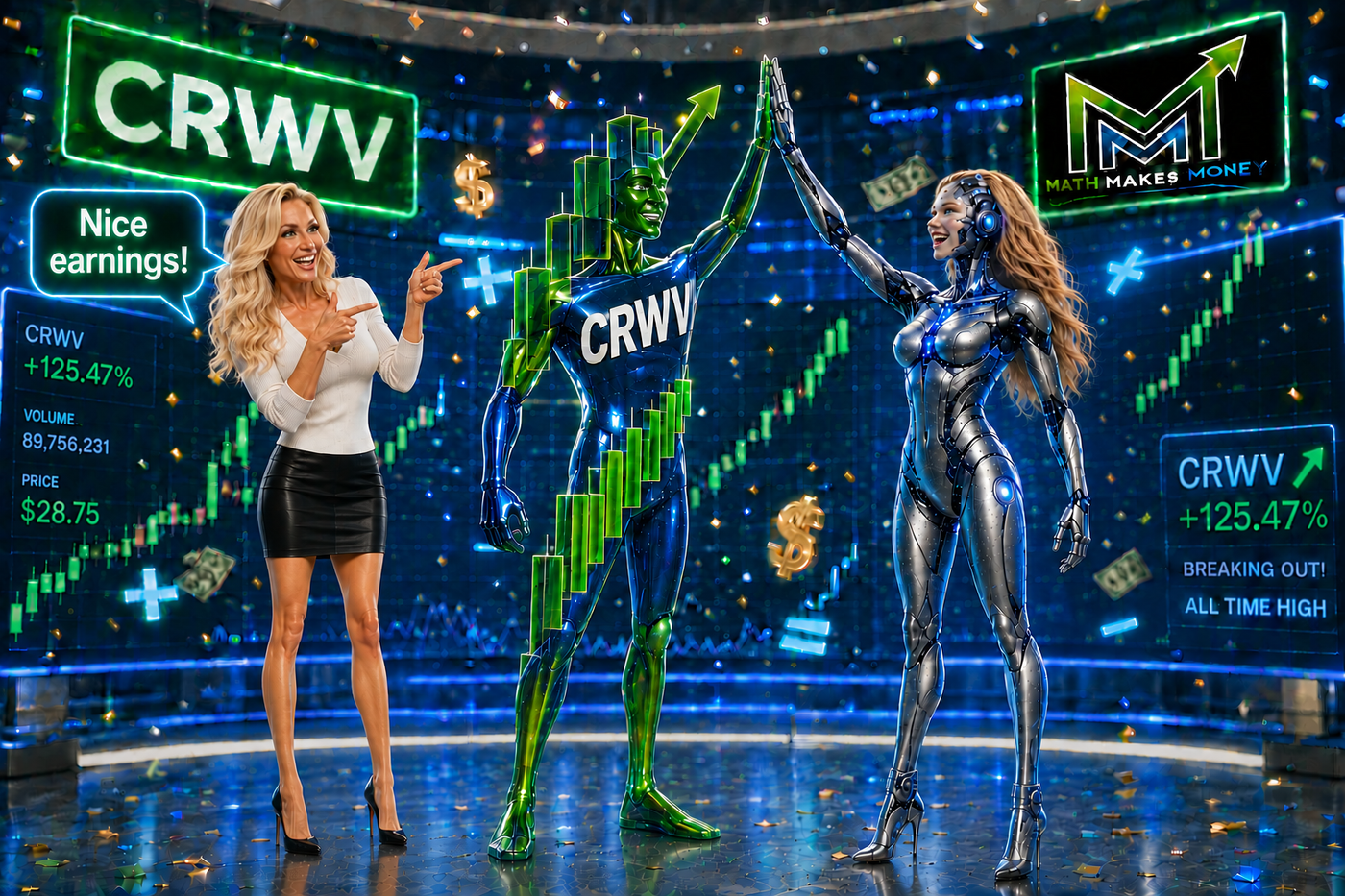 Tap the image to view full size Earnings Briefing · August 11, 2026 · AI Infrastructure AI Infrastructure Demand Stays Red-HotCoreWeave pairs explosive backlog growth with heavy financing needs. Super Micro combines record demand with a sharp margin recovery. | $2.58B CRWV Q2 Revenue | $104B Backlog (+246%) | +12% AH CRWV After-hours |
CoreWeave: Exceptional demand, expensive expansionQ2 revenue more than doubled YoY and edged past consensus. Adjusted net loss of $567M was narrower than the $677M analysts expected. Backlog climbed 246% to $104B, with more than $25B of new commitments added early in Q3. CoreWeave also became the first cloud provider to test Nvidia's Vera Rubin NVL72 platform. Capacity comes at a steep price: quarterly capex reached $9.4B, contracted power rose to about 3.7 GW, and the company has raised more than $10B through unsecured debt and convertible bonds. Investor Lens Growth is exceptional, but leverage, interest expense, continuing losses and customer concentration keep the risk profile elevated. |
$11.1B SMCI Q4 Revenue | 17.6% Non-GAAP Margin | $65-72B FY27 Outlook |
Super Micro: Margin recovery strengthens the storyFiscal Q4 revenue nearly doubled YoY to $11.1B. Non-GAAP gross margin reached 17.6% — an encouraging improvement alongside rapid revenue growth. Management forecast $65B–$72B FY27 revenue, supported by record backlog and more than $60B of new orders received during the quarter. Q1 revenue guidance of $14.5B–$15.5B points to continued strength across AI servers and data-center infrastructure. Investor Lens The near-term setup is stronger, but execution, order conversion and the durability of improved margins remain the key watchpoints. |
Market reactions reflect after-hours trading and may change. For informational purposes only. |
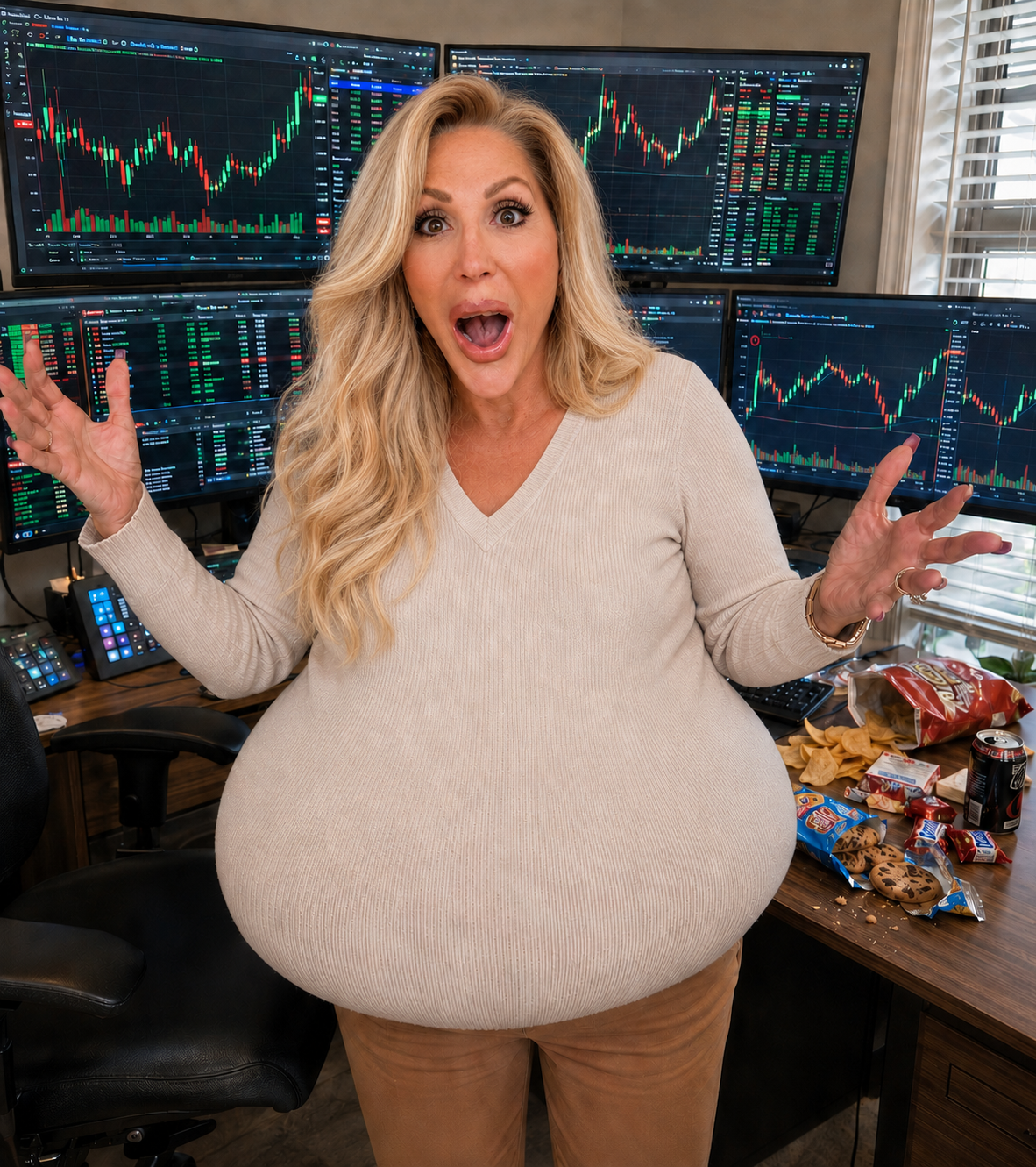 Tap the image to view full size Maria's Market Note · Trader Health · Special Edition Do You Have SMWG? — Stock Market Weight GainThe market may be moving all day. The trader may not be. Long hours, boredom and mindless snacking can quietly add up. | 10:47 A.M. — No setup. No trade. One hand is on the mouse. The other is in the snack bag. Boredom has a calorie countWhen the charts stop moving, food becomes entertainment. The trader is not always hungry — just bored, restless or waiting for another five-minute candle. Because attention stays on the screen, the calories barely register. A handful becomes half the bag. One cookie becomes four. A coffee becomes dessert with a lid. The trade may never trigger. The appetite already did. Remote trading changes the equationRemote trading removes the small movements built into a normal workday. No commute. No walk between meetings. Sometimes no real lunch break. The desk becomes the office, restaurant and command center. Six hours pass. The market travels hundreds of points. The trader travels six feet. Every emotion can become an excuse to eatA loss creates stress, so we eat for comfort. A win creates excitement, so we eat as a reward. A missed rally creates frustration, so we eat while replaying the trade we should have taken. Add energy drinks, delivery meals and late-night charts. Sleep suffers. Energy drops. Exercise disappears. Then the cycle resets before the next opening bell. Weight gain rarely arrives like a crash. It behaves like a bad position moving slowly against you: easy to ignore at first, expensive if you never manage it. |
Put health rules in the trading planTrading has entry rules, exit rules and risk rules. Health needs rules too. 1. Keep food away from the trading desk.
2. Prepare meals and snacks before the opening bell.
3. Stand or walk for five minutes every hour.
4. Use price alerts instead of staring at every tick.
5. Take a real lunch break away from the screens.
6. Keep water nearby instead of endless sugary drinks.
7. Schedule exercise like an important market event.
8. Track sleep and daily movement alongside trading results. |
Maria's Bottom Line Building wealth while destroying your health is not success. It is a bad trade you refused to close. Protect the trader. Without the trader, the account is just a number on a screen. |
|
Market Intelligence · CPI Watch CPI Tomorrow: The Fed Is Split — The Market Is WaitingInflation is improving, but it isn't dead. Wednesday's CPI could give policymakers more room to ease — or another reason to stay cautious. | Wed 8:30 ET CPI Release | ~4.69% 10-Year Yield | 11-Mo High Small-Biz Optimism |
Cleveland Fed President Beth Hammack has remained focused on inflation risk, arguing that price pressures are still too high and policy shouldn't turn easy too quickly. Markets are now watching Wednesday's 8:30 AM ET CPI report for another clue about where rates may go next. Why This One MattersTomorrow's CPI is about one thing: is inflation cooling enough to give the Fed room to ease, or is it still too sticky to declare victory? A softer reading could help bring Treasury yields down, improve the outlook for rate cuts and give stocks some breathing room. A hotter reading could do the opposite — keep yields elevated, push rate-cut expectations further out and put pressure back on growth stocks. The 10-year Treasury yield was near 4.69%, still high enough to matter for stock valuations and borrowing costs. At the same time, small-business sentiment rose to an 11-month high — businesses becoming a little more optimistic even while inflation remains a concern. Maria's Bottom Line The Fed is split, inflation is still the issue, and CPI could help decide which side gets the stronger argument. As traders, we love a little volatility — it brings premium and opportunity. But we also want a healthy economy. Cooling inflation and stable rates may mean less excitement in the options chain, but they can create a better environment for stocks to grow in value. Sometimes we want the bumps in the road for premium, while still hoping the road itself keeps heading higher. |
|
Market Intelligence · Active vs. Passive Is "Set It and Forget It" Investing Getting Too Big?Michael Green, Senior Executive Advisor at Tier 1 Alpha, is challenging the old idea that investors should simply buy the index and never look under the hood. | The Simple AdviceFor years, investors have been told the simplest strategy may be the best: buy an S&P 500 index fund, keep adding money and leave it alone. The argument challenges that thinking — not because passive investing hasn't worked, but because it has become an enormous force in the market. ~63% of U.S. stock-fund assets are now in passive funds (Kiplinger) | 42% of active funds outperformed passive in H1 2026 (AJ Bell/MoneyWeek) |
When the Money Moves AutomaticallyMarket-cap-weighted index funds don't stop and ask whether NVIDIA, Apple or another company looks expensive. When new money enters the fund, it is allocated according to the index — and the biggest companies generally receive the biggest share. Are stock prices being driven only by earnings and fundamentals — or increasingly by the sheer flow of money into the market? Active investors can help keep prices connected to fundamentals by buying undervalued stocks and selling expensive ones. The model assumes that this stabilizing force weakens as passive ownership grows. In the 2026 paper, the model suggests index volatility could begin rising sharply when passive ownership reaches roughly 65%. At about 90%, it projects much faster increases in volatility and more extreme boom-and-bust cycles. Why Passive Still WorksPassive investing remains low-cost, diversified and notoriously difficult for active managers to beat consistently. Broad index funds also reduce dependence on any single company or manager while making it easier to invest consistently over time. Those benefits do not erase concerns about market structure; they explain why the debate is about understanding the trade-offs, not declaring passive investing good or bad. What the Argument Really SaysThe market is not simply earnings, P/E ratios and company fundamentals anymore. ETF flows, algorithms, options positioning, liquidity, bot trading and enormous amounts of money moving automatically now matter too. Passive investing may still be a perfectly good long-term strategy — but the larger it becomes, the more important it is to understand how those automatic flows can affect the stocks and indexes traders are watching every day. Maria's Bottom Line I've heard the same advice for years: "Just invest in the S&P 500. Buy it, hold it and don't complicate things." That approach may make sense for many investors, but simply following a familiar strategy has never been enough for me. I want to know what I own, why I own it and whether it still fits the future I am working toward. Passive investing has earned its place by offering simplicity, diversification and low costs. But simplicity should not mean disengagement. The real choice is not active versus passive — it is whether you are making decisions deliberately or relying on habit. For me, staying curious is part of protecting capital. Markets evolve, leadership shifts and yesterday's assumptions do not always survive tomorrow's reality. |
|
» MARKET TIDBIT 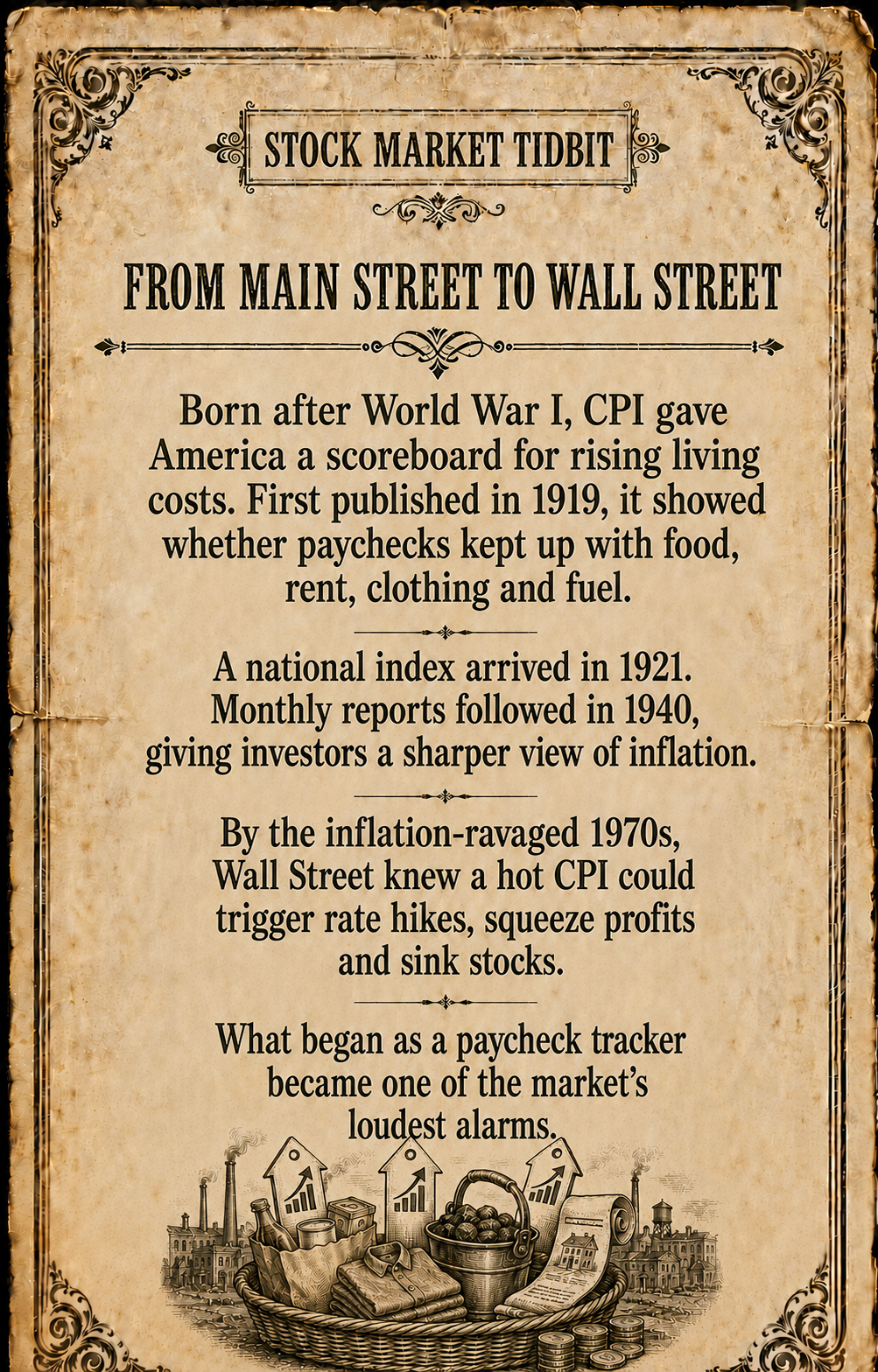 Tap the tidbit to view full size The Week Ahead Earnings Calendar · Aug 10–14The names still worth putting on your radar this week. | 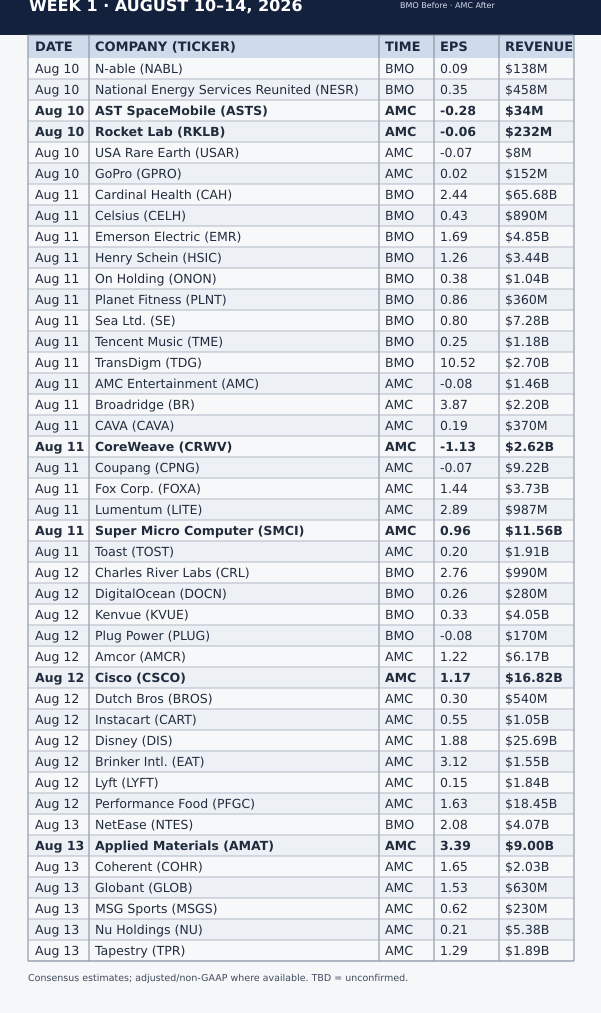 Tap the chart to view full size Still ahead this week: AMAT + NU + COHR Wed 8/13 AMC. |
» DAY 204 · TUE AUG 11 · DAILY TRADING UPDATE 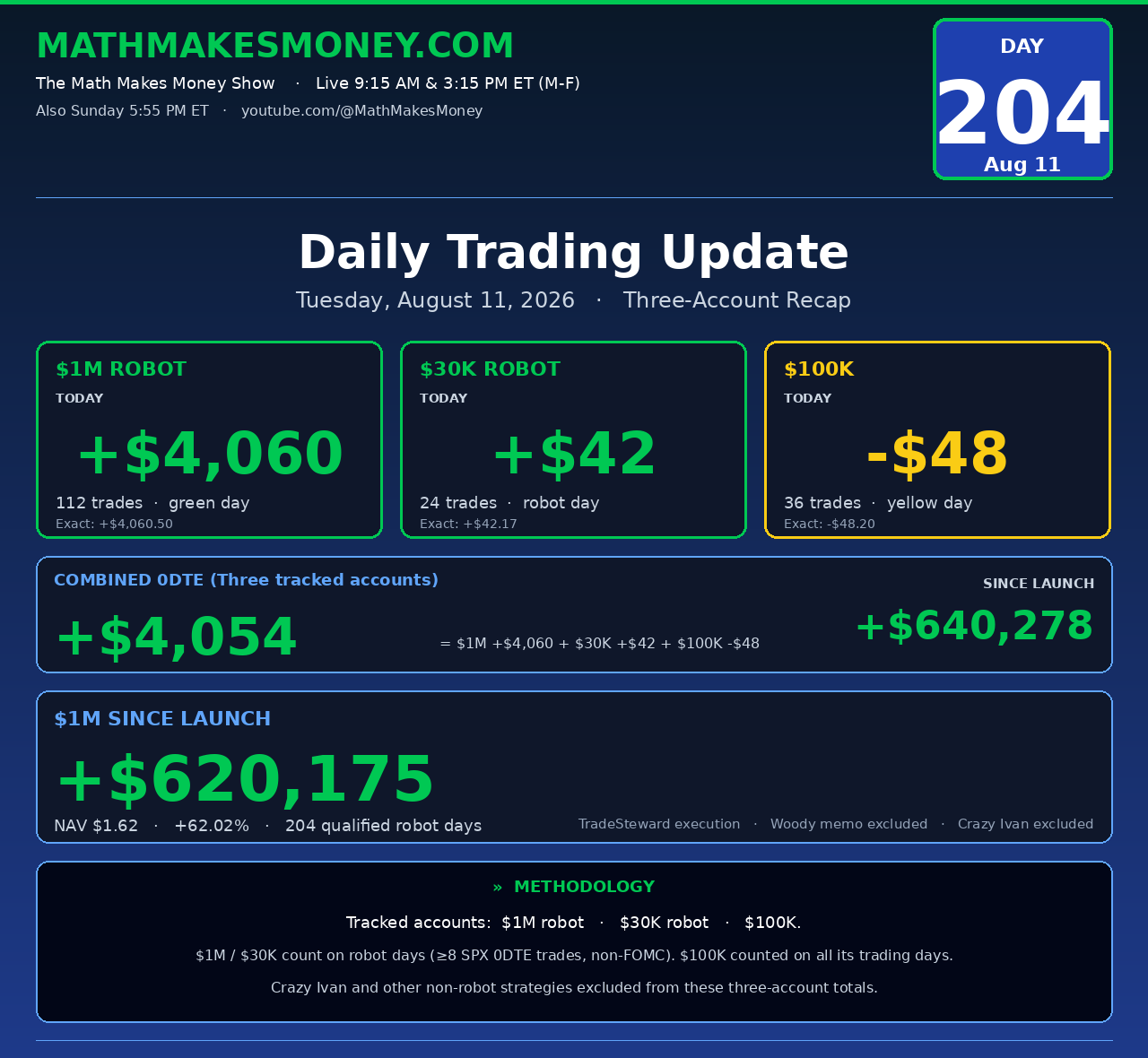 Tap the dashboard to see the full summary online 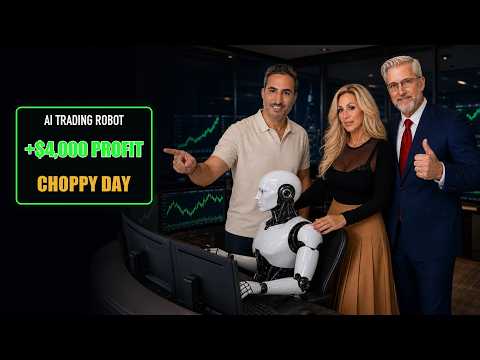 » Tap to watch the live daily show at 9:15 AM and 3:25 PM Monday through Friday, as well as Sunday at 5:55 PM ET » TRADES OF THE WEEK Week of August 10 — Two SPX 0DTE trades | | Entry Time | Strategy | | 11:25 | 225 M 95 50 00 | | 15:23 | 225 M 95 50 00 |
Two SPX 0DTE plays — same 225 M 95 50 00 strategy, morning and afternoon. |
Free Community Join our Discord with over 1,000 like-minded traders who believe that math makes money when it comes to trading Trade ideas, screenshots, daily banter. Zero cost. Join the Discord → |
MATH MAKES MONEY Rob and Maria Helmick and Nick Battista · The Trading Addict Newsletter MathMakesMoney.com Educational only. Not investment advice. Trading options involves substantial risk. Past performance does not guarantee future results. |
|