Issue No. 49 • Friday July 31, 2026
The Trading Addict Newsletter by Maria Helmick
Tap the image to view full size
|
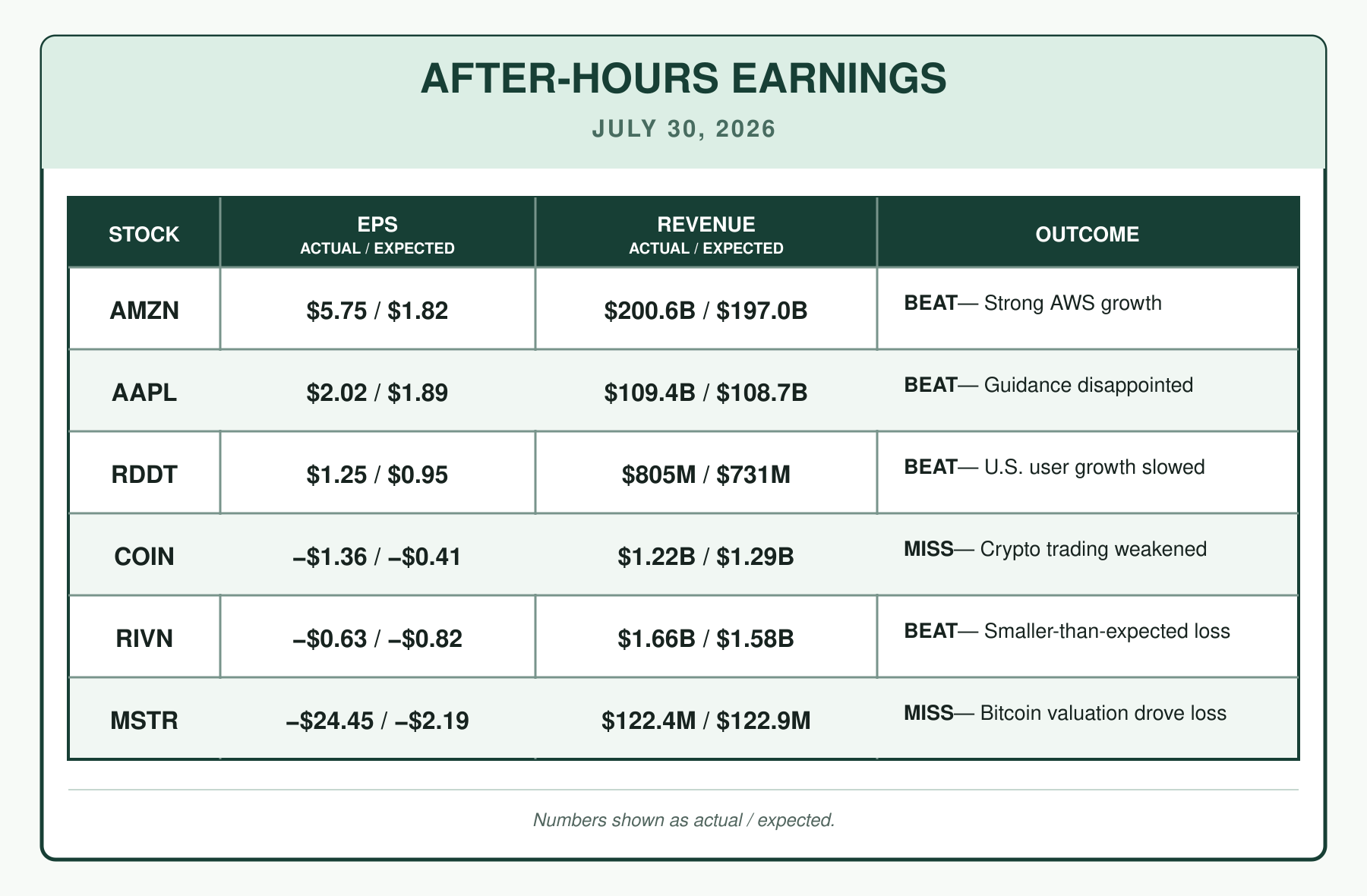
Thursday After-Hours · July 30, 2026
The After-Hours Earnings Report
|
Amazon (AMZN) — BEAT
EPS $5.75 vs $1.82 expected. Revenue $200.6B vs $197.0B expected. Strong AWS growth was the driver.
Apple (AAPL) — BEAT
EPS $2.02 vs $1.89. Revenue $109.4B vs $108.7B. Guidance disappointed some investors.
Reddit (RDDT) — BEAT
EPS $1.25 vs $0.95. Revenue $805M vs $731M. U.S. user growth slowed.
Coinbase (COIN) — MISS
EPS -$1.36 vs -$0.41. Revenue $1.22B vs $1.29B. Crypto trading weakened.
Rivian (RIVN) — BEAT
EPS -$0.63 vs -$0.82. Revenue $1.66B vs $1.58B. Smaller-than-expected loss.
MicroStrategy (MSTR) — MISS
EPS -$24.45 vs -$2.19. Revenue $122.4M vs $122.9M. Bitcoin valuation drove the loss.
|
|
The AI Trading Institute
AUGUST COHORT WAITLIST OPEN
The July cohort sold out. Add your name to the August waitlist and we'll notify you the moment enrollment opens.
Join the August waitlist →
|

Tap the image to view full size
|
AI · Leverage · Wall Street
The 24-Year-Old Behind a $20 Billion Hedge Fund
Leopold Aschenbrenner's AI thesis produced extraordinary gains. Then leverage turned a market reversal into a very expensive lesson.
|
|
Most 24-year-olds are still trying to figure out what they want to do with their lives. Leopold Aschenbrenner built a hedge fund reportedly worth more than $20 billion — and initially delivered returns that seasoned Wall Street veterans would have trouble believing.
Born in Germany, Aschenbrenner graduated from Columbia University at 19 after studying mathematics, statistics and economics. He later spent roughly a year at OpenAI, gaining an early look at the technology he believed would reshape the global economy.
Despite having no traditional professional investing experience, he reportedly raised $1.5 billion in 2025. Ten months later, his fund, Situational Awareness, reportedly managed more than $20 billion. According to The Wall Street Journal, it returned more than 1,000% after fees during its first two years, including a reported 270% gain in 2026 through May.
Those gains came from concentrated, heavily leveraged bets on the infrastructure needed to build advanced AI. The portfolio included semiconductor, memory-chip, energy and technology companies positioned to benefit from AI's enormous computing and electricity demands.
The fund also invested in Anthropic when the private AI company was reportedly valued at approximately $61 billion. Its valuation later climbed sharply, creating another powerful winner.
Aschenbrenner laid out his thinking in Situational Awareness, the 165-page essay he published in 2024. He argued that AI could experience another 100,000-fold increase in effective computing power within four years. That prediction became the foundation of his investment strategy.
The early results attracted serious Wall Street attention. Jane Street reportedly invested, and experienced executives from Goldman Sachs and Citadel joined the operation. Yet Situational Awareness reportedly employed only eight people, with just four working in investment roles.
Leopold Aschenbrenner may be one of the most knowledgeable people in AI, but he was just schooled on a fundamental Wall Street truth: Being the smartest person in the room does not make you immune from a brutal trade.
When AI stocks sold off sharply, the fund's leverage magnified the losses. On Thursday, Ken Griffin's Citadel bought a portion of Situational Awareness's public stock portfolio. The fund kept its private investments, including its Anthropic stake, but part of the public portfolio is now in Citadel's hands.
Wall Street has a colorful way of describing a leveraged position that reverses with this much force: getting your face ripped off. That is essentially what happened here, with Citadel stepping in to acquire part of the public-stock portfolio after the losses mounted. The exact damage has not been publicly disclosed, and Situational Awareness remains in business, but the episode shows how quickly leverage can turn a brilliant thesis into a painful lesson.
|
Maria's Bottom Line
This may not have ended the way Leopold Aschenbrenner envisioned, but he is only 24 — and this was his first go-around. We all learn some hard lessons when it comes to trading, and the most valuable ones are usually learned through experience, not from a textbook. I have a feeling this will not be the last time we hear his name. Whether it is on Wall Street or somewhere else in the AI industry, I expect we will be seeing him again.
|
Reporting referenced: The Wall Street Journal, Reuters and Business Insider, July 2026. Exact fund losses have not been publicly disclosed.
|

Tap the image to view full size
|
Space & Defense
Rocket Lab Wins $266M Space Force Contract
|
|
$266M
New Contract
|
12 + 6
Launches + Options
|
$2.2B
Q1 Backlog
|
Rocket Lab initially moved higher after securing its largest launch contract to date. The stock later gave back those gains before rebounding 10.4% Thursday to close at $64.68.
The daily stock movement is interesting, but the contract is the real story. Rocket Lab is becoming a much more serious player in defense and space.
The U.S. Space Force awarded the company a $266 million contract for 12 HASTE suborbital launches, with options for six more. The first mission is expected no earlier than the end of 2026, with most launches taking place from Kodiak, Alaska.
HASTE is the suborbital version of Rocket Lab's Electron rocket. Instead of placing satellites into orbit, it supports hypersonic testing, missile-defense development and other national-security missions.
Earlier this year, Rocket Lab secured a separate $190 million contract for 20 HASTE launches. Together, these awards show that HASTE has moved well beyond the experimental stage and is developing into a real defense business.
The Business Behind The Contract
Rocket Lab reported first-quarter revenue of $200.3 million, up 63.5% from the previous year. Its backlog reached a record $2.2 billion, up approximately 20% from the previous quarter, while its GAAP gross margin improved to a record 38.2%.
The company now makes money from Electron launches, HASTE defense missions, satellite manufacturing, spacecraft systems and government contracts. It is no longer simply a small-rocket company.
Rocket Lab is still losing money, reporting a $45 million first-quarter net loss and an adjusted EBITDA loss of approximately $11.8 million. The growth is real, but the company still has to turn it into consistent profits.
That brings us to Neutron, Rocket Lab's larger reusable rocket and the biggest test ahead. A successful launch would allow the company to compete for much larger missions and move closer to the major launch providers. Its first flight is currently targeted for the fourth quarter of 2026 following a qualification-testing delay.
Neutron has the potential to dramatically expand Rocket Lab's market — but first, it has to fly.
SpaceX remains the giant of the industry. It operates businesses, including Starlink and Starship, that Rocket Lab cannot currently match. SpaceX also just received a $1.6 billion Space Force contract covering 18 Falcon 9 launches.
But Rocket Lab does not have to replace SpaceX to become a successful company or investment. It needs to keep winning contracts, complete those missions, successfully launch Neutron and move toward profitability. This $266 million award is another meaningful step in that direction.
Rocket Lab reports second-quarter results after the market closes on Monday, August 10. I will be watching for an updated backlog, defense revenue, margins, cash burn and, most importantly, progress on Neutron.
|
Maria's Bottom Line
I have Rocket Lab in my portfolio, along with short puts. I would be happy to add more shares at a lower effective price.
The company is winning real contracts and building a stronger defense and space business. Neutron and profitability remain the big tests, but I like the direction Rocket Lab is heading — and I am willing to be patient.
|
To the moon, Alice — to the moon! Oh no, that's a different show. Sorry.
|
|
Maria's Bull Case
Palantir: The Bull Case Is Still Standing
The valuation is rich. The expectations are high. But this company is delivering the kind of growth that makes Wall Street keep coming back.
|
|
$1.63B
Q1 Revenue
|
+133%
U.S. Commercial
|
+84%
U.S. Government
|
206
$1M+ Deals
|
The growth is not just a good story
Palantir's Artificial Intelligence Platform is turning its technology into serious business. First-quarter revenue reached $1.63 billion, up 85% from a year earlier. U.S. commercial revenue surged 133% to $595 million, while U.S. government revenue climbed 84% to $687 million. Those are the numbers behind the excitement.
The deal flow may be even more important. Palantir signed 206 contracts worth more than $1 million; 72 topped $5 million and 47 exceeded $10 million. Total contract value reached $2.41 billion. This is not a promise about someday. It is customers committing real money today.
Net income reached roughly $871 million, up 53%, and management delivered that growth with fewer employees than it had two years ago. Rapid expansion, larger contracts and operating discipline — that is exactly what I want to see in an AI company.
Why the bull case still has room
Palantir guided for second-quarter revenue near $1.8 billion and full-year revenue of approximately $7.65 billion. Oppenheimer analyst Param Singh expects another beat-and-raise quarter and placed a $200 target on the shares. That target is no guarantee, but it shows how strongly Wall Street is responding to the momentum.
Palantir also has something many AI names are still trying to find: a product that works inside complicated, high-stakes organizations. It helps government agencies and businesses connect scattered data, make decisions in real time and put AI to work. That is much sturdier than simply attaching the letters A and I to a presentation.
Yes, the valuation deserves respect
A forward price-to-earnings ratio near 90 leaves little room for a weak quarter. If growth slows sharply, the multiple can contract and the stock can fall even while the company remains profitable. I would not chase Palantir blindly or own it without accepting volatility.
But an expensive valuation is not a broken business. Premium companies can stay premium when they keep beating expectations. Palantir now has to prove that its growth, profits and contracts can support the price.
|
Maria's Bottom Line
Michael Burry is wrong to call Palantir a "sandcastle." Sandcastles do not produce $1.63 billion in quarterly revenue, sign 206 million-dollar-plus deals and generate record profits. He may be right that the stock is expensive, but he is confusing valuation risk with business weakness. Palantir has real customers, real contracts and real earnings. The tide may shake the stock, but this company is built on far more than sand.
|
|
|
■ True or False? · Portfolio IQ
The Delta-Neutral Overnight Trap
|
|
The Question
A portfolio that is delta-neutral when the market closes will remain protected overnight, even if the market opens sharply lower the next morning.
Delta-neutral describes the portfolio's exposure at one moment in time. It is not permanent protection.
What can change while you sleep?
|
Gamma Risk
A large overnight move changes option deltas — sometimes dramatically.
|
|
Volatility
A volatility spike can reprice options before the opening bell.
|
|
Correlation
Positions that normally offset each other may suddenly move together.
|
|
Gaps
The market can reopen beyond the price where you could have adjusted the hedge.
|
|
The Trap
You may go to bed delta-neutral and wake up heavily directional.
Market-neutral at the close does not mean risk-neutral overnight.
|
|
» DAY 196 · THU JUL 30 · DAILY TRADING UPDATE
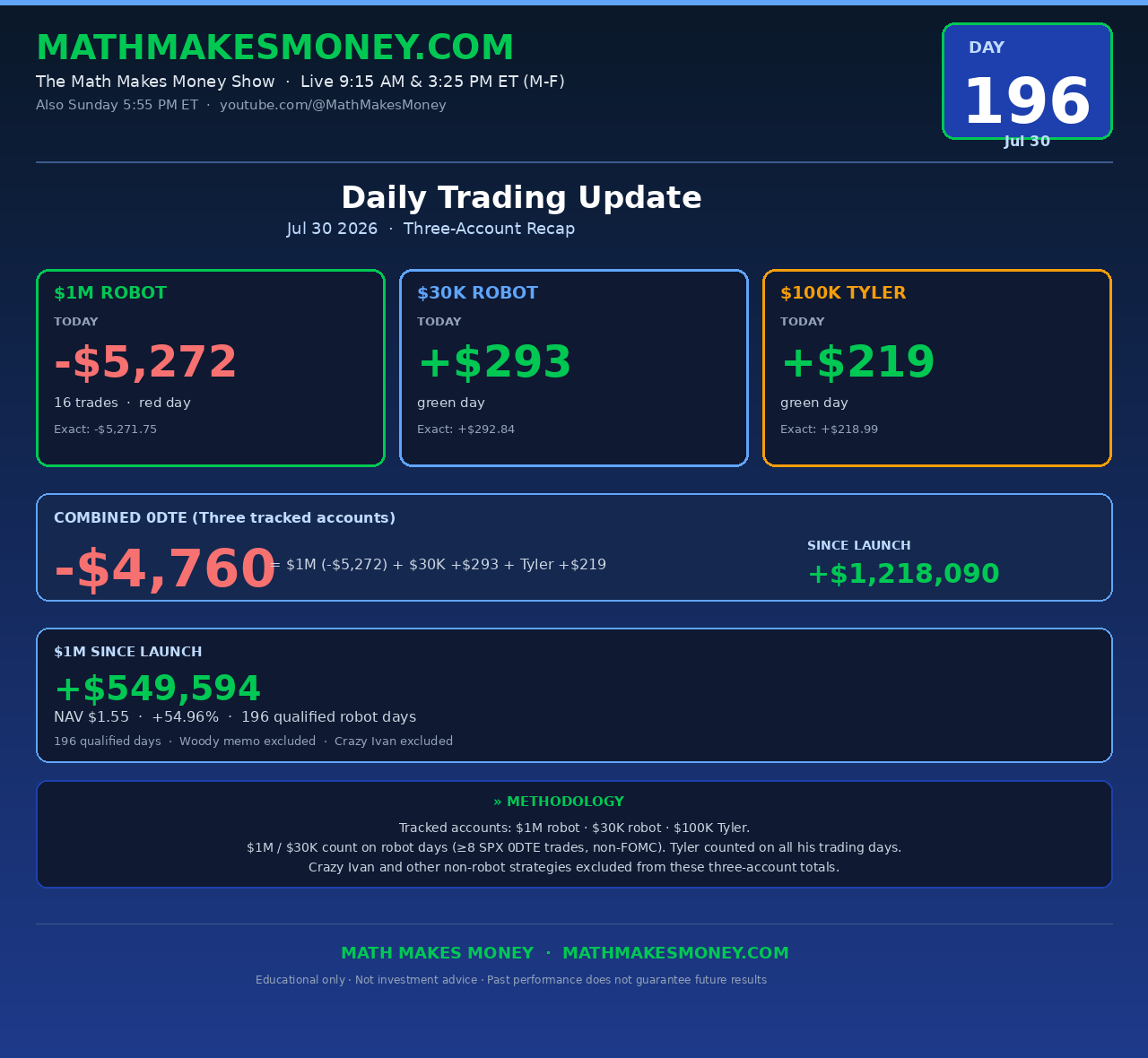
Tap the dashboard to see the full summary online

» Tap to watch the live daily show at 9:15 AM and 3:25 PM Monday through Friday, as well as Sunday at 5:55 PM ET
» TRADES OF THE WEEK
|
Week of July 27 — Two SPX 0DTE trades
|
| Entry Time |
Strategy |
| 10:57 |
185 M 95 50 00 |
| 15:09 |
185 M 95 50 00 |
Two SPX 0DTE plays — morning and late-day. Same strategy, different entry times.
|
|
Free Community
Join a community of 900+ like-minded traders in our Discord who trade based on math
Trade ideas, screenshots, daily banter. Zero cost.
Join the Discord →
|
MATH MAKES MONEY
Rob and Maria Helmick and Nick Battista · The Trading Addict Newsletter
MathMakesMoney.com
Educational only. Not investment advice. Trading options involves substantial risk. Past performance does not guarantee future results.
|
|