Issue No. 47 • Wednesday July 29, 2026
The Trading Addict Newsletter by Maria Helmick

Tap the image to view full size
WHAT CATHIE WOOD IS BUYING — AND WHY IT MATTERS
ARK Invest · Market Strategy · Innovation
|
|
While much of Wall Street was reducing risk ahead of the Federal Reserve meeting, Cathie Wood was buying. ARK Invest used the recent technology selloff to add aggressively to Tesla and several other AI leaders, reinforcing the firm's conviction that innovation — not short-term market swings — will drive the next decade of growth.
ARK Bought the Tesla Drop
The firm's largest recent purchase was Tesla. ARK bought roughly 160,000 shares across four of its actively managed ETFs after the stock sold off following earnings. The purchase was valued at approximately $50.5 million to $52.7 million, with most going into ARK's flagship ARK Innovation ETF.
ARK treated the selloff as a buying opportunity, which fits Cathie Wood's long-held view that Tesla is far more than an automaker. Her thesis centers on autonomous driving, artificial intelligence, energy storage and robotics, although much of that future growth is already reflected in the stock price.
SpaceX Becomes Another Major ARK Bet
ARK has also been increasing its exposure to SpaceX. The company gives ARK exposure to reusable rockets, government and defense contracts, commercial launches and Starlink, its satellite internet network.
ARK has estimated that SpaceX could eventually reach a multitrillion-dollar valuation by 2030. Ambitious, but it explains why Cathie Wood continues to view space and satellite communications as one of her highest-conviction themes.
ARK Is Buying More Than Elon Musk
Tesla and SpaceX grabbed the headlines, but ARK also added Meta Platforms and Tempus AI. Meta gives ARK exposure to a profitable technology giant spending heavily on AI, while Tempus AI brings that same theme into healthcare through data-driven personalized medicine.
Together, the purchases show that ARK is building its AI exposure across several industries — not just betting on one company.
ARK Was Selling Too
ARK trimmed positions in Figma, Shopify and other technology and healthcare holdings. That does not necessarily mean Cathie Wood has turned bearish. ARK regularly trims positions after strong rallies to keep individual holdings from becoming too large. A sale does not automatically signal a negative outlook, just as a purchase does not guarantee a stock has reached its bottom.
High Conviction Comes With High Volatility
ARK is betting on industries Cathie Wood believes could shape the next decade — artificial intelligence, robotics, space, digital finance and precision medicine. The upside could be enormous, but many of these companies are still priced on future growth rather than current profits. That makes ARK's portfolio especially vulnerable when interest rates rise or investors become less willing to wait.
|
Maria's Take
I Will Continue Watching What She Buys — Especially During a Selloff
|
|
I follow Cathie Wood because her trades often give me new investment ideas.
I have found that women investors bring a different perspective to the market. We often have more patience and are willing to let a long-term investment story develop instead of reacting to every short-term move.
Cathie's recent buying tells me she remains highly confident in Tesla, SpaceX, artificial intelligence and other disruptive technologies.
I would not blindly copy every ARK trade, but I will continue watching what she buys — especially when she is buying during a selloff.
|
|
|
The AI Trading Institute
AUGUST COHORT WAITLIST OPEN
The July cohort sold out. Add your name to the August waitlist and we'll notify you the moment enrollment opens.
Join the August waitlist →
|

Tap the image to view full size
MICHAEL BURRY IS BETTING AGAINST MICRON — AND QUESTIONING THE AI BOOM
By Maria Helmick · July 28, 2026
|
|
When Michael Burry makes a major market bet, investors pay attention. He earned that reputation by predicting the 2008 housing collapse long before most investors saw it coming. Now, he is taking a bearish position against several companies tied to the AI boom.
Burry recently increased his short position in Micron Technology (MU) while also adding to bearish positions in Nvidia, the SOXX Semiconductor ETF, and Caterpillar. He continues to hold bearish positions in Tesla and Palantir. Together, these trades suggest he is questioning the strength and sustainability of the broader AI investment cycle.
Why Burry Is Concerned
Burry is not arguing that AI is unimportant or that Micron is a weak company. His concern is that the pace of AI spending may be moving faster than the demand needed to support it.
The world's largest technology companies are spending hundreds of billions of dollars on data centers, advanced processors, networking equipment, storage and HBM. That spending has created extraordinary growth for semiconductor companies.
Burry believes the risk lies in how some of that expansion is being financed. He has pointed to private credit, off-balance-sheet arrangements and circular investment structures that may be making demand appear stronger and more durable than it really is.
Micron's Results Remain Extremely Strong
Micron's current financial performance tells a very different story. The company recently reported $41.46 billion in quarterly revenue, compared with $9.30 billion during the same period last year. GAAP net income reached $28.24 billion, operating cash flow climbed to $25.39 billion, and Micron ended the quarter with approximately $30.2 billion in cash.
Management guided for approximately $50 billion in Q4 revenue, an estimated 86% gross margin, and about $31.00 in non-GAAP EPS.
Why Micron Matters
Micron manufactures high-bandwidth memory (HBM). AI processors need extremely fast memory to move massive amounts of data during training and inference. Without that memory, even the most advanced processors cannot operate at full capacity.
Micron has already begun high-volume shipments of its HBM4 products for a major customer platform. HBM4E volume production is expected in 2027.
The Real Debate
The disagreement is not about whether AI has a future. It is about whether current spending levels and stock valuations can continue.
The timing is uncertain. Burry has made several successful calls, but he has also been early. A powerful market trend can continue much longer than a bearish investor expects, even when the underlying concern is valid.
|
Maria's Bottom Line
For Now, It Remains a Loose Prediction — And the Premiums Are Getting Tasty
|
|
Michael Burry's notoriety came from calling out the housing crisis before it collapsed, but today's AI market is not quite the same. The housing breakdown was visible to anyone with access to bank delinquency reports and foreclosure filings. Rising delinquencies, weak lending standards and deteriorating loans were there in black and white.
Today's AI market is different. There is no clear evidence showing that the industry is already weakening. Burry may eventually be right that spending has gone too far, but for now, it remains a loose prediction. Micron is still producing extraordinary revenue, profits and cash flow.
I have to admit, the one good thing about all this negative talk is that the premiums on AI options are getting pretty tasty. Eventually, however, Micron's financial results will matter more than repeated warnings about what might happen.
|
|
Tap the image to view full size
THE VANISHING ATTENTION SPAN OF THE AMERICAN INVESTOR
There was a time when buying a stock meant owning a piece of a business for years. Today, many investors measure success by what happens before lunch.
|
|
Average Holding Period
| Year | Avg. Holding Period |
| 1960 | 8.3 years |
| 1970 | 5.3 years |
| 1980 | 2.8 years |
| 1990 | 2.2 years |
| 2000 | 1.2 years |
| 2010 | 1.0 year |
| 2020 | 0.6 years |
In 1960, the average stock was held for more than eight years. By 2020, that estimate had fallen to about 0.6 years — roughly seven months. That is a complete change in how people approach the market.
Years ago, buying a stock often meant buying into a company story — investors expected to sit through good quarters, bad quarters, recessions and product cycles. Today, many people enter a position already thinking about the exit. The question is no longer only, What can this company become? It is often, What can this stock do by Friday?
From Ownership to Constant Motion
The market itself did not suddenly become impatient — the world around it did. Prices flash on phones. Alerts arrive before breakfast. Social media turns every market move into an emergency, a celebration or a prediction.
Commission-free trading removed one of the final barriers. That change opened the market to millions of people — a good thing — but it also made clicking buy or sell feel almost consequence-free. The easier it became to trade, the harder it became to sit still.
When Activity Replaces Patience
Constant access can create the feeling that an investor should always be doing something. A quiet day can seem unproductive. A position that has not moved for two weeks can feel like dead money.
But a strong business needs time. Frequent trading can also interrupt one of the most powerful forces in wealth building: compounding. An investor who constantly jumps from one idea to another may never stay long enough to see that process develop.
A Falling Stock Is Not Always a Failing Company
A stock may fall because interest rates rise, investors rotate into another sector, or expectations became too high. A quality company can lose 20% of its market value without losing 20% of its customers, factories, patents or long-term opportunity.
But patience is not the same as denial. If revenue is weakening, margins are shrinking, debt is rising or management keeps missing its promises, then the original reason for owning it may no longer exist. The important question is not, Is the stock down? The better question is, Has the business changed?
Trading and Investing Are Not the Same Thing
A trade and an investment can involve the same stock, but they are not the same decision. A trader may enter because of momentum, volatility, a technical level, an earnings event or an options premium. An investor may enter because of the company's balance sheet, earnings power and long-term growth. Both can work. Confusing them usually does not.
Before opening a position, an investor should know why they are entering, how much they are willing to risk, what outcome they are looking for and what would cause them to change their mind. A clear plan does not guarantee a profit, but it prevents every headline and price swing from rewriting the strategy.
Patience Is Still an Edge
Individual investors may not be able to compete with every institution on speed. But they can still compete on behavior. They can refuse to chase. They can keep cash available. They can wait for a better price. The advantage is not simply holding longer. The advantage is making fewer emotional decisions.
|
Maria's Bottom Line
There Is Room for Both Investors and Traders — Know Which One You Are
|
|
I think the market has changed because the people in it have changed. Years ago, most people were naturally investors. Today, many of us are traders looking for the next opportunity and, yes, sometimes the next fast buck.
I do not see anything wrong with that. Simply put, some of us are (TRADING ADDICTS) because we truly love trading. I love the movement, the decisions and the challenge of trying to figure out what the market may do next.
What matters to me is whether a person can actually succeed at it. Loving the market is not enough. A trader still needs discipline, risk control and a strategy that can survive the days when the market does not cooperate.
There is room in the market for both investors and traders. I just believe you should know which one you are — and be good at it.
|
|
Tap the image to view full size
|
Newsletter Challenge
TRUE OR FALSE?
A market-history question built to fool even experienced traders
|
|
The Question
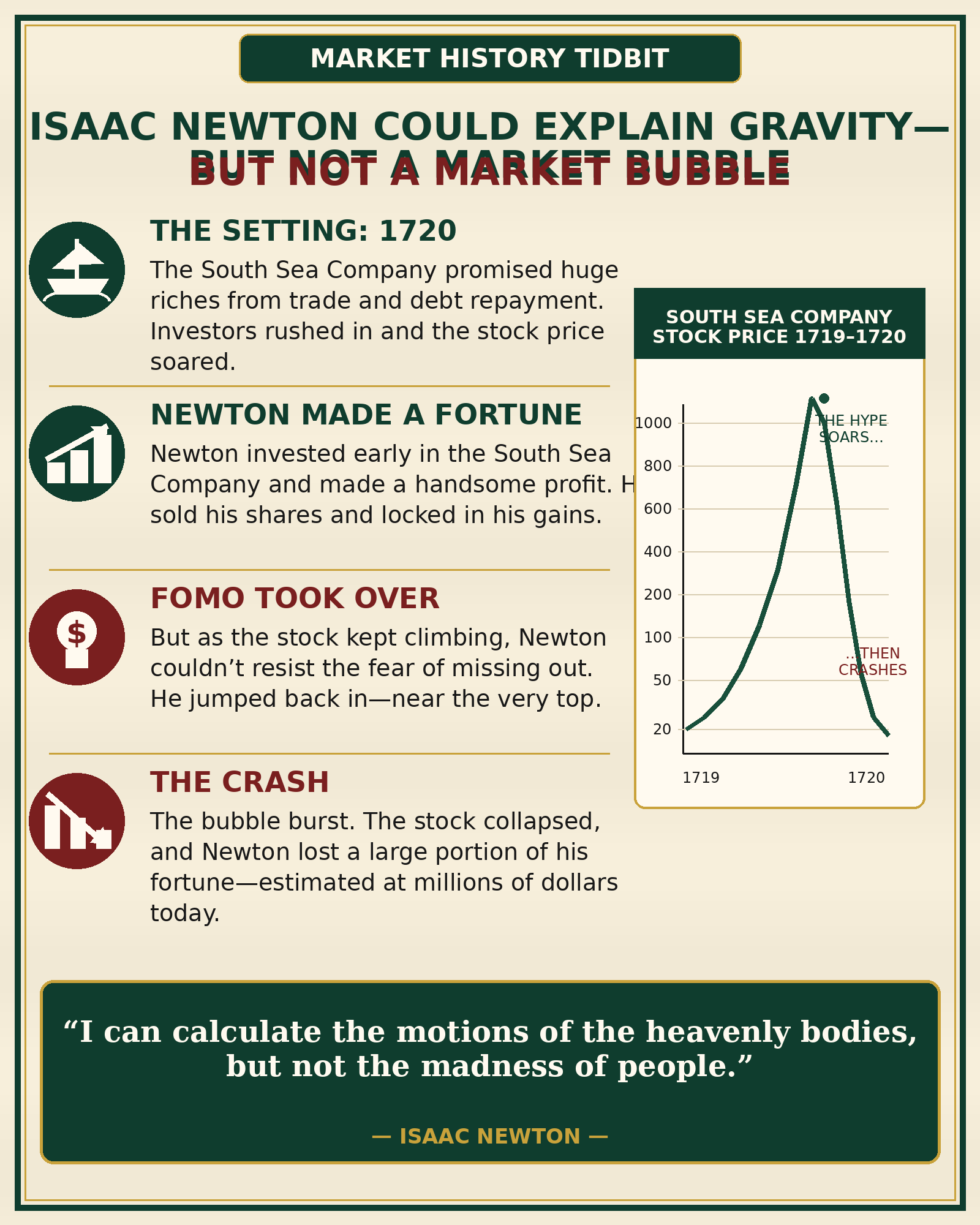
On Black Monday in 1987, the Dow crashed more than 22% in a single day — yet the options market kept functioning normally, traders continued receiving reliable prices, and investors could still enter and exit positions without major disruption.
On October 19, 1987, the Dow plunged 22.6% in one day — but the market was anything but normal.
Orders backed up, prices were delayed, communications systems were overwhelmed, and some traders could not tell what stocks were actually worth.
Options became even more chaotic because market makers were pricing contracts against stale or unreliable stock prices.
The market stayed open, but in many cases, it was barely functioning.
|
The Trading Lesson
A market does not have to close to become nearly untradeable.
During a panic, liquidity can disappear, spreads can explode, and the price on the screen may be nowhere near the price you actually get.
|
Market history can sound unbelievable — until you study what actually happened.
|
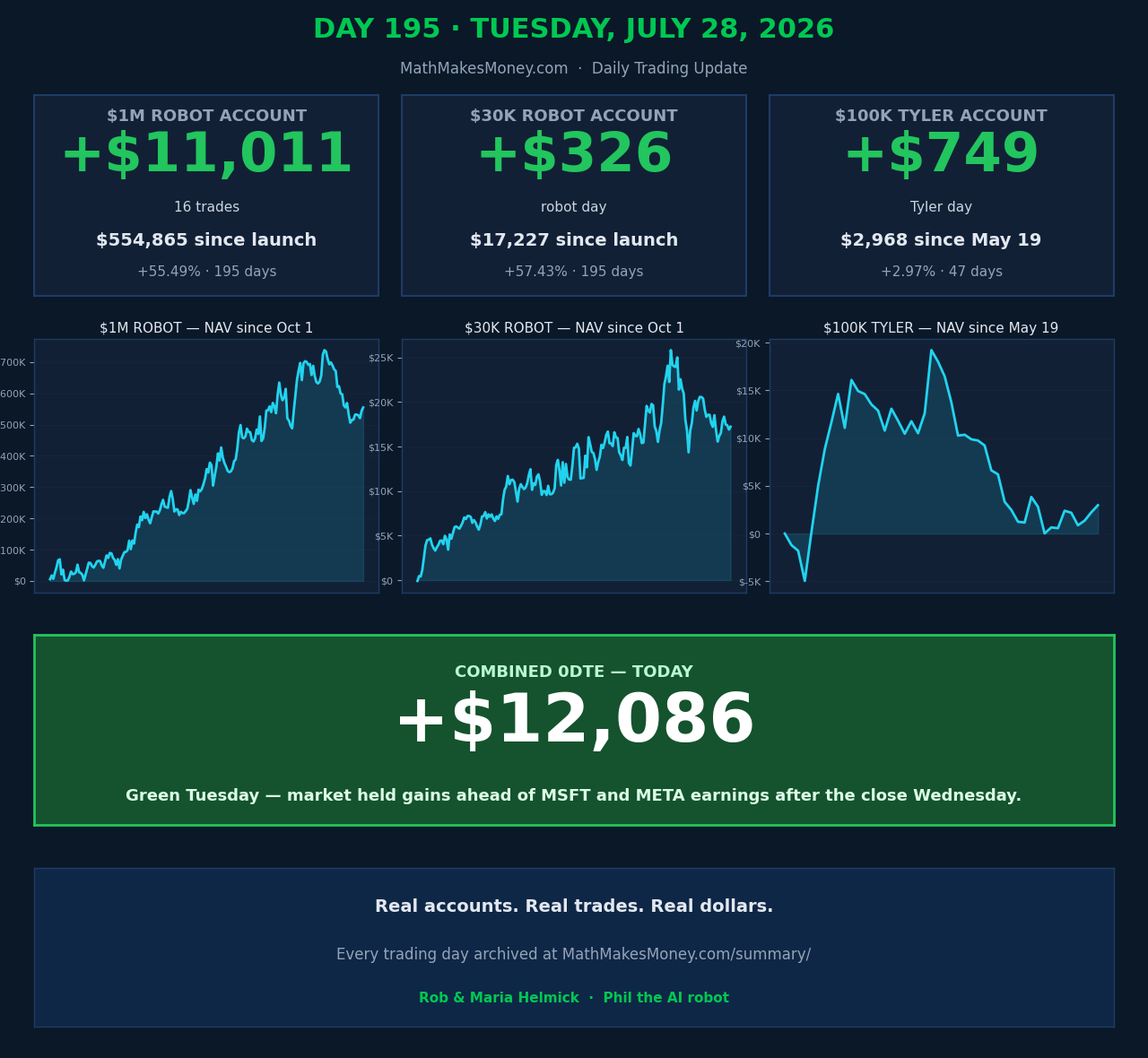
Tap for the full Day 195 dashboard
Green Tuesday · Combined 0dte +$12,086 · $1M NAV $1.55M · +55.49% since Oct 1

» Tap to watch the live daily show at 9:15 AM and 3:25 PM Monday through Friday, as well as Sunday at 5:55 PM ET
» TRADES OF THE WEEK
|
Week of July 27 — Two SPX 0DTE trades
|
| Entry Time |
Strategy |
| 10:57 |
185 M 95 50 00 |
| 15:09 |
185 M 95 50 00 |
Two SPX 0DTE plays — morning and late-day. Same strategy, different entry times.
|
|
Free Community
Join a community of 900+ like-minded traders in our Discord who trade based on math
Trade ideas, screenshots, daily banter. Zero cost.
Join the Discord →
|
MATH MAKES MONEY
Rob and Maria Helmick and Nick Battista · The Trading Addict Newsletter
MathMakesMoney.com
Educational only. Not investment advice. Trading options involves substantial risk. Past performance does not guarantee future results.
|
|