|
Nvidia just made another major move in the global AI race, and this one goes far beyond simply selling GPUs.
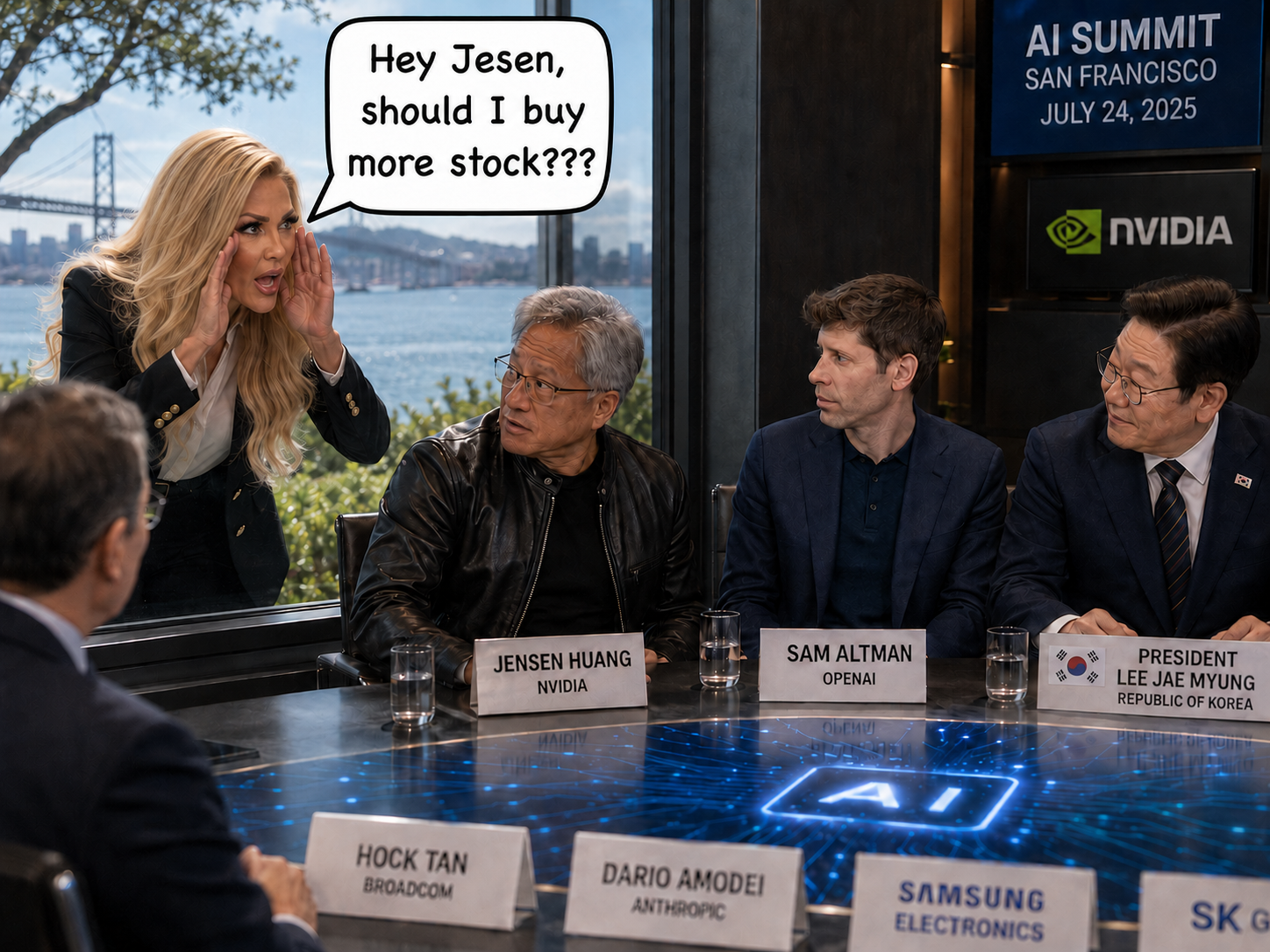
During an AI summit in San Francisco on July 24, South Korean President Lee Jae Myung met with some of the biggest names in technology, including Nvidia CEO Jensen Huang, OpenAI CEO Sam Altman, Broadcom CEO Hock Tan and Anthropic CEO Dario Amodei.
Executives from Samsung, SK Group, Hyundai Motor and Naver were also there. By the end of the summit, South Korea had announced approximately $950 billion in proposed AI and semiconductor partnerships with major U.S. technology companies.
The numbers are huge, but the bigger story is what Nvidia is doing behind the scenes. Jensen Huang is not waiting for AI demand to arrive. He is traveling the world securing the memory, data centers, power and strategic partners Nvidia will need to keep feeding the AI boom for years.
Nvidia Is Securing the Supply Chain
One of Nvidia's biggest future challenges may not be finding customers. It may be securing enough advanced memory, power and data-center capacity to meet demand.
High-bandwidth memory (HBM) sits close to an AI processor and moves enormous amounts of data at extremely high speeds. Without enough HBM, even the most expensive and powerful AI processors can be forced to sit idle while waiting for information.
Nvidia is not waiting for a shortage to slow down its growth. It is attempting to lock down the memory, infrastructure and computing capacity it will need years before that demand arrives. That is smart business, and it gives Nvidia another advantage over competitors that may still be trying to figure out where their future supply will come from.
Nvidia, Samsung and the Bigger AI Buildout
The biggest announcement from the summit was a $500 billion-plus partnership between Nvidia and South Korea's SK Group.
This is much more than a large order for chips or memory. The multiyear plan includes AI data centers, Nvidia's next-generation Vera Rubin systems, SK Hynix high-bandwidth memory, cloud services and the joint development of future AI memory technology.
Nvidia and SK Group signed letters of intent to move the project forward. SK Telecom is expected to build a massive AI data center that could eventually require as much as 2 gigawatts of power, with the first facility expected to begin operating in 2027. We could be looking at hundreds of thousands of advanced processors working together across a huge AI infrastructure network.
The project is expected to pair Nvidia's Vera Rubin platform with SK Hynix's next-generation HBM4 memory.
Samsung made a major announcement of its own, signing a separate agreement with Broadcom covering as much as $200 billion in memory, advanced packaging and semiconductor manufacturing services. Samsung is expected to help Broadcom develop next-generation AI accelerators using its HBM technology, advanced packaging capabilities and manufacturing processes below 2 nanometers.
Together, these agreements show that the next phase of the AI race will not be decided by chips alone. It will depend on which companies can secure the memory, manufacturing capacity, power and data centers needed to deploy those chips on a massive scale. Nvidia is clearly trying to lock down the supply chain, while Samsung is fighting to become a bigger part of the infrastructure behind it.
The AI Opportunity Is Spreading
Nvidia remains the most obvious beneficiary because these partnerships strengthen its access to advanced memory and support the future rollout of its Vera Rubin systems. But the opportunity reaches far beyond Nvidia.
SK Hynix becomes even more important as demand grows for HBM. Samsung could benefit from stronger memory demand and a recovery in its semiconductor manufacturing business. Broadcom gains another major production partner for its custom AI chips. Micron was not at the center of these announcements, but it remains part of the same overall investment story.
Only a handful of companies can produce advanced memory at the scale required by the AI industry. If demand continues to outpace supply, pricing could remain strong across HBM, DRAM and other memory products. The AI trade is no longer limited to the company designing the chip.
Keep the Numbers in Perspective
The announced figures do not represent immediate or guaranteed revenue. The Nvidia-SK arrangement is based on letters of intent and covers a multiyear infrastructure buildout. The $500 billion-plus figure includes data-center construction, computing systems, memory and related services. It does not mean Nvidia suddenly received a $500 billion purchase order.
Still, even after putting the headline numbers into proper perspective, the scale of these agreements is extraordinary. Companies and governments are preparing to invest massive amounts of capital in AI infrastructure, and Nvidia continues placing itself directly in the middle of that spending.
|
Maria's Bottom Line
The Two AI Cousins Could Take This Market by Storm — And I'm Riding It All the Way
|
|
In my opinion, Nvidia and AMD are the two AI cousins that could take this market by storm. Nvidia is locking down the infrastructure, while AMD is building a serious position of its own.
The AI market is becoming far too large for one company to capture every dollar, and I believe both companies can be major winners.
Of course, there will be pullbacks. Nvidia and AMD can both become expensive, expectations are high, and neither stock will move straight up forever.
But the long-term AI story keeps getting bigger, and it looks like it is going to be one very interesting ride — one I am definitely riding, possibly all the way to the last stop, wherever that might be.
|
|