Issue No. 37 • Wednesday July 15, 2026
THE TRADING ADDICT
NEWSLETTER
by Maria Helmick
» Market Update · Technology & AI
Tap the image to view full size
|
Market Update · Technology & AI
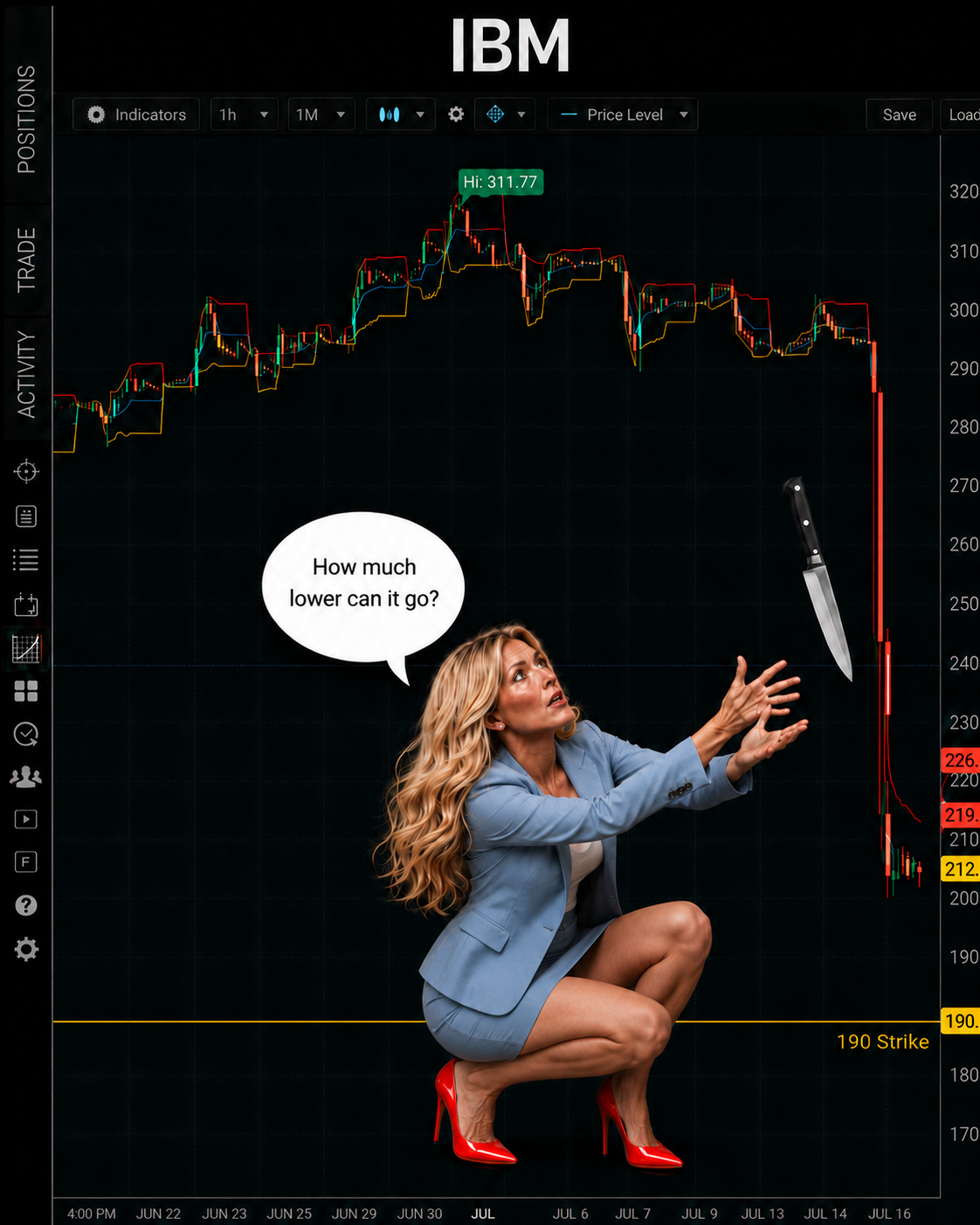
IBM's AI Spending Shock
A 23% selloff shows how quickly corporate technology budgets are moving toward AI infrastructure.
Stock Move DOWN 23% |
IBM Forecast $2.93 EPS
$17.2B rev |
Wall Street $3.01 EPS
$17.86B rev |
Important Preliminary only
Full earnings Jul 22 |
IBM shares fell about 23% in morning trading after the company released preliminary second-quarter results that fell short of Wall Street expectations. The company now expects adjusted earnings of $2.93 per share on revenue of $17.2 billion, below analysts' estimates of $3.01 per share on $17.86 billion in revenue.
It is important to note that IBM has not yet released its complete earnings report or updated guidance. This was an early courtesy update to investors containing selected preliminary results. The company will report full second-quarter earnings and discuss its outlook on July 22, leaving investors with more information — and potentially more volatility — still to come.
CEO Arvind Krishna said customers shifted spending toward servers, storage and memory ahead of expected price increases, while cybersecurity concerns delayed decisions and several large deals failed to close on schedule. He acknowledged that IBM did not adapt quickly enough, making the shortfall as much an execution problem as a spending shift.
|
Customers have not stopped spending — they've changed where they are spending.
|
As companies accelerate their AI initiatives, budgets are increasingly flowing toward servers, networking equipment, memory, storage and the infrastructure required to build AI systems. That leaves less room for some traditional software projects, which are now being delayed or pushed into future budget cycles.
This is creating a noticeable split across the technology sector. Companies supplying the infrastructure behind artificial intelligence continue to benefit from enormous capital spending, while software companies are being forced to prove their products remain essential enough to avoid budget cuts or purchasing delays.
IBM's warning wasn't simply about weaker quarterly results. It highlighted how quickly enterprise spending priorities can shift and how costly it becomes when management fails to adjust fast enough. Even strong companies can stumble when customer demand changes faster than expected.
For investors, this is another reminder that the AI story has evolved. The market is no longer rewarding every company connected to artificial intelligence. Instead, investors are becoming much more selective, favoring the businesses that are actually capturing today's AI spending.
Maria's
Take
$190 STRIKE
38 DTE · 19 DELTA
|
My immediate thought after seeing the selloff was a naked put — that's simply how my mind works. A sharp decline can create opportunity, but only if the premium justifies the risk.
IBM does not report full earnings until July 22, so I want to see how the premium changes as we get closer to the report and whether the stock finds support or continues lower.
The return on risk needs to improve, and there is another question: do I actually want IBM in my portfolio if the put is assigned? Until I can answer that confidently, this remains a watch — not a trade.
The selloff caught my attention. Now I will let the market show me whether the trade is worth taking.
|
|
|
Educational only. Not investment advice.
|
» New Cohort · Institute Starts Sat July 25
Apply to The AI Trading Institute
Learn How We Actually Build, Run, and Update Our AI Trading Robot Phil
The next Institute group begins Saturday, July 25.
Applications close Friday, July 24 at 5:00 PM ET.
Seats are limited. Rob and Nick Battista review every application personally and do a personal interview with each applicant via Zoom.
APPLY AT MATHMAKESMONEY.COM →
|
» Market & Fed Update · July 14, 2026

Tap the image to view full size
|
Market & Fed Update · July 14, 2026
Warsh Sets the Tone: Firm on Inflation, Steady with Congress
The Fed's new Chairman delivered a disciplined message to Congress, reinforcing the central bank's commitment to inflation while avoiding promises on future interest rate policy.
|
|
Warsh's first appearance before Congress gave investors something they have been looking for — a clear, disciplined message from the Federal Reserve.
|
A Disciplined First Appearance
Kevin Warsh used his first congressional testimony as Chairman of the Federal Reserve to make one point unmistakably clear: inflation remains the Federal Reserve's primary responsibility. While recent inflation reports have shown meaningful improvement, Warsh stressed that one or two favorable months do not mean the battle has been won. The Fed, he said, will continue to focus on restoring and maintaining price stability before declaring victory.
|
THE FED WILL FOLLOW THE DATA — NOT POLITICS OR DAILY MARKET MOVES.
|
Throughout the hearing, lawmakers repeatedly attempted to get Warsh to reveal where interest rates may be headed. Rather than speculate, he remained disciplined. He declined to signal whether rates would move higher, lower, or remain unchanged at the next Federal Open Market Committee meeting, emphasizing that monetary policy decisions will continue to be made by the committee as economic data develops — not by political pressure or market expectations.
That message was well received by investors. Markets generally prefer predictability, and Warsh projected exactly that. Instead of attempting to manage daily market movements through carefully chosen words, he reinforced that the Federal Reserve's responsibility is to make decisions based on inflation, employment, and overall economic conditions.
Another important theme throughout the testimony was the independence of the Federal Reserve. Warsh made it clear that neither Congress nor the White House should dictate monetary policy. While acknowledging that elected officials have every right to ask difficult questions, he reminded lawmakers that preserving the Fed's independence remains essential to maintaining long-term confidence in the financial system.
Artificial Intelligence Continues To Shape The Economy
Warsh also addressed one of the biggest investment themes of the decade — artificial intelligence.
He believes AI has the potential to become one of the largest productivity improvements in decades, increasing efficiency across businesses and supporting long-term economic growth. At the same time, he acknowledged that today's AI investment boom is creating extraordinary demand for semiconductors, networking equipment, memory, servers, power infrastructure, and data centers.
|
AI IS NO LONGER JUST A SOFTWARE STORY — IT IS DRIVING DEMAND FOR CHIPS, MEMORY, NETWORKING, DATA CENTERS, AND POWER.
|
That observation is important because AI is no longer simply a software story. It has become an industrial spending cycle touching nearly every corner of the technology sector. While higher productivity could eventually help ease inflationary pressures, the enormous amount of capital currently flowing into AI infrastructure is something the Federal Reserve will continue monitoring closely.
Overall, Wall Street responded favorably to both the testimony and the latest inflation data. Investors viewed Warsh's comments as measured, confident, and disciplined — firm on inflation without sounding unnecessarily aggressive on future rate hikes. Technology shares continued to lead the market higher as investors interpreted his comments as supportive of continued economic expansion without abandoning the Fed's inflation mandate.
|
THE BIGGEST TAKEAWAY WAS NOT A RATE-CUT PROMISE — IT WAS CONFIDENCE THAT WARSH IS IN CONTROL.
|
MARIA'S TAKE
The feedback on Kevin Warsh continues to be favorable, and honestly, what's not to like? Compared with the mixed signals and constant second-guessing investors became used to under the prior Fed leadership, Warsh comes across as clear, steady, and fully prepared. He sticks to his guns, answers the question without giving away future policy decisions, and does not appear easily pushed around by Congress, Wall Street, or politics.
What stands out most to me is that he already seems to have the respect of the other Fed members. He looks like someone who is leading the committee rather than reacting to it. That does not mean everyone will agree with him, but the Fed appears more organized, more disciplined, and more confident in its message.
Markets do not need a Fed Chair who promises rate cuts every time stocks wobble. They need someone consistent enough that investors understand the rules of the game. So far, Warsh is giving the market exactly that — and after what we had before, the bar may not have been very high, but he is clearing it comfortably.
|
|
|
BULLISH, BUT SELECTIVE | DISCIPLINE OVER NOISE | DATA OVER PROMISES
|
Educational only. Not investment advice.
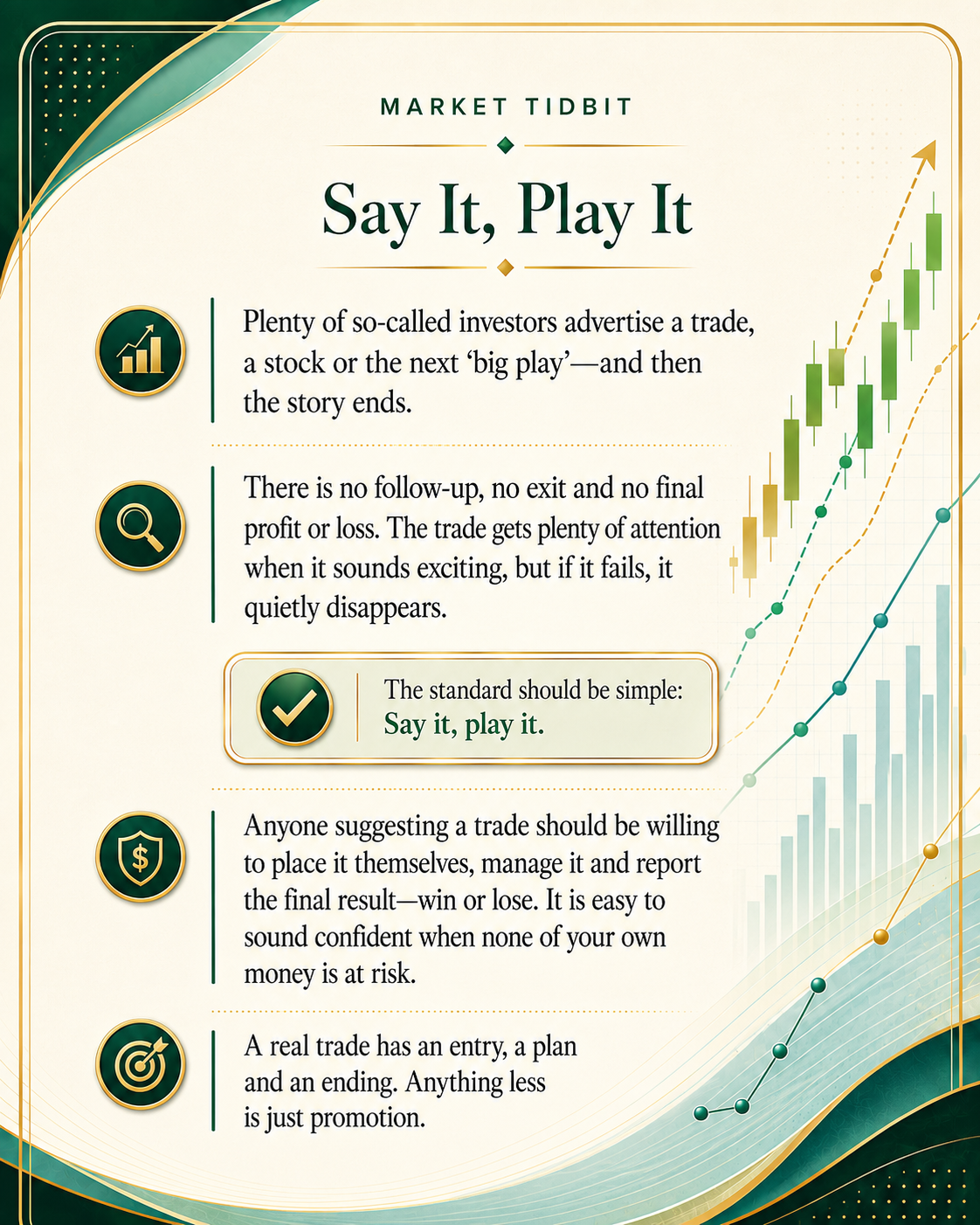
» Market Tidbit · Say It, Play It
Tap the image to view full size
» Yesterday's Results · Three Accounts
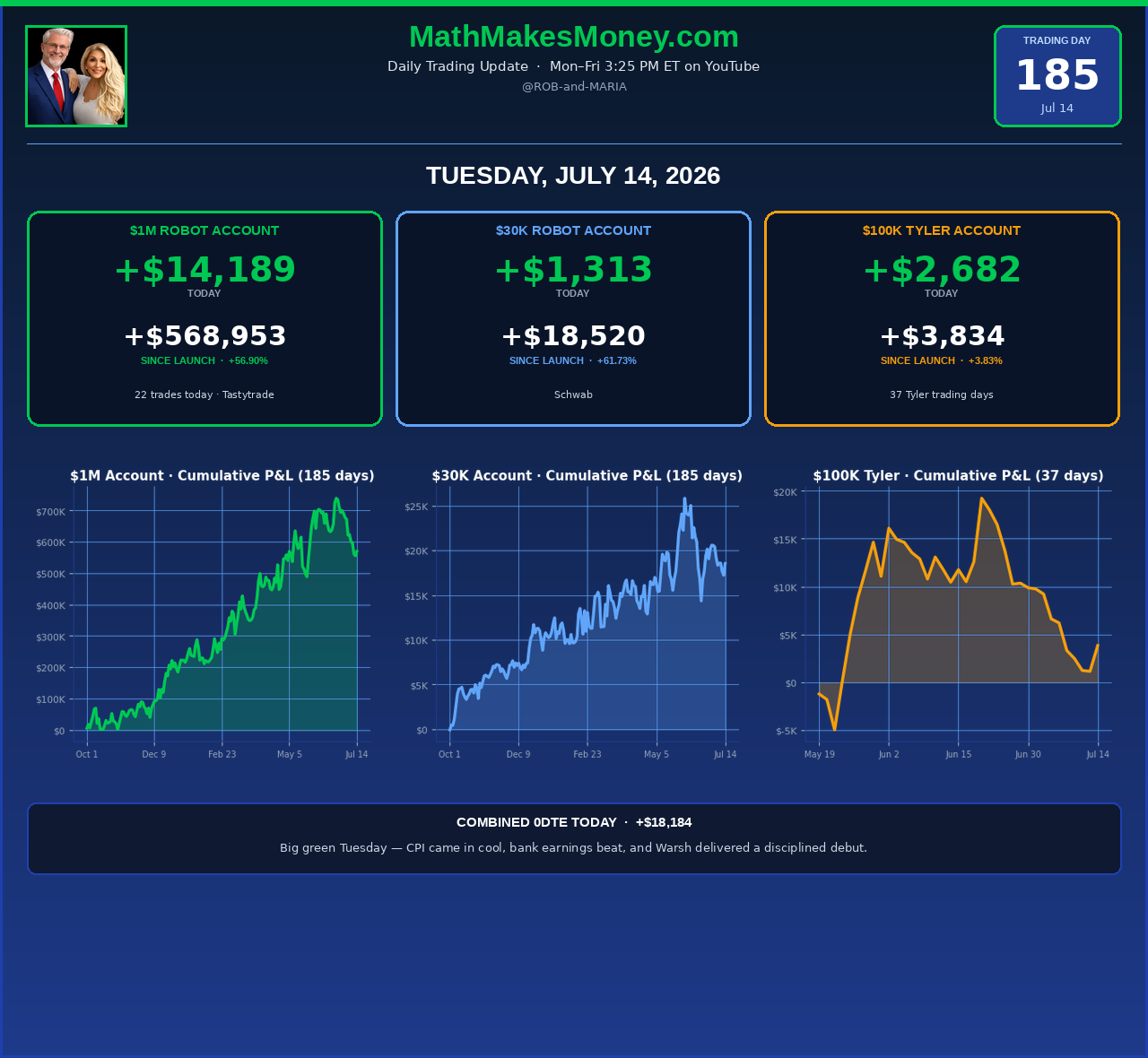
Tap the dashboard for the full Day 185 results · Big green Tuesday · +$18,184 combined
|
» This Morning's Show · Watch on YouTube
The Math Makes Money Show with Rob, Nick, and Maria
 ► WATCH ON YOUTUBE
|
|
» Join the Community
Trade With Us In Discord
Live trading with the AI robot every session. Ask Rob, Nick, and Maria questions in the YouTube chat. A community of trading addicts.
JOIN THE DISCORD →
|
Get a fill, Phil.
© 2026 Math Makes Money · Rob and Maria Helmick
Educational only. Trading options involves substantial risk of loss.
|
|