|
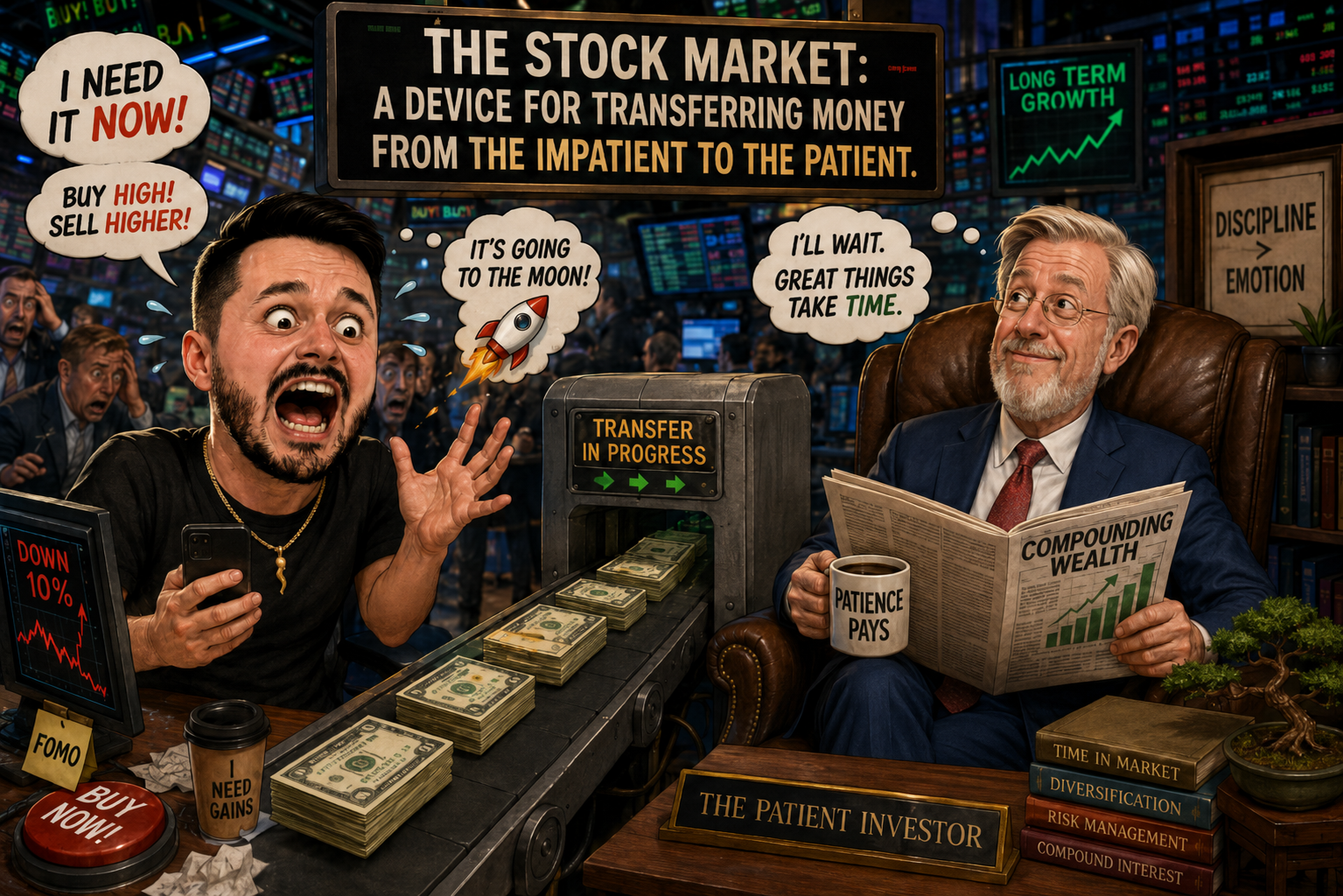
“The stock market is a device for transferring money from the impatient to the patient.”
— Warren Buffett | Rob Helmick
|
That lesson feels especially timely as investors watch the market near record highs and wonder whether to stay invested, take profits or prepare for the next pullback.
At moments like this, the instinct is often to act — chase what is working, sell winners too early or move to cash because prices feel expensive. But constant activity is not the same as good investing.
Sometimes the smartest move is to stay disciplined and give a strong investment thesis time to develop.
The Market Rewards What Comes Next
A strong earnings report is not always enough to push a stock higher. What matters is whether the company gives investors a reason to believe the next quarter — and the next year — will be even better.
Markets respond to stronger demand, expanding margins, rising guidance and improving cash flow. When expectations are already extremely high, even good results can disappoint. When expectations are low, the first sign of improvement can send a stock sharply higher.
The real question is whether the business is getting stronger — or whether the market is already expecting perfection.
Record Highs Are Not the Same as a Market Top
New highs often make investors uneasy, but markets cannot rise over time without reaching them repeatedly.
The better question is whether the fundamentals still support the price. Are earnings growing? Are estimates moving higher? Is demand holding up? Are companies producing real cash flow? Is the valuation reasonable compared with the growth ahead?
Risk and valuation still matter, especially after a strong run. But reaching a new high alone is not a reason to sell. Strong businesses can keep producing strong returns long after investors begin worrying that the move has gone too far.
AI Is Moving From Hype to Proof
The artificial-intelligence trade is increasingly being judged by measurable results: capital spending, data-center construction, semiconductor demand, cloud revenue, margins and free cash flow.
The largest technology companies continue to invest heavily in AI infrastructure. That spending supports a broad supply chain that includes processors, memory, networking, power, cooling and cloud services.
The next phase will likely be more selective. Investors will reward the companies that can convert AI demand into real earnings and stronger cash generation. That is where the difference between an AI story and an AI business becomes important.
Patience Works Best When the Business Is Still Delivering
Patience does not mean holding every stock forever. It works when earnings, demand and cash flow continue to support the investment thesis.
Companies such as Nvidia, Micron and Amazon illustrate the point. Each benefits from a different part of the AI buildout — computing, memory and cloud infrastructure — but their stocks will ultimately be judged by whether that demand continues turning into stronger earnings.
The lesson is not to own these three stocks blindly. It is to avoid selling a strong business merely because the stock has already risen.
When Patience Stops Working
Patience is valuable, but only while the original reason for owning the stock still holds. A falling share price by itself does not mean the investment is broken, just as a rising price does not automatically mean everything is fine. What matters is whether the business continues to deliver — whether earnings expectations are holding up, margins remain healthy, debt is under control and management is still executing.
There are also times when the company may still be strong, but the position has simply become too large for the portfolio. Trimming in that situation is not a lack of conviction. It is risk management.
The real decision should not be based on whether the stock had a good day or a bad one. It should be based on whether the facts have changed.
|
Be patient with normal volatility, but do not ignore a business that is clearly moving in the wrong direction.
|
✦ Maria's Take
Every investor has rules, but none of us follows them perfectly. Markets get noisy, emotions creep in, and sometimes we lose sight of our process. It happens.
When I'm unsure, I slow down, go back to the facts, and often bounce my thinking off an AI assistant. It doesn't make my decisions, but it helps me ask better questions.
The best investment decisions usually come from discipline — not emotion.
|
|