Issue No. 34 • Friday July 10, 2026
THE TRADING ADDICT
NEWSLETTER
by Maria Helmick
» Risk · Volatility · Discipline
Tap the image to view full size
|
Risk • Volatility • Discipline
How Much Risk Are You Really Taking?
|
|
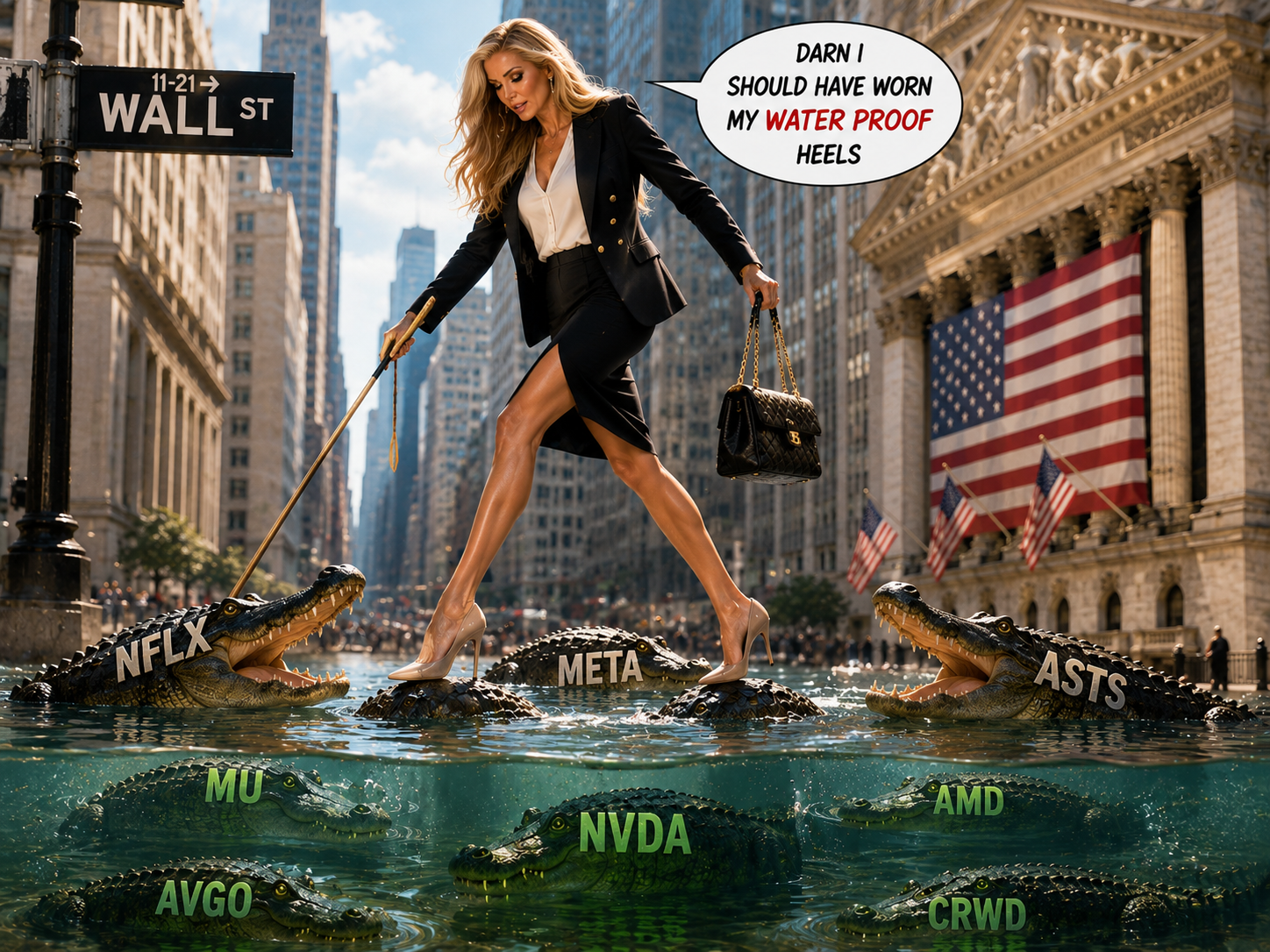
Most traders believe they understand their risk tolerance until a position moves sharply against them. It is easy to feel aggressive when the market is rising, but the real test comes when a stock drops 10%, volatility jumps, and the loss becomes larger than expected.
Risk tolerance is not simply conservative, moderate, or aggressive. It is the amount of financial and emotional pressure you can handle without abandoning your plan. Portfolio size, experience, time horizon, financial obligations, and position size all play a role.
|
The goal is not to avoid risk. The goal is to know what you are accepting and decide whether the potential reward is worth it.
|
NVIDIA is a good example. During the period examined, NVDA had a beta of approximately 2.02 compared with SPY, meaning it experienced much larger swings than the broader market. It reportedly averaged a daily gain of 0.16%, with typical daily movement of approximately 3.6%.
That volatility can create opportunity, but it can also create losses quickly. NVIDIA experienced a drawdown of approximately 36.89% during the April decline. A $25,000 position falling that much would temporarily lose more than $9,200, while a $100,000 position would fall by nearly $36,900.
Another way to measure risk is the Sharpe Ratio, which compares return with the volatility required to earn it. A higher ratio generally means the investor received more return for the risk taken. During the period measured, NVDA scored 0.30, compared with 0.34 for SPY, showing that its larger swings did not produce a better risk-adjusted return. Recovery time matters as well, since sitting below a previous high for months can test your patience and mentally challenge the trading guidelines you thought you would follow.
Before entering a position, know how much it could realistically lose, how long you are willing to hold it, and whether you can stay disciplined when the loss is sitting on the screen.
Trading with AI has also helped me better understand the stocks I own. I use an AI assistant that follows my companies, gives me updates, and helps me spot changes that could affect the risk. It does not make the decisions for me, but it helps me stay informed — and that is another story for another day.
Maria's Bottom Line
Risk tolerance is different for every stock. It depends on how well you know the company, how much confidence you have in it, and where you bought it. A decline feels very different when you are still sitting on a large profit than when you bought near the top.
That is why I am more comfortable with the volatility in NVIDIA, AMD, and Micron than I might be with a stock I do not understand as well. We all have our favorites, and that is part of what makes the market work.
Conviction matters, but position size still has to make sense. Even a great company can become too much risk when you own more than you can comfortably handle.
|
|
Educational only. Not investment advice.
|
» New Cohort · Institute Starts Sat July 25
Apply to The AI Trading Institute
Learn How We Actually Build, Run, and Update Our AI Trading Robot Phil
The next Institute group begins Saturday, July 25.
Applications close Friday, July 24 at 5:00 PM ET.
Seats are limited. Rob and Nick Battista review every application personally and do a personal interview with each applicant via Zoom.
APPLY AT MATHMAKESMONEY.COM →
|
» AI Infrastructure · Semiconductors · Memory
Tap the image to view full size
|
|
AI Infrastructure • Semiconductors • Memory
Micron Breaks Ground on America's AI Memory Bet
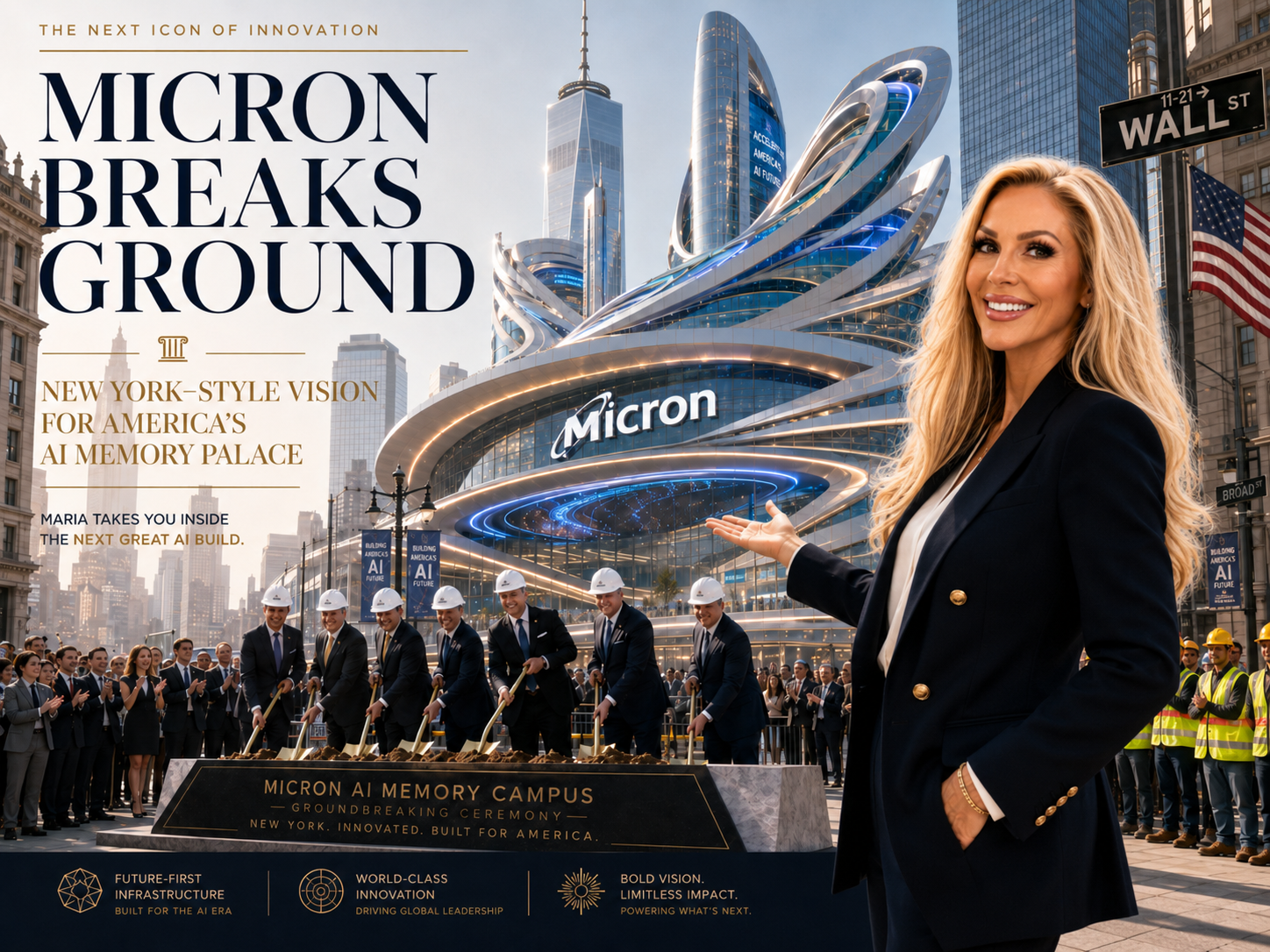
Micron just broke ground on its massive new semiconductor plant in Clay, New York, and this is much bigger than a ribbon-cutting. This is one of the clearest signs yet that the AI buildout is moving from Wall Street headlines into real factories, real infrastructure, and real long-term capital spending.
The project is expected to become the largest semiconductor manufacturing site in the United States, with plans for four fabrication plants, 2.4 million square feet of cleanroom space, and roughly 50,000 jobs tied to the buildout. That kind of scale tells you Micron is not planning for a short AI cycle. Management is investing billions because they believe demand for advanced memory will continue growing for years.
Micron CEO Sanjay Mehrotra summed up the current environment with one simple statement:
|
"Pricing today is based on markets."
|
That matters because memory has always been a cyclical business. Prices rise, prices fall, and investors get nervous. But AI is changing the setup. Advanced systems need high-bandwidth memory, and the more powerful the AI models become, the more memory they require. That puts Micron in a much stronger position than the old commodity-memory story investors used to trade around.
One comment from Mehrotra really put the project into perspective.
|
"Four Empire State Buildings worth of concrete will go into one of our fabs."
|
Think about that for a minute.
AI is not just software or flashy headlines. It is factories, power generation, cooling systems, water, steel, concrete, advanced manufacturing equipment, GPUs, and memory. Micron's groundbreaking is a reminder that every AI breakthrough starts with physical infrastructure. Without that infrastructure, there is no AI revolution.
For years, NVIDIA has been the face of AI, but companies like Micron are becoming just as critical behind the scenes. The world's fastest processors cannot reach their full potential without enough high-performance memory feeding them data. That makes Micron one of the companies quietly helping power the next generation of artificial intelligence.
Maria's Bottom Line
Micron is not just talking about AI. It is building for it, and I'm staying on the MU train.
My bet is that Micron still has room to run, but the stock now has to prove that demand can keep up with expectations. The story is exciting, the buildout is massive, and yes, the bar is getting higher.
One last thought — if Micron can build memory chips that power AI, maybe their next project should be one for my brain. I won't just invest — I'll be pre-ordering one first.
|
|
Educational only. Not investment advice.
» Disruptive Tech Watch · ARK Invest
Tap the image to view full size
|
Disruptive Tech Watch
Cathie Wood Doubles Down on Disruptive Technology
|
|
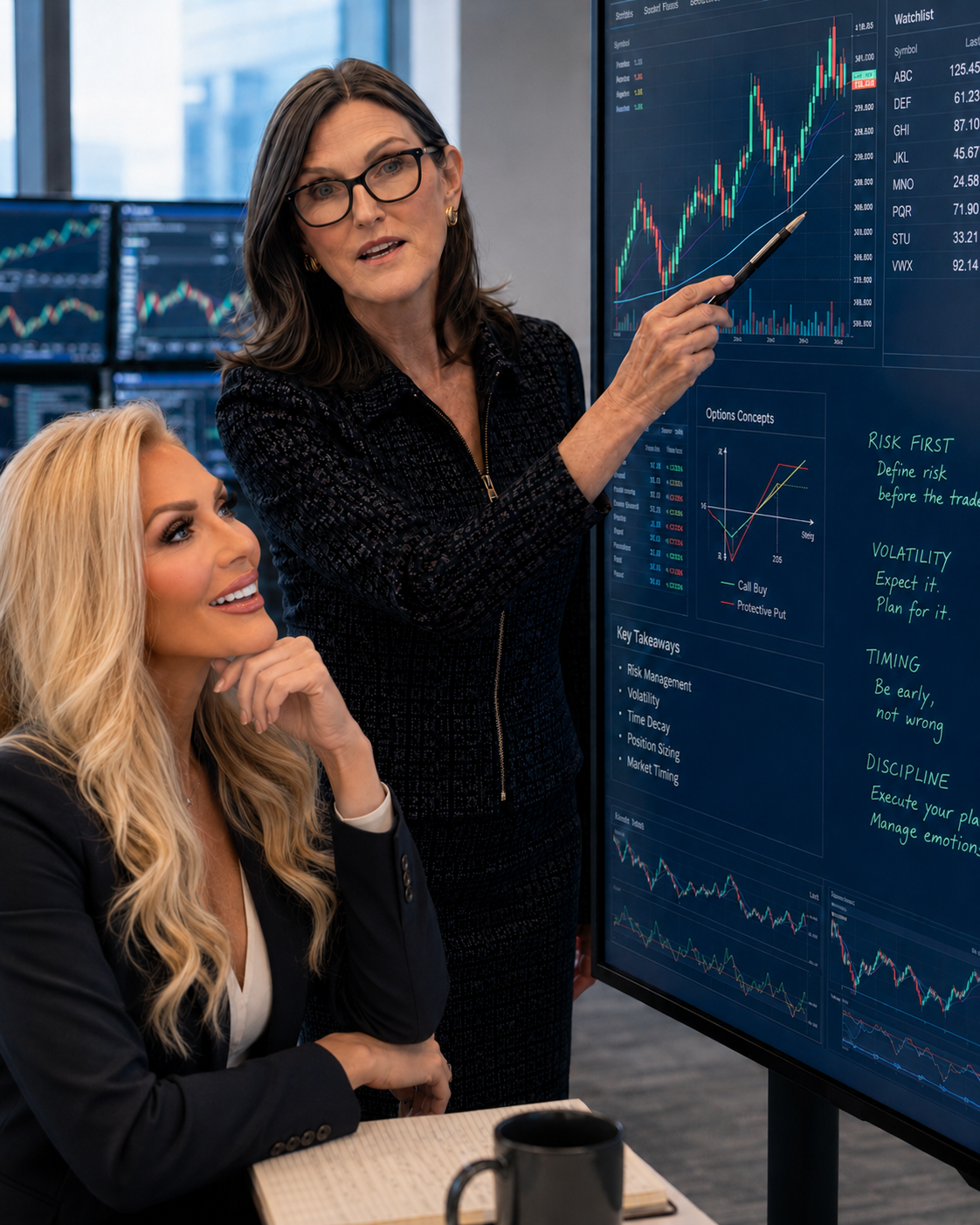
Cathie Wood is buying volatility again. ARK Invest has recently added to five companies Wood believes could reshape major industries: SpaceX, Tesla, Palantir, Circle Internet and Cerebras Systems. The businesses are very different, but the investment thesis behind them is the same — ARK is willing to accept substantial short-term risk for exposure to technologies that could create entirely new markets.
SpaceX: Buying After the IPO Excitement Faded
SpaceX completed its historic IPO on June 12 at $135 per share, giving public investors their first opportunity to own the rocket and satellite company directly. The shares initially surged above $200 before pulling back sharply, creating the type of decline Cathie Wood often views as a buying opportunity. ARK reportedly purchased additional SpaceX shares as the stock fell from its post-IPO high. The company now represents a significant position across several ARK funds and is the largest holding in ARK's space-focused ETF.
The long-term SpaceX story extends far beyond rocket launches. Starlink is building a global satellite communications network, while Starship could dramatically reduce the cost of moving equipment and people into space. SpaceX is also pursuing more ambitious projects involving lunar infrastructure, artificial intelligence and potentially semiconductor manufacturing. Those opportunities are enormous, but so are the expectations already built into the valuation.
Tesla: The Robotaxi Bet Continues
Tesla remains one of Wood's largest and most recognizable positions. Her thesis is no longer based primarily on electric-vehicle sales. ARK increasingly views Tesla as an artificial-intelligence and robotics company whose future value could come from autonomous driving, robotaxis and humanoid robots.
That distinction matters because Tesla's vehicle business continues to face uneven demand, pricing pressure and aggressive competition. Wood is betting that autonomous transportation eventually becomes more important than the number of vehicles Tesla delivers during any single quarter. The potential reward is substantial, but the company still must prove that its robotaxi technology can move from demonstrations and limited rollouts into a safe, scalable and profitable service.
Palantir: The Enterprise AI Operating System
Palantir may be one of the strongest operating businesses in the group. Its software helps governments and corporations organize enormous quantities of data and use artificial intelligence to make operational decisions. Palantir's Artificial Intelligence Platform has become a central part of its growth story as companies look for practical ways to integrate AI into their existing operations.
The question is not whether Palantir is benefiting from AI adoption. It clearly is. The question is how much future growth investors are already paying for. Palantir's valuation leaves little room for disappointment, making execution and continued customer growth especially important.
Circle: A Bet on Stablecoins Becoming Financial Infrastructure
Circle Internet operates behind USDC, one of the world's largest dollar-backed stablecoins. Wood's investment suggests she believes stablecoins could eventually become an important part of the global payment system. They could make transferring money faster and less expensive while connecting traditional banking with blockchain-based financial networks.
Circle's opportunity is significant, but the competitive landscape is changing quickly. Large banks, payment companies and technology firms are developing their own blockchain and digital-payment systems. Circle must prove that USDC can remain a leading platform as better-capitalized competitors enter the market.
Cerebras: Challenging Nvidia With a Different Kind of AI Chip
Cerebras is the smallest and most specialized company on the list, but it may have one of the most unusual technologies. Instead of dividing computing workloads among many conventional chips, Cerebras produces massive wafer-scale processors designed to handle demanding artificial-intelligence models. The technology could offer advantages for certain training and inference workloads where speed and memory capacity are critical.
The challenge is commercialization. Cerebras must persuade customers that its specialized systems provide enough performance and cost advantages to justify moving away from the broader Nvidia ecosystem. Nvidia does not simply sell chips — it offers software, networking and a deeply established developer platform. Breaking into that market will not be easy.
Why These Purchases Matter
Cathie Wood is not searching for inexpensive companies based on traditional valuation measurements. She is searching for companies that could become much larger if their technologies succeed. That is an important distinction. Calling these stocks "discounted" does not necessarily mean they are cheap. It means their share prices have declined from previous highs while ARK's long-term expectations remain intact.
SpaceX must execute on Starship and Starlink. Tesla must turn autonomous driving into a real business. Palantir must maintain its rapid AI growth. Circle must defend its stablecoin position. Cerebras must prove that its technology can compete commercially with established chip leaders. Every company has tremendous potential. Every company also carries substantial execution and valuation risk.
Maria's Take
Cathie Wood is doing exactly what Cathie Wood does best — buying companies with enormous stories while other investors are concentrating on the immediate problems. Sometimes that approach produces spectacular returns. Other times, investors spend years waiting for the future to catch up with the valuation.
Of the five, Palantir currently has the clearest operating momentum, while SpaceX may have the largest long-term opportunity. Tesla still depends heavily on proving that robotaxis can become more than another promise. Circle and Cerebras are interesting, but both face powerful competitors and business models that still need to mature.
The lesson is not to blindly follow every ARK purchase. The lesson is to understand what you are buying. These are not quiet, predictable compounders. They are high-expectation technology investments that can move violently in either direction.
Cathie Wood may be buying the dip — but investors should remember that a lower price does not automatically mean a low-risk investment.
|
|
Educational only. Not investment advice.
» Wall Street History · The 12½-Cent Decision

Tap the image to view full size
|
Wall Street History
The Biggest Stock-Market Mistake in History
How a dispute over 12½ cents may have cost $100 billion.
|
|
One of the greatest fortunes in stock-market history began with a decision Warren Buffett later called "monumentally stupid." In 1962, Buffett began buying shares of Berkshire Hathaway, a struggling New England textile company. The stock appeared incredibly cheap. Shares traded near $7.50, while the company had working capital of $10.25 and a book value above $20 per share. Buffett saw it as a classic "cigar-butt" investment — a fading business with one profitable puff remaining.
The plan was simple: buy cheaply, sell the shares back to management at a higher price and move on. Management indicated it would repurchase Buffett's shares for $11.50. But when the official offer arrived, the price was only $11.375.
|
The difference was just 12½ cents.
|
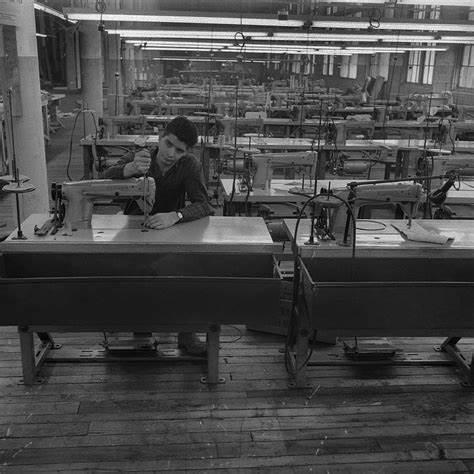
Buffett was furious. Instead of taking the profit, he made it personal. He refused the offer, bought more shares and eventually took control of the entire company. All over 12½ cents. A profitable trade had suddenly become ownership of a dying textile business. More than one-quarter of Buffett's partnership capital became tied up in an industry already being crushed by cheaper competition.
Twenty Years of a Losing Battle
For nearly two decades, Buffett tried to save the mills. He invested more money, purchased equipment and changed management. Nothing worked. Berkshire finally closed its textile operations in 1985, but the company itself did not disappear. Buffett had already begun transforming Berkshire Hathaway into a holding company built around insurance and investments.
The Real Cost: Roughly $100 Billion
The biggest loss was not the money spent on the textile mills. It was the ownership Buffett's original partners gave up when National Indemnity was placed inside Berkshire Hathaway rather than purchased directly through the partnership, leaving them with a much smaller share of the enormous wealth that followed.
Buffett later estimated that placing the insurer inside Berkshire shifted roughly $100 billion in future wealth away from his original partners.
|
A dispute over 12½ cents may have cost Buffett's partners approximately $100 billion.
|
The mistake was not buying a cheap stock. It was allowing anger, pride and ego to take control of the decision. Buffett had already won. He had bought the shares cheaply and could have walked away with a strong profit. Instead, 12½ cents turned a winning trade into a 20-year burden.
The extraordinary part is that Buffett was able to recover, rebuild and transform Berkshire Hathaway into one of the most powerful business empires ever created. Most investors would not have survived the mistake long enough to rewrite the ending, but Buffett did — proving that even one of the greatest investors in history could make a terrible decision, learn from it and refuse to let it define him.
Maria's Bottom Line
Every trader has an ego. The best ones learn to keep it out of the trade.
If Warren Buffett can lose $100 billion over 12½ cents of pride, the rest of us can lose a lot more over a lot less. Take the win when the math says take the win.
|
|
Educational only. Not investment advice.
» Today's Trading Update · Three Accounts
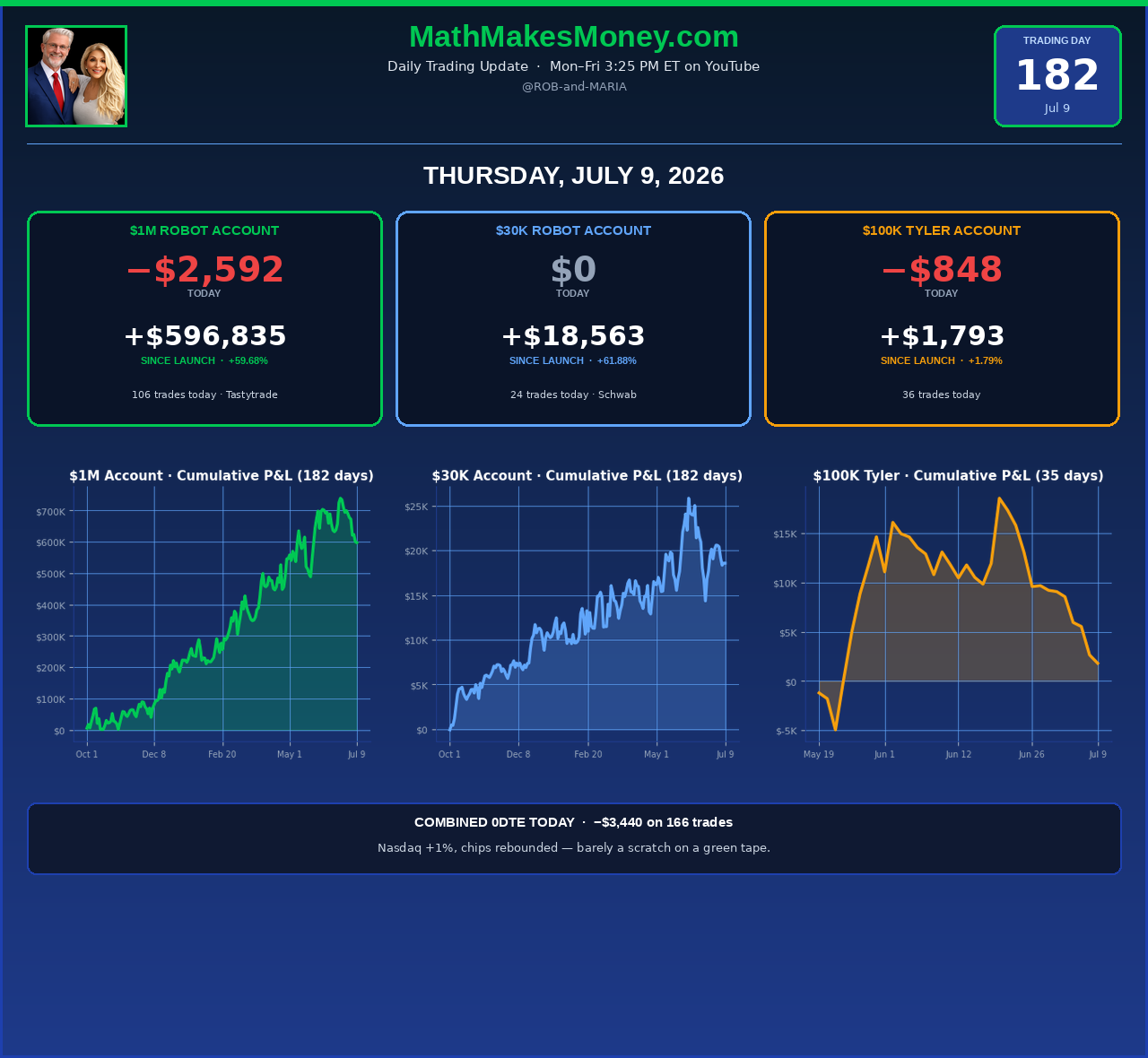
Tap the dashboard for the full Day 182 audit
|
» Join the Community
Trade With Us In Discord
Live trading with the AI robot every session. Ask Maria and Rob questions in the YouTube chat. A community of trading addicts.
JOIN THE DISCORD →
|
Get a fill, Phil.
© 2026 Math Makes Money · Rob and Maria Helmick
Educational only. Trading options involves substantial risk of loss.
|
|