» Story No. 1 of 2 · Space · Rocket Lab · Iridium
Tap the image to view full size
🚀 🚀 🚀
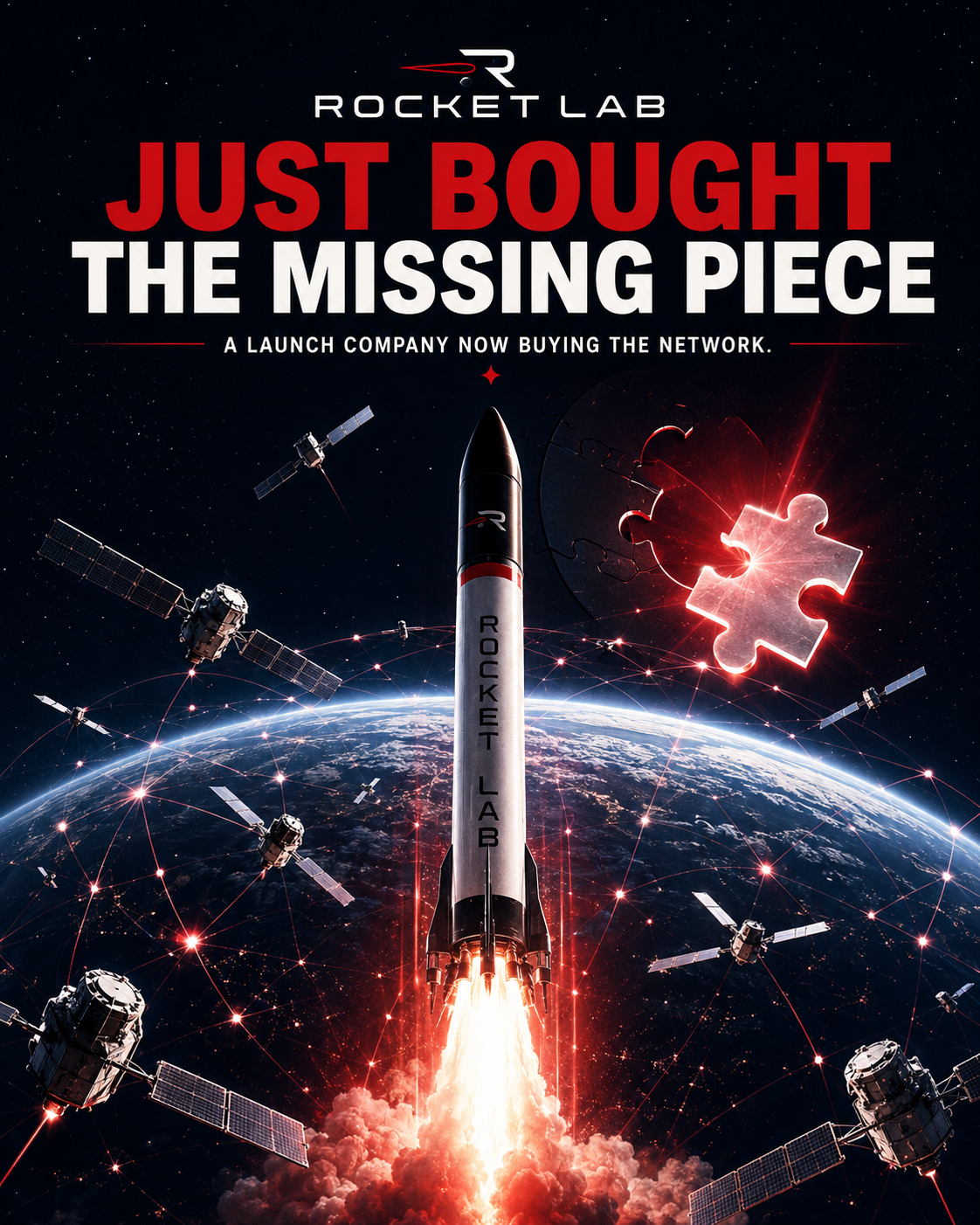
Rocket Lab Just Bought Its Next Growth Engine
Why this deal may change how investors look at Rocket Lab.
Rocket Lab did not just buy another company—it may have changed the way investors value the business.
Rocket Lab has agreed to acquire Iridium Communications in an $8 billion transaction that is expected to close around mid-2027. Iridium is a global satellite communications company that operates a worldwide network serving government, military, aviation, maritime, emergency response, and commercial customers.
Iridium operates a constellation of 66 active low-Earth-orbit satellites and serves more than 2.5 million subscribers worldwide, making it one of the largest satellite communications networks in operation.
That matters because Rocket Lab is not just buying satellites. If the deal closes, it is buying an operating business with real customers, existing infrastructure, and recurring revenue. That is the part investors should pay attention to.
🚀 Why This Deal Matters
The easiest way to think about this deal is to look at SpaceX.
SpaceX is not valuable just because it launches rockets. A big part of its value comes from Starlink, its satellite communications business that provides internet service to millions of customers around the world.
Rocket Lab is not trying to become another SpaceX overnight, but this acquisition moves it in a similar direction.
If the deal closes, Rocket Lab will own an operating communications business with paying customers, recurring revenue, and long-term government and commercial contracts.
For investors, that means Rocket Lab could become less dependent on one-time launch contracts and more dependent on predictable, recurring cash flow.
🛰️ What Rocket Lab Is Really Buying
Rocket Lab is not just buying satellites. It is buying a communications network that is already operating, already trusted, and already serving customers around the world.
Building this kind of network from scratch would take years, billions of dollars, spectrum approvals, government relationships, and a tremendous amount of execution. By acquiring it, Rocket Lab is buying time.
If the acquisition closes, the company will gain a business that fits its long-term vision: launch the rockets, build the satellites, operate the network, and generate recurring revenue from the services those satellites provide.
⚠️ The Risk
This deal is exciting, but it is not clean and easy.
Rocket Lab is making an $8 billion bet, and investors are going to want proof that management can handle it. The biggest questions are simple: how much debt comes with it, how much dilution shareholders face, and how smoothly the two businesses can be combined.
The opportunity is big, but so is the execution risk.
If Rocket Lab pulls it off, the company could look a lot stronger. If it does not, this deal could become a very expensive distraction.
⭐ Maria’s Bottom Line
I have been holding Rocket Lab since before the SPCX IPO because I thought going public would finally move the needle. It helped, but this acquisition could be the bigger catalyst.
If the acquisition closes as expected, Rocket Lab will become much more than a launch story. It will own a satellite communications business with paying customers, global infrastructure, and recurring revenue.
That can change how Wall Street values the company.
This deal adds risk, debt, and execution pressure, so I am not calling it a victory lap. But I do like the direction.
Rocket Lab is trying to build a business that makes money getting to space—and from what happens after it gets there.
🚀 ✦ 🛰️ ✦ 🚀 ✦ 🛰️ ✦ 🚀
Educational only. Not investment advice.
|
Apply to The AI Trading Institute
Learn How We Actually Build, Run, and Update Our AI Trading Robot Phil
The next class starts Monday, July 6. The waitlist closes Tuesday, July 1 at 5:00 PM ET.
Seats are limited and the group is curated. Rob and Nick Battista review every application personally and do a personal interview with each applicant via Zoom.
APPLY AT MATHMAKESMONEY.COM →
|
» Story No. 2 of 2 · Markets · S&P 500 · Valuation

Tap the image to view full size
| |
Market Valuation Watch
The S&P 500 Is Expensive — But That Does Not Mean a Crash Is Coming
The Shiller CAPE ratio is getting a lot of attention because it is sitting near dot-com-era levels. That sounds scary, and it should make investors pay attention. But it does not automatically mean the market is about to crash.
|
|
The CAPE ratio is just a long-term valuation tool. It compares today’s stock prices to the past 10 years of inflation-adjusted earnings. In plain English, it tells us whether stocks are cheap, fair, or expensive compared with history.
Right now, the answer is simple: stocks are expensive.
You can find the CAPE ratio on Multpl by searching “Shiller PE ratio.”
But here is the part traders need to remember: expensive does not mean broken.
A high CAPE ratio does not tell us the market has to fall tomorrow, next week, or even this year. It only tells us investors are paying a high price for future earnings. That matters, but it is not a sell button by itself.
This is why the 1999 comparison gets everyone nervous. Back then, investors were chasing internet and technology stocks at crazy prices. Eventually, the bubble popped, the S&P 500 fell hard, and the Nasdaq got crushed even worse.
So when people see the CAPE ratio near those levels again, they immediately think, “Here we go again.”
But markets do not usually give warnings that clean.
In 1999, stocks were already expensive before the market finally cracked. The problem is, they also kept going higher first. Traders who sold too early just because valuation looked stretched had to watch the market keep running without them.
That is why valuation is useful, but it is not magic.
The CAPE ratio tells us risk is building. It does not tell us when buyers will stop showing up. It is like seeing storm clouds in the distance. You pay attention, but you do not run into the basement every time the sky gets dark.
The real question is not just, “Is the market expensive?”
The better question is, “Are earnings still strong enough to back it up?”
Right now, that is the reason this market has not cracked. Corporate earnings are still holding up, AI spending is still flowing, and large-cap technology is still carrying a lot of the market. FactSet is still projecting strong S&P 500 earnings growth for Q2, and positive guidance is currently outnumbering negative guidance.
That is important.
The bear case needs more than “stocks are expensive.” If companies are still growing earnings, still guiding higher, and investors still believe in the AI spending cycle, the market can ignore valuation warnings longer than people expect.
This does not mean risk is gone. It means the warning light is on, but the engine has not failed.
For this story to really change, earnings would need to slow, guidance would need to weaken, AI spending would need to cool off, or investors would need to stop rewarding growth. That is when high valuation becomes more than a warning sign.
An expensive market with strong earnings is a yellow light.
An expensive market with cracking earnings is when that light gets a lot closer to red.
|
Maria’s Bottom Line
I am not calling this a crash alarm.
Stocks are expensive, no doubt. But expensive alone is not enough to make me bearish.
For now, I still want quality names, real earnings, good liquidity, and trades with enough premium to give me room.
This is not a market where I blindly chase everything. It is also not a market where I panic just because one valuation chart looks uncomfortable.
For now, this is a yellow light — not a red one.
And traders love to say they slow down at yellow lights… right before they hit the gas.
|
|
Educational only. Not investment advice.
» Maria's Odd Market Tidbit

Tap the image to view full size
|
Math Makes Money
TRADES OF THE WEEK
0DTE SPX • $30K SCHWAB ACCOUNT
Week of June 29, 2026 · 7 trades scheduled
|
| Entry |
Premium |
Width |
Stop |
| 11:53 AM | $3.00 MEIC | 50W | 95% |
| 12:00 PM | $2.25 MEIC | 50W | 95% |
| 3:09 PM | $3.50 MEIC | 50W | 95% |
| 3:09 PM | $2.25 MEIC | 50W | 95% |
| 3:30 PM | $3.00 MEIC | 50W | 95% |
| 3:44 PM | $1.85 MEIC | 50W | 95% |
| 3:44 PM | $1.45 MEIC | 50W | 95% |
Week 38 buying power deployed: $2,300,000. Day 175 (Mon Jun 29) opened green: combined 0dte +$6,857 on 196 trades. Educational only — not a recommendation.
|
» Daily Results · Tap to View Full Page
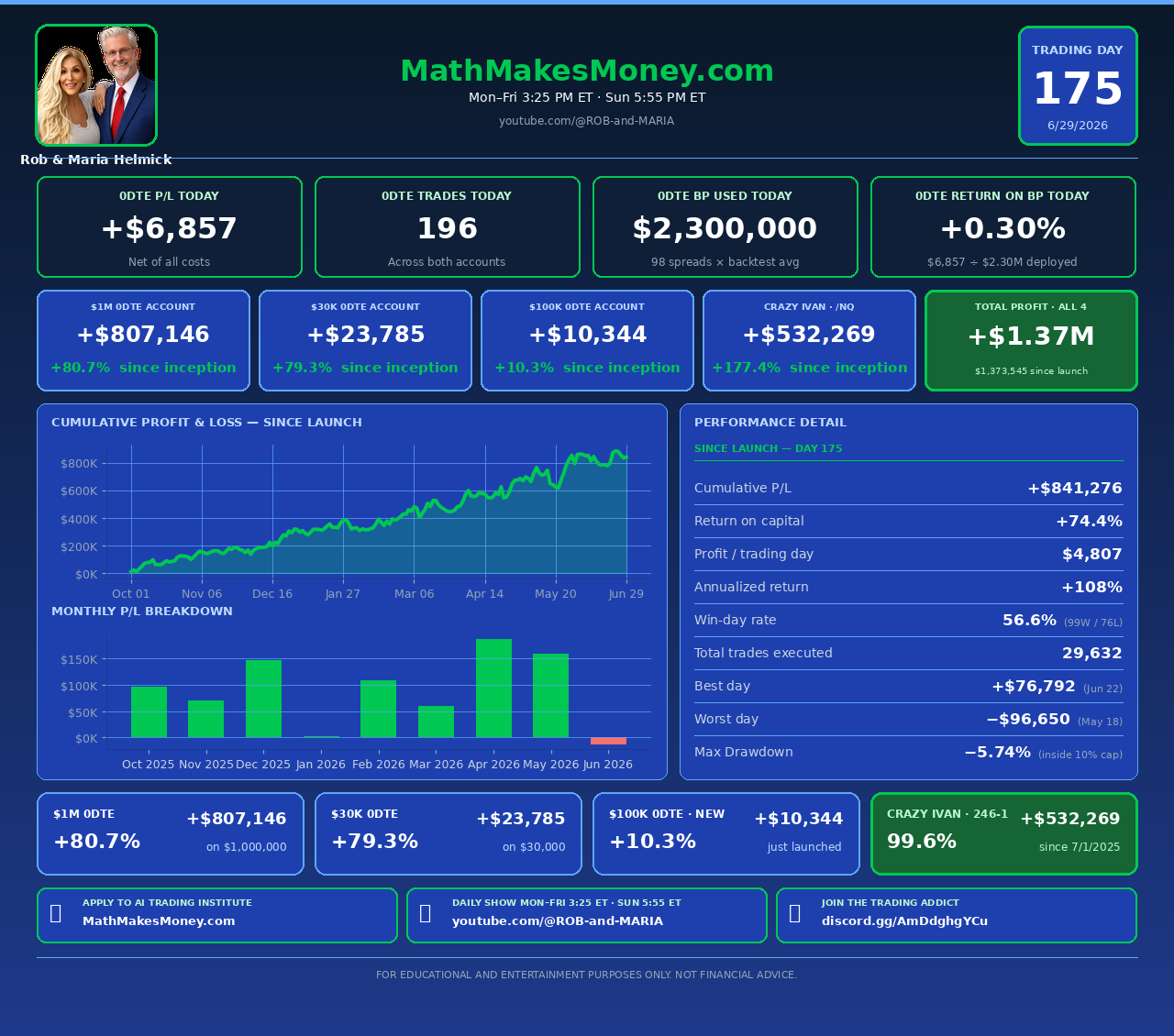
Tap the dashboard to view the full Day 175 results page
|
» This Week's Show · Watch on YouTube
The Weekly Setup — What We're Watching
 ► WATCH ON YOUTUBE
|
|
» Join the Community
Trade With Us In Discord
Live trading with the AI robot. Ask Maria and Rob questions in the YouTube chat. A community of trading addicts.
JOIN THE DISCORD →
|
Math is the method. Income is the outcome.
Get a fill, Phil.
© 2026 Math Makes Money · Rob and Maria Helmick
Educational only. Trading options involves substantial risk of loss.