Issue No. 27 • Monday June 29, 2026
THE TRADING ADDICT
NEWSLETTER
by Maria Helmick
» Story No. 1 of 3 · Markets · Small Caps · Rotation

Tap the image to view full size
Market Watch
Small Caps Are Back In The Game
The market may finally be trying to broaden out, but the risk appetite underneath the surface deserves attention.
Small caps are finally starting to get some attention again, and that matters. For a long stretch, the market has been dominated by mega-cap tech, AI names, and the same handful of leaders carrying the indexes higher. But when small caps begin to outperform, it can be an early sign that traders are willing to move further out on the risk curve.
That does not automatically mean the market is healthy across the board, but it does tell us something important: money is starting to rotate.
Small-cap stocks are often more tied to the real economy than the mega-cap names. They can react quickly to changes in rates, credit conditions, inflation expectations, and economic data. When traders start buying them, it usually means they are feeling more confident about growth, rate cuts, or a broader market rally. But there is another piece of this story that traders should not ignore.
The Leveraged ETF Warning
The more interesting part is what is happening underneath the surface. Leveraged ETF trading is exploding.
According to Goldman Sachs, U.S.-listed leveraged ETFs are now averaging about $45 billion in daily trading volume. That is a massive number, and it shows just how much short-term risk appetite is building in this market.
Leveraged ETFs are not quiet, long-term investment vehicles. They are trading tools. They are built for speed, momentum, and short-term moves. When volume in these products surges, it usually means traders are not just participating in the market — they are pressing harder.
That can help fuel big moves higher when momentum is working. But it can also make reversals sharper when the trade gets crowded.
Why This Can Make the Market Choppier
When small caps start outperforming at the same time leveraged ETF volume is surging, that is not a sleepy market. That is a risk-on market — and risk-on markets can get loud fast. Small caps usually move quicker and swing wider than large-cap stocks. They are more sensitive to interest rates, credit conditions, economic data, and investor sentiment. Many smaller companies also depend more on borrowing, so higher-for-longer rates can hit them harder than cash-rich mega-cap names. That is why this rally needs to be respected, but also watched carefully. The Fed’s latest median projections still show inflation running above target, with 2026 PCE inflation projected at 3.6% and core PCE at 3.3%. The Fed also sees 2026 real GDP growth at 2.2%. That is not a disaster, but it is not exactly a perfect runway either.
What to Watch
The key now is follow-through. Small caps had the move, but the next test is whether buyers keep showing up after the first burst of excitement. A real rotation does not happen in one day. It needs support to hold, more stocks to participate, and money to keep spreading beyond the same crowded mega-cap names. If small caps stay firm while the major indexes hold up, that would be a healthy sign. But if leveraged ETF volume keeps surging and the market starts whipping around harder, that could mean traders are pressing too aggressively too fast.
Maria’s Bottom Line
I like seeing small caps wake up because it tells me the market may be trying to broaden out. That is a good thing, but I am not going to confuse opportunity with easy money. When traders start piling into small caps and leveraged ETFs at the same time, the market can get exciting fast — but it can also get sloppy just as quickly. For now, I want to respect the rotation, watch the volume, and see if this rally can hold once the excitement cools down. Small caps may be sending a bullish message, but the leverage underneath the surface is a reminder that this tape can move fast.
Educational only. Not investment advice.
|
Apply to The AI Trading Institute
Learn How We Actually Build, Run, and Update Our AI Trading Robot Phil
The next class starts Monday, July 6. The waitlist closes Tuesday, July 1 at 5:00 PM ET.
Seats are limited and the group is curated. Rob and Nick Battista review every application personally and do a personal interview with each applicant via Zoom.
APPLY AT MATHMAKESMONEY.COM →
|
Market Tidbits
The Stutz Squeeze: When Wall Street Changed the Rules
A Wall Street Lesson From 1920
In 1920, financier Allan A. Ryan tried to corner the stock of Stutz Motor Car, a luxury sports car company. Short sellers were betting against it, so Ryan bought up a massive amount of shares and squeezed them hard.
The stock ran up to about $391, and Ryan reportedly wanted trapped shorts to settle at $750 a share. For a moment, it looked like he had Wall Street boxed in.
Then the New York Stock Exchange stepped in and suspended trading in Stutz. The squeeze collapsed, Ryan later went bankrupt, and the car company eventually faded away — proving that sometimes the squeeze works, until the exchange decides the game is over.
Market Lesson
A squeeze can work — until the exchange decides the game is over.
» Story No. 2 of 3 · Markets · Pre-IPO · SpaceX

Tap the image to view full size
Market Watch
SpaceX Skips The Index Line — But Entry Still Matters
SpaceX is getting the fast pass into the Nasdaq-100, but real buying pressure still does not erase entry risk.
The Setup
SpaceX is getting the Wall Street fast pass. Nasdaq confirmed the stock will join the Nasdaq-100 before trading opens on July 7, creating a real buying catalyst because index funds now have to make room for it.
That is unusually fast for a newly public company, and it happened because Nasdaq changed the rules earlier this year. The old framework could have forced major new listings to wait much longer. The new rules allow certain huge companies to qualify faster, and at a valuation around $2 trillion, SpaceX easily clears the size test.
SpaceX did not just qualify. It kicked the door open.
Why The Float Matters
This is not just a normal IPO story. This is a market-mechanics story, and traders need to understand the difference.
When a company gets added to the Nasdaq-100, funds that track the index usually have to buy it. They are not buying because the stock is cheap. They are not buying because the chart looks perfect. They are buying because the index tells them to.
That is where the story gets interesting. SpaceX is expected to enter the index with a weighting of less than 1%. That may sound small, but when hundreds of billions of dollars track the Nasdaq-100, even a small weighting can create serious demand.
The bigger issue is the float. Only a small slice of SpaceX shares trades publicly, so if forced buying hits limited supply, the move can get exaggerated fast.
Why This Buying Wave Matters
The big question is not whether index funds will buy. They likely have to. The real question is how much available stock they will be chasing.
J.P. Morgan estimates SpaceX’s Nasdaq-100 addition could create about $4.3 billion in passive inflows from funds tied to the index. That is a serious amount of forced demand, especially for a stock with a very limited public float.
Reports have put SpaceX’s public float around 4.3%, meaning most shares are still not freely trading. So when billions of dollars in index demand meet a small pool of available shares, the move can get exaggerated.
That is the bullish side of the setup. The risk is that once the fast-pass buying rush is priced in, the stock still has to prove there is real demand underneath it.
The Trader Warning
This is the part where the story can trick traders. SpaceX may be exciting, but excitement is not an entry signal. A tight float can push the stock higher fast, but it can also make the downside feel like an elevator drop when sellers show up.
That is why this is not a “close your eyes and buy it” trade. The Nasdaq-100 addition is the catalyst right now because it can force index-related buying into a stock with limited shares available.
The S&P 500 dream may come later, but that is not the trade today. For now, the real test is whether SpaceX can hold up after the Nasdaq buying wave hits, or whether the fast-pass crowd already priced in the best part of the move.
Maria’s Bottom Line
I still like this stock, and I have to admit, when it first went public, I did feel some FOMO. However, that is usually my reminder to slow down. The more exciting the story gets, the more important discipline becomes.
SpaceX has the momentum, the index catalyst, and the attention, but that does not mean the right move is to chase it at any price. I would rather let the setup come to me and get in at the right time instead of buying just because everyone else is watching the rocket.
For me, this is a name I want on my radar. But before I hit the buy button, I want discipline, not emotion.
Sometimes the rocket launches. And sometimes it shakes every passenger out before takeoff.
Educational only. Not financial advice.
Educational only. Not investment advice.
» Story No. 3 of 3 · Markets · Oil · Jobs · Short Week

Tap the image to view full size
Market Watch
Short Week, Big Pivot
AI, Tesla, jobs, oil, and market rotation are all hitting at once — and traders may get answers fast.
The market is heading into a short holiday week, but this setup is anything but quiet. AI stocks are being tested, Tesla delivery numbers are on deck, the June jobs report hits Thursday morning, and Iran/oil headlines are back in focus. At the same time, the market is sending mixed signals. The Dow and small caps have shown strength, while the Nasdaq and some AI names have looked weaker. That tells me money is not leaving the market completely — but it may be rotating.
AI Is Still the Big Test
AI is still the main story, but the trade is facing another gut check. Big Tech is spending huge money on AI infrastructure, and investors are starting to ask when that spending turns into real profits. The market still loves the AI story, but it wants receipts now — not just promises. The easy “buy anything with AI attached to it” phase may be getting more selective.
Rotation Helps, But Risk Is Still There
Strength in health care, banks, trucking, small caps, and some defensive names is encouraging because a broader market is healthier than one carried by only a few mega-cap tech stocks. But rotation does not remove risk. If the Nasdaq and S&P 500 start breaking key levels, the stronger groups may have trouble holding up too.
Oil Is the Wild Card
Iran and oil headlines are another risk traders cannot ignore. Reports of a halt in strikes and talks in Qatar may calm some nerves, but the Strait of Hormuz is still one of the world’s most important oil routes. If tensions flare again, oil could quickly become a bigger problem for inflation, bonds, and market mood.
Tesla and Jobs Add the Heat
Tesla delivery numbers matter because Tesla is still one of the most-watched stocks in the market. Then comes the jobs report, where a strong number could make traders worry the Fed has less reason to cut rates, while a weak number could bring recession fears back into the conversation.
Maria’s Bottom Line
This may be a short week, but it has plenty of things that can move the market fast. AI still has potential, but the market wants proof now. Rotation is encouraging, but only if buyers keep showing up and the indexes hold. For me, this is not a chase-it market. I want to see what holds, where money is flowing, and whether this bounce has real strength behind it. Tap the brakes, stay flexible, and do not let one good day make you forget there is still risk on the table.
Educational only. Not investment advice.
|
Math Makes Money
TRADES OF THE WEEK
0DTE SPX • $30K SCHWAB ACCOUNT
Week of June 29, 2026 · 7 trades scheduled
|
| Entry |
Premium |
Width |
Stop |
| 11:53 AM | $3.00 MEIC | 50W | 95% |
| 12:00 PM | $2.25 MEIC | 50W | 95% |
| 3:09 PM | $3.50 MEIC | 50W | 95% |
| 3:09 PM | $2.25 MEIC | 50W | 95% |
| 3:30 PM | $3.00 MEIC | 50W | 95% |
| 3:44 PM | $1.85 MEIC | 50W | 95% |
| 3:44 PM | $1.45 MEIC | 50W | 95% |
Week 38 buying power deployed: $2,300,000. Trades planned from 20M+ weekly backtests. Educational only — not a recommendation.
|
» Daily Results · Tap to View Full Page
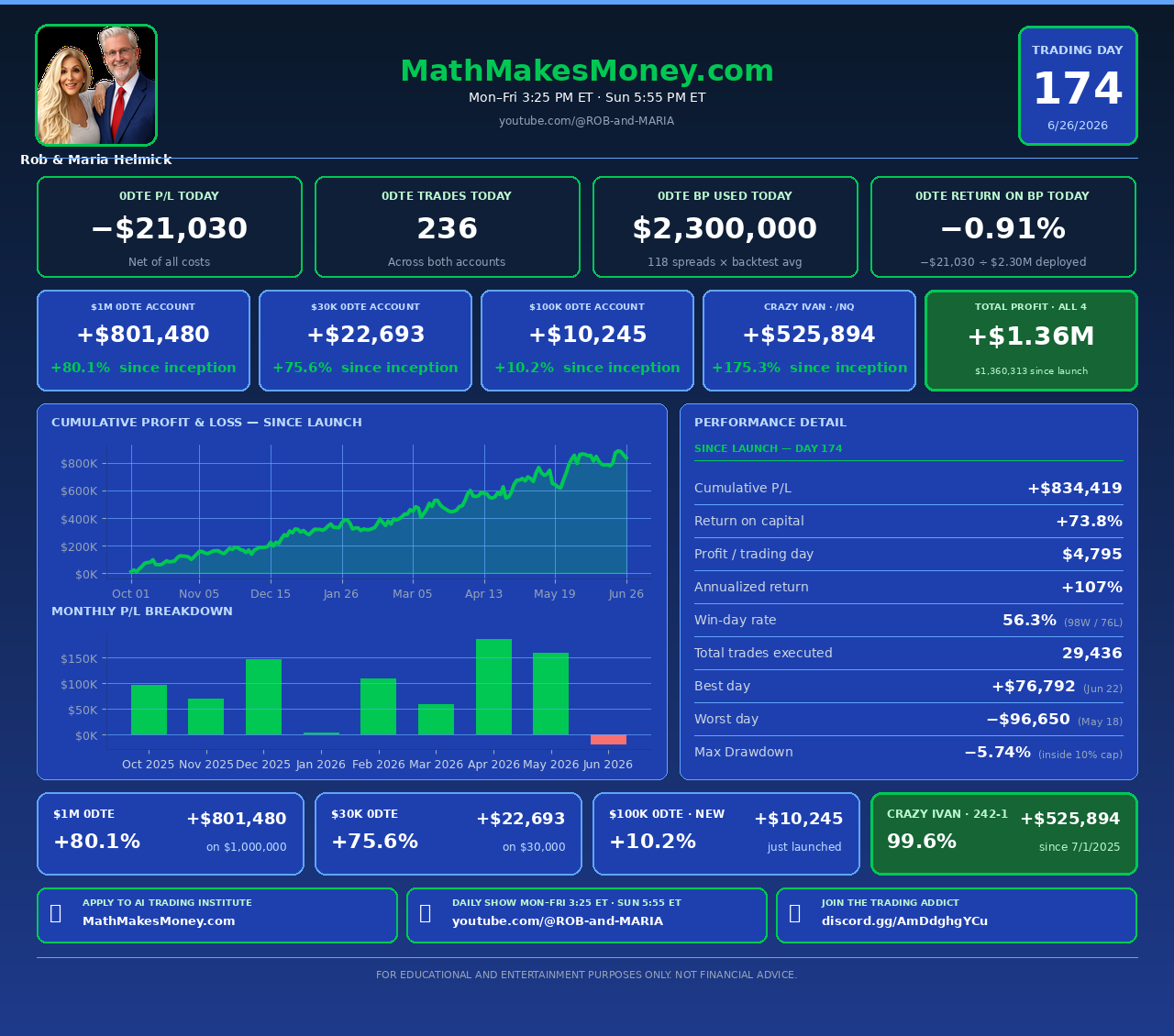
Tap the dashboard to view the full Day 174 results page
|
» This Week's Show · Watch on YouTube
The Weekly Setup — What We're Watching
 ► WATCH ON YOUTUBE
|
|
» Join the Community
Trade With Us In Discord
Live trading with the AI robot. Ask Maria and Rob questions in the YouTube chat. A community of trading addicts.
JOIN THE DISCORD →
|
Math is the method. Income is the outcome.
Get a fill, Phil.
© 2026 Math Makes Money · Rob and Maria Helmick
Educational only. Trading options involves substantial risk of loss.
|