| » AI TRADING INSTITUTE — APPLY BY JULY 1 — NEXT COHORT JULY 6 » |
Issue No. 26 • Friday June 26, 2026

|
|
THE TRADING ADDICT
NEWSLETTER
by Maria Helmick
» Story No. 1 of 2 · Maria's Trade Watch
Tap the image to view full size
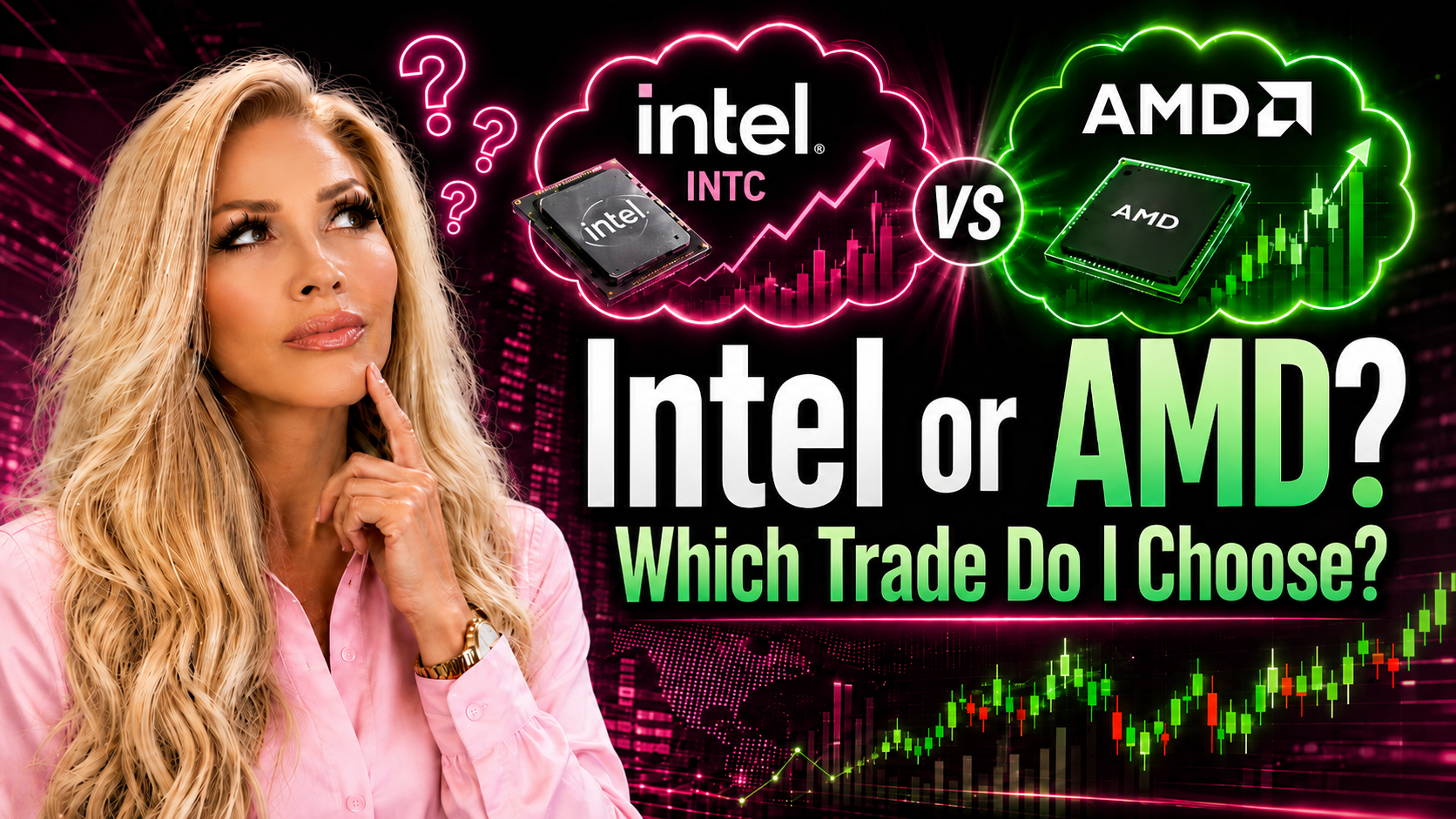
AMD vs. Intel: The Headline Stock vs. the Trade Setup
Intel has the comeback story. AMD has the cleaner trade setup. That is the difference I am looking at right now.
Intel has grabbed attention because investors love a turnaround. Government support, foundry hopes, and renewed interest in U.S. chip manufacturing have made the stock exciting again. But after such a big move, Intel is no longer the quiet underdog. Now the stock has to prove the story.
AMD is not as dramatic, but the setup is cleaner. The company is tied directly to AI infrastructure, data center demand, and the chip cycle. I am not saying AMD is cheap, and I am not looking to chase the stock higher. But I do like the idea of using options to sell premium below the market with room to be right.
AMD has earnings expected on August 4, which makes the expiration date important. The setup I am watching uses the July 31 expiration, which comes before earnings.
That is the important part. This is not an earnings gamble. It is a pre-earnings premium trade.
AMD Trade Setup
|
The $410 strike is about 20% below the stock. After the credit, the breakeven is about 22% below the stock.
That is the cushion.
AMD's last four earnings reactions averaged about an 11.15% move. If AMD made an average move lower from $515.60, the stock would be around $458.10.
The $410 strike is still about $48 below that level.
That does not make the trade risk-free. If AMD sells off hard, a short put can lose money, and margin can change. But compared with chasing shares near the highs, I would rather look at a setup with premium, distance, and a clear expiration before earnings.
There is another way to look at it.
If AMD premium expands right before earnings because IVR moves higher, a bullish trader could look at selling premium using an August expiration. That would keep the trade open after earnings and give the position more time to work or recover if AMD moves around after the report.
But that is a different trade.
You would have to check the option chain at that time and decide whether the premium is worth the earnings risk. For me, on this setup, I would rather use the July 31 expiration and be out before earnings.
|
Maria's Bottom Line Intel may have the better headline. AMD has the better trade setup. I do not need the flashiest story. I want the trade that gives me room to be right. Right now, AMD gives me a cleaner way to structure risk, collect premium, and stay out of the earnings event. That is the trade I would rather plan. |
Educational only. Not investment advice.
» Story No. 2 of 2 · Markets · Retail Trading · Prediction Markets

Tap the image to view full size
Prediction Markets: Wall Street's New Casino Door?
A closer look at when a trade starts looking a lot like a bet.
There was a time when gambling looked like gambling. You called your bets into the local bookie, dealt in cash, or maybe took one of those “friendly” undisclosed loans you hoped you would never have to repay with your kneecaps.
Nobody dressed it up. Nobody gave it a fancy name. Nobody called it a market-structure innovation. You knew what it was, and back then, it was frowned upon.
Fast-forward 65 years, and Wall Street has found a cleaner way to say it.
Prediction markets. Sounds smarter, doesn't it?
It sounds like something built for serious traders. It sounds like research, probability, market expectations, and price discovery. And maybe sometimes it is. But let's not pretend the line is as clean as Wall Street wants it to be. Because at the end of the day, a lot of these products come down to one very simple thing. Yes or no. Will this happen, or won't it? If you are right, you get paid. If you are wrong, you lose.
Robinhood already understands this. Robinhood knows retail traders love simple. They love fast. They love something they can understand in three seconds. A yes-or-no contract is perfect for that kind of customer. No option chains to haggle through. No need to understand delta, volatility, assignment, or time decay. You just need an opinion — and we all know the old saying about opinions: everybody has one.
That is what makes prediction markets so attractive, and also what makes them risky. Robinhood understands the appeal perfectly. Tap yes. Tap no. Make a call. No long option chain, no complicated setup, just a button and an opinion.
Now Cboe has walked into that same room, only with a Wall Street suit on.
Cboe is giving the same basic idea a more serious look by tying its first prediction-style products to the S&P 500. That matters, because an S&P-based contract feels more like trading than betting on a game.
But the packaging is not the whole story.
The feeling behind the trade can still be very close. You think something is going to happen. You put money behind that opinion. Then you wait to see if you were right.
That is where the line gets blurry. Wall Street can say it is regulated. It can say it is exchange-listed. It can say it is tied to real financial markets, and all of that may be true. But none of that changes the most important question: does the trader have an edge? Because if there is no edge, no plan, and no control over size, then the fancy name does not matter.
|
It is still just a bet. |
That is the part traders need to understand. The danger is not only the product. The danger is how easy the product feels. When something is simple enough to click in two seconds, people can stop thinking like traders and start acting like they are just trying to be right.
|
Remember in trading, trying to be right is not a strategy. |
That is where prediction markets and gambling start looking a lot more alike than Wall Street probably wants to admit.
This is not just about Robinhood anymore. Cboe getting involved gives the whole category more credibility. It tells the market this is not some sideshow. Prediction markets are moving closer to the mainstream trading world.
Once the big platforms start offering them, retail traders are going to see them everywhere. Some traders may use them the right way, with a plan, a reason, and maybe even as a hedge. But plenty of people will not look at them that way. They will see a yes-or-no button and treat it like a sportsbook inside a brokerage account.
That is where the trouble starts. The easier a product looks, the less people tend to respect the risk. Complicated products scare traders away, but simple products invite them in. And when the decision feels too easy, people can trade bigger, faster, and with less thought. That is exactly why this could become huge. It gives retail traders a quick decision, a clear payoff, and the thrill of being right.
But traders need to remember something.
Just because something sits inside a brokerage account does not make it investing. Just because it is regulated does not make it smart. And just because Wall Street calls it a prediction market does not mean the person clicking the button is trading.
That is the real line. A trade has a plan, a size, and an edge. A bet has a feeling, a little hope, and the need to be right.
Robinhood made prediction markets easy. Cboe is making them look legitimate. For traders with no plan, that line can disappear fast.
|
Maria's Bottom Line Maria's bottom line is this: prediction markets may be useful for disciplined traders, but for traders who just want action, they may become gambling with better branding. Maybe that is innovation… or maybe it is Wall Street's newest casino door. |
Educational only. Not investment advice.
|
Apply to The AI Trading Institute Learn How We Actually Build, Run, and Update Our AI Trading Robot PhilThe next class starts Monday, July 6. The waitlist closes Tuesday, July 1 at 5:00 PM ET. Seats are limited and the group is curated. Rob reviews every application personally and does a personal interview with each applicant via Zoom. APPLY AT MATHMAKESMONEY.COM → |
|
Math Makes Money TRADES OF THE WEEK0DTE SPX • $30K SCHWAB ACCOUNT Week of June 22, 2026 |
|
All trades 0dte SPX iron condors on the $30K Schwab account. MEIC = Multiple Entry Iron Condor. 50W = 50-wide wings. 95% = stop loss on short leg. No profit target — let trades expire. |
|
Risk Warning At the time of this writing, we plan on entering most of these trades, but they are part of a much greater and larger trading program and should be considered for educational and entertainment purposes only. Not financial advice of any kind. Trading involves substantial risk and is not suitable for every investor. You can lose some or all of your money. Nothing here is financial advice or a recommendation to buy, sell, or copy any trade. Do not copy trades blindly. Do your own due diligence, understand the risk, and make decisions based on your own account, risk tolerance, and financial situation. |
Join the Live Daily ShowMon–Fri 3:25 PM ET • Sun 5:55 PM ET Live trading with the AI robot. Ask Maria and Rob questions in the YouTube chat. A community of trading addicts.
|
» Daily Trading Update · Day 173 · Tap for live dashboard
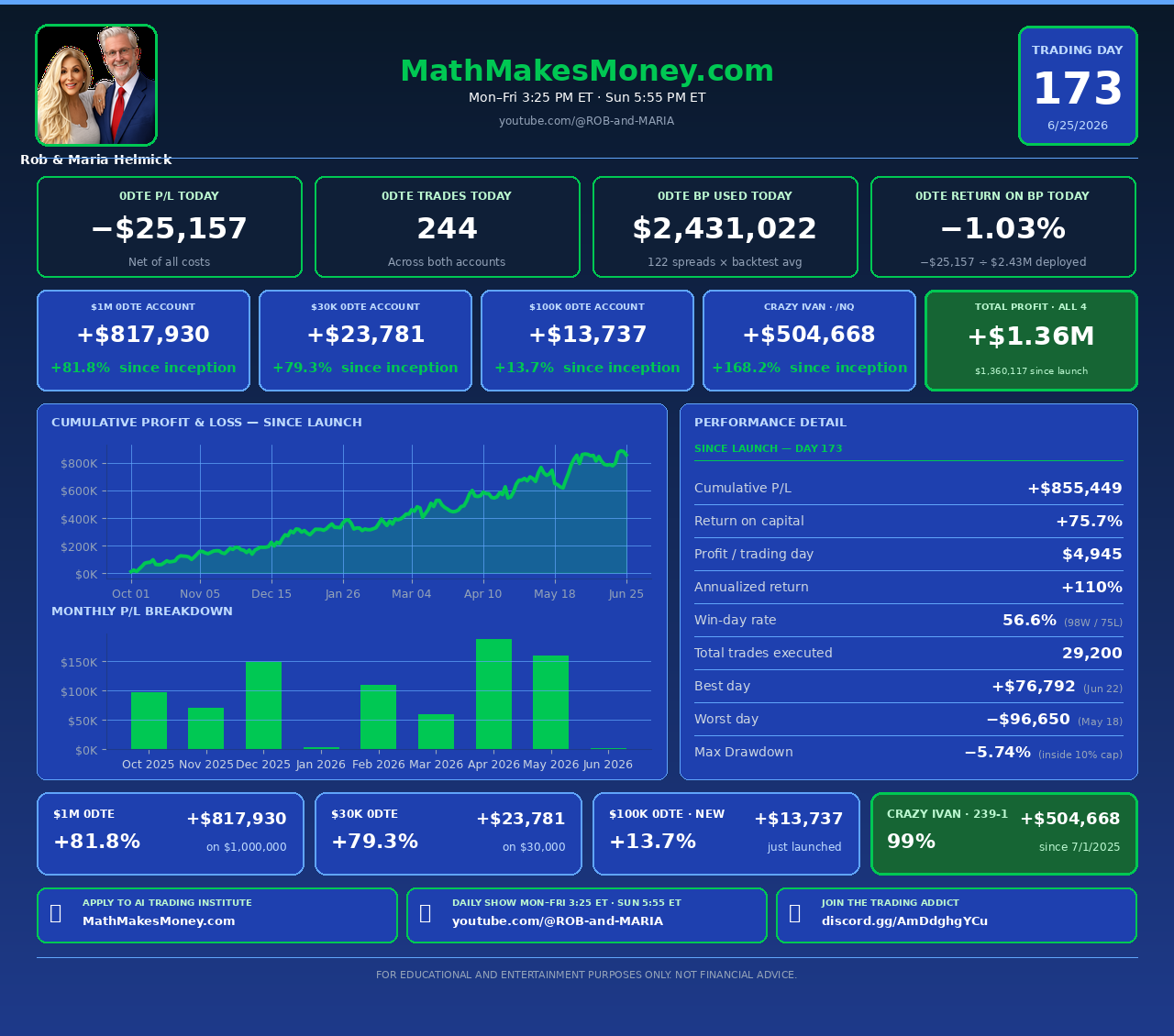
Strong close to Week 36 (Thu Jun 18 — Juneteenth holiday closed Friday). Combined 0dte +$18,429 on 252 trades. Grand Total $1,299,757 — back toward $1.3M.
|
» Quick Short · Watch on YouTube Intel or AMD? Plus Prediction Markets
|


Trade small, trade often.
Trade with your head, not with your heart.
Math Makes Money.
Get a fill, Phil.
— Maria
Math Makes Money · AI Trading Holdings LLC